


Role of glycan synthesis in colonization of the mammalian gut by the bacterial symbiont Bacteroides fragilis
- PMID: 18723678
- PMCID: PMC2529095
- DOI: 10.1073/pnas.0804220105
Role of glycan synthesis in colonization of the mammalian gut by the bacterial symbiont Bacteroides fragilis
Abstract
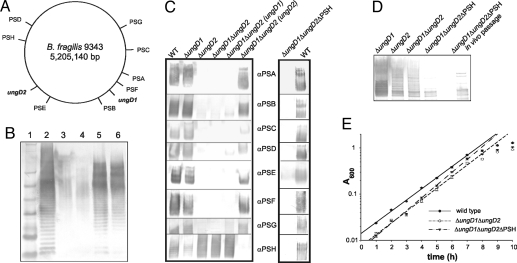
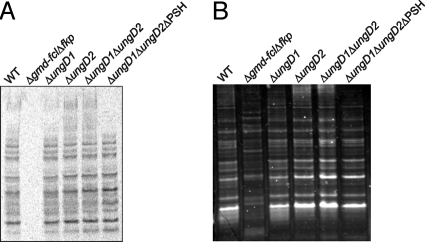
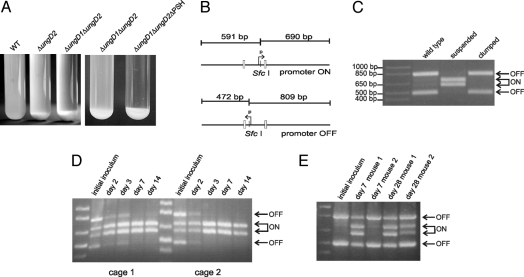
Bacteroides species are the most abundant Gram-negative bacteria of the human colonic microbiota. These endogenous organisms are unique in that they synthesize an extensive number of phase-variable surface polysaccharides. Pathogenic bacteria phase vary expression of surface molecules for immune evasion, but the importance of the synthesis of multiple phase-variable polysaccharides to these commensal bacteria is unknown. We previously showed that a Bacteroides fragilis mutant unable to synthesize 4 of the 8 capsular polysaccharides and unable to glycosylate proteins properly is rapidly outcompeted by the wild-type strain for colonization of the gnotobiotic mouse intestine. In the present study, we constructed mutants defective only in capsule polysaccharide synthesis to define better the importance of these surface molecules to intestinal colonization. We discovered a key enzymatic activity required for synthesis of 7 of the 8 capsular polysaccharides. Deletion of its gene resulted in the first B. fragilis mutant able to synthesize only one phase-variable polysaccharide, and further mutation resulted in a stable acapsular mutant. We show that the acapsular mutant is rapidly outcompeted, but synthesis of a single polysaccharide is sufficient for the organism to colonize the gnotobiotic intestine competitively. These data demonstrate that initial colonization of the gnotobiotic mouse intestine by B. fragilis requires that the organism synthesize only a single polysaccharide and suggest that the synthesis of multiple phase-variable polysaccharides is important for the bacteria's long-term maintenance in the normally complex and competitive ecosystem.
Conflict of interest statement
The authors declare no conflict of interest.
Figures
References
-
- Mazmanian SK, Liu CH, Tzianabos AO, Kasper DL. An immunomodulatory molecule of symbiotic bacteria directs maturation of the host immune system. Cell. 2005;122:107–118. - PubMed
-
- Krinos CM, et al. Extensive surface diversity of a commensal microorganism by multiple DNA inversions. Nature. 2001;414:555–558. - PubMed
-
- Coyne MJ, Reinap B, Lee MM, Comstock LE. Human symbionts use a host-like pathway for surface fucosylation. Science. 2005;307:1778–1781. - PubMed
Publication types
MeSH terms
Substances
Grants and funding
LinkOut - more resources
Full Text Sources
Other Literature Sources
Molecular Biology Databases
