


The linear-quadratic model is an appropriate methodology for determining isoeffective doses at large doses per fraction
- PMID: 18725109
- PMCID: PMC2750078
- DOI: 10.1016/j.semradonc.2008.04.004
The linear-quadratic model is an appropriate methodology for determining isoeffective doses at large doses per fraction
Abstract
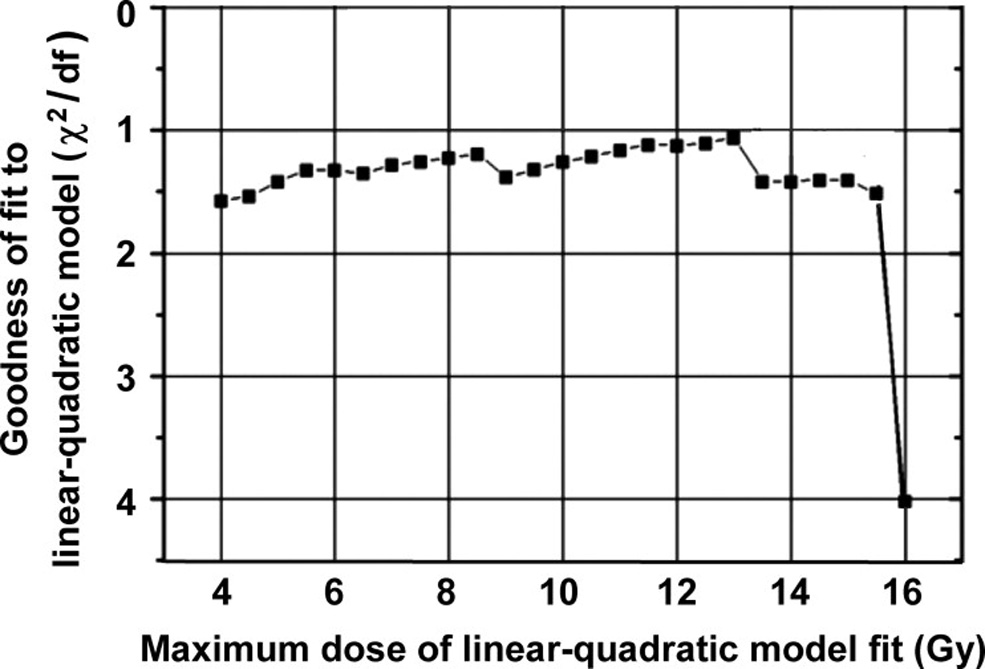
The tool most commonly used for quantitative predictions of dose/fractionation dependencies in radiotherapy is the mechanistically based linear-quadratic (LQ) model. The LQ formalism is now almost universally used for calculating radiotherapeutic isoeffect doses for different fractionation/protraction schemes. In summary, the LQ model has the following useful properties for predicting isoeffect doses: (1) it is a mechanistic, biologically based model; (2) it has sufficiently few parameters to be practical; (3) most other mechanistic models of cell killing predict the same fractionation dependencies as does the LQ model; (4) it has well-documented predictive properties for fractionation/dose-rate effects in the laboratory; and (5) it is reasonably well validated, experimentally and theoretically, up to about 10 Gy/fraction and would be reasonable for use up to about 18 Gy per fraction. To date, there is no evidence of problems when the LQ model has been applied in the clinic.
Figures




References
-
- Fowler JF. The linear-quadratic formula and progress in fractionated radiotherapy. Br J Radiol. 1989;62:679–694. - PubMed
-
- Thames HD, Hendry JH. Fractionation in Radiotherapy. London; New York: Taylor & Francis; 1987.
-
- Dale RG. The application of the linear-quadratic dose-effect equation to fractionated and protracted radiotherapy. Br J Radiol. 1985;58:515–528. - PubMed
-
- Lea DE. Actions of Radiation on Living Cells. Cambridge: University Press; 1946.
-
- Sachs RK, Hahnfeld P, Brenner DJ. The link between low-LET dose-response relations and the underlying kinetics of damage production/repair/misrepair. Int J Radiat Biol. 1997;72:351–374. - PubMed
Publication types
MeSH terms
Grants and funding
LinkOut - more resources
Full Text Sources
Other Literature Sources
