Review
. 2008 Sep;118(9):3006-9.
doi: 10.1172/JCI36617.

The elusive physiologic role of Factor XII

Affiliations
Review

The elusive physiologic role of Factor XII

Alvin H Schmaier. J Clin Invest. 2008 Sep.

Abstract

Physiologic hemostasis upon injury involves many plasma proteins in a well-regulated cascade of proteolytic reactions to form a clot. Deficiency of blood coagulation Factors VIII, IX, or XI is associated with hemophilia. Factor XII (FXII) autoactivates by contact with a variety of artificial or biologic negatively charged surfaces (contact activation), resulting in blood coagulation and activation of the inflammatory kallikrein-kinin and complement systems. However, surprisingly, individuals deficient in FXII rarely suffer from bleeding disorders. Most biologic surfaces that activate FXII become expressed in disease states. Investigators have long searched for physiologic activators of FXII and its role in vivo. In this issue of the JCI, Maas et al. show that misfolded protein aggregates produced during systemic amyloidosis allow for plasma FXIIa and prekallikrein activation and increased formation of kallikrein-C1 inhibitor complexes, without Factor XIa activation and coagulation (see the related article beginning on page 3208). This study describes a novel biologic surface for FXII activation and activity, which initiates inflammatory events independent of hemostasis.


Figures
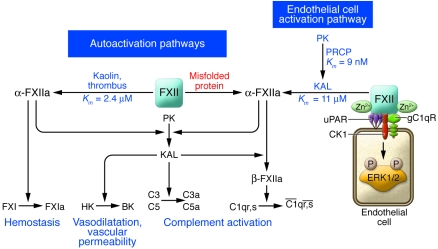
Figure 1
Figure 1. Mechanisms for FXII activation.
There are two pathways for FXII (Hageman factor) activation: autoactivation upon exposure to negatively charged surfaces and proteolytic activation on cell membranes. FXII autoactivates (Km = 2.4 μM) on an artificial or biologic surface such as kaolin or a thrombus to activate FXII to α-FXIIa. α-FXIIa then activates FXI to FXIa to initiate hemostasis and activates PK to form plasma kallikrein (KAL). KAL cleaves HK to liberate bradykinin, which induces vasodilatation and vascular permeability. KAL also activates the complement system by directly activating complement components C3 and C5 and cleaving α-FXIIa to form β-FXIIa (a soluble light chain enzymatic form [Hageman factor fragment]), which then activates the macromolecular C1qr,s complex to enzymatically active C1r and C1s. The results of the study by Maas et al. in this issue of the JCI (10) suggest that a second FXII autoactivation mechanism occurs upon exposure of FXII to aggregates of misfolded proteins and that this activation results in PK activation without FXI activation — showing that the kallikrein-kinin system can be activated separately from the coagulation cascade by FXII. A second pathway for FXII activation occurs on endothelial cells. PK bound to HK on endothelial cells is activated to plasma KAL by the serine protease prolylcarboxypeptidase (PRCP) (Km = 9 nM). KAL then activates FXII to α-FXIIa (Km = 11 μM). FXII also binds to endothelial cells in the presence of zinc ions and when bound stimulates ERK1/2 phosphorylation. CK1, cytokeratin 1; gC1qR, gC1q receptor; uPAR, urokinase plasminogen activator receptor.

Comment on

References

    1. Ratnoff O.D., Colopy J.E. A familial hemorrhagic trait associated with a deficiency of a clot promoting fraction of plasma. J. Clin. Invest. 1955;34:602–613. doi: 10.1172/JCI103109. - DOI - PMC - PubMed
    1. Davie E.W., Ratnoff O.D. Waterfall sequence for intrinsic blood coagulation. Science. 1964;145:1310–1320. doi: 10.1126/science.145.3638.1310. - DOI - PubMed
    1. Macfarlane R.G. An enzyme cascade in the blood clotting mechanism, and its function as a biochemical amplifier. Nature. . 1964;202:498–499. doi: 10.1038/202498a0. - DOI - PubMed
    1. Rocha E., Silva M., Beraldo W.T., Rosenfeld G. Bradykinin, a hypotensive and smooth muscle stimulating factor released from plasma globulin by snake venoms and by trypsin. Am. J. Physiol. 1949;156:261–273. - PubMed
    1. Ghebrehiwet B., Silverberg M., Kaplan A.P. Activation of the classic pathway of complement by Hageman factor fragment. J. Exp. Med. 1981;153:665–676. doi: 10.1084/jem.153.3.665. - DOI - PMC - PubMed
