. 2008 Oct 31;283(44):29650-7.
doi: 10.1074/jbc.M806102200. Epub 2008 Aug 26.

Regulatory monoubiquitination of phosphoenolpyruvate carboxylase in germinating castor oil seeds

Affiliations

Regulatory monoubiquitination of phosphoenolpyruvate carboxylase in germinating castor oil seeds

R Glen Uhrig et al. J Biol Chem. .

Abstract

Phosphoenolpyruvate carboxylase (PEPC) is a tightly regulated enzyme situated at the core of plant C-metabolism. Although its anaplerotic role and control by allosteric effectors, reversible phosphorylation, and oligomerization have been well documented in the endosperm of developing castor oil seeds (COS), relatively little is known about PEPC in germinating COS. The initial phase of COS germination was accompanied by elevated PEPC activity and accumulation of comparable amounts of pre-existing 107-kDa and inducible 110-kDa immunoreactive PEPC polypeptides (p107 and p110, respectively). A 440-kDa PEPC heterotetramer composed of an equivalent ratio of non-phosphorylated p110 and p107 subunits was purified from germinated COS. N-terminal microsequencing, mass spectrometry, and immunoblotting revealed that both subunits arose from the same gene (RcPpc3) that encodes the p107 subunit of a phosphorylated 410-kDa PEPC homotetramer in developing COS but that p110 is a monoubiquitinated form of p107. Tandem mass spectrometry sequencing of a diglycinated tryptic peptide identified Lys-628 as p110's monoubiquitination site. This residue is conserved in vascular plant PEPCs and is proximal to a PEP-binding/catalytic domain. Incubation with a human deubiquitinating enzyme (USP-2 core) converted the p110:p107 PEPC heterotetramer into a p107 homotetramer while significantly reducing the enzyme's K(m)(PEP) and sensitivity to allosteric activators (hexose-Ps, glycerol-3-P) and inhibitors (malate, aspartate). Monoubiquitination is a non-destructive and reversible post-translational modification involved in the control of diverse processes such as transcription, endocytosis, and signal transduction. The current study demonstrates that tissue-specific monoubiquitination of a metabolic enzyme can also occur and that this modification influences its kinetic and regulatory properties.


Figures
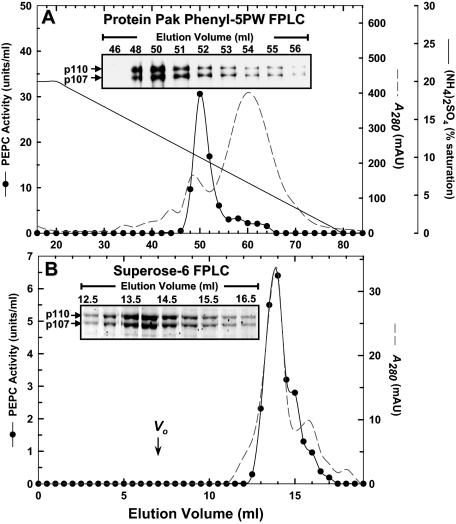
FIGURE 1.
FIGURE 1.
Co-elution of PEPC activity with 110- and 107-kDa PEPC polypeptides (p110 and p107, respectively) during Protein Pak Phenyl-5PW and Superose-6 FPLC of PEPC from germinating COS endosperm. A, Protein Pak Phenyl-5PW elution profile. Inset, aliquots (1-μl each) from various fractions were subjected to SDS-PAGE and immunoblotting using anti-(COS p107)-IgG (5). B, Superose-6 HR 10/30 elution profile. Vo denotes the column's void volume. Inset, aliquots (5-μl each) from various fractions were subjected to SDS-PAGE followed by protein staining with Sypro-Red.
FIGURE 2.
FIGURE 2.
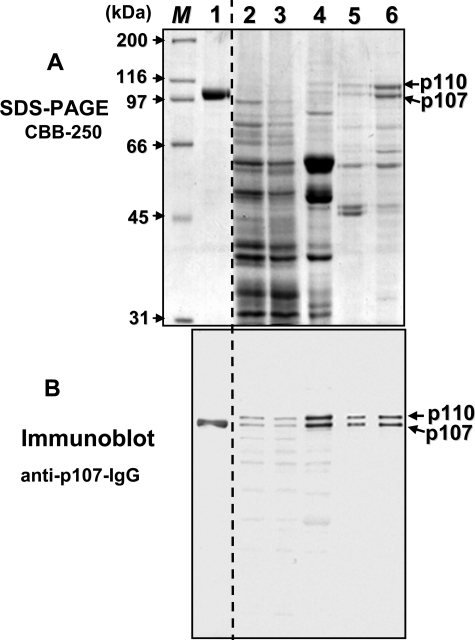
SDS-PAGE and immunoblot analysis of various fractions obtained during the purification of germinating COS PEPC. A, SDS-PAGE was followed by protein staining with Coomassie Blue R-250 (CBB-250). B, immunoblot analysis was performed using anti-(COS p107)-IgG (5). Lane 1 contains 2.5 μg (A) or 50 ng (B) of homogeneous, non-proteolyzed, Class-1 PEPC (p107) from stage VII (full cotyledon) developing COS endosperm (4, 5). Lanes 2 and 3 contain 45 (A) or 15 μg (B) of protein from the clarified extract and 4–20% PEG fractions, respectively. Lane 4 contains 4 (A) or 2 μg (B) of the butyl-Sepharose fraction. Lanes 5 and 6 contain 2 (A) or 0.1 μg (B) of the DEAE-Fractogel and Protein Pak Phenyl-5PW fractions, respectively. M denotes various protein Mr standards.
FIGURE 3.
FIGURE 3.
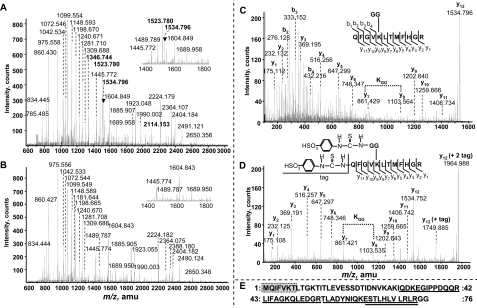
The p110 subunit of purified PEPC from germinated COS is monoubiquitinated at Lys-628. A and B, MALDI-TOF MS spectra of p110 and p107 tryptic peptides. Peptide mass fingerprinting of the p110 subunit (A) revealed several tryptic peptides (labeled with bold font) that were not observed in the p107 spectra (B). A, the singly charged ion at m/z 1534.796 matched a diglycinated (i.e. ubiquitin-conjugated) p110 peptide, whereas the remaining peptides unique to p110 originated from ubiquitin (supplemental Table S2). C and D, MS/MS analysis of the ubiquitin-conjugated peptide (C) and corresponding sulfonated derivative p110 tryptic peptide (D). C- and N-terminal fragment ions are denoted by y and b, respectively. E, alignment of amino acid sequences obtained during MALDI QqTOF MS/MS sequencing of p110 tryptic peptides or N-terminal microsequencing of p110, with the deduced sequence of Arabidopsis ubiquitin (gi 136666). MALDI QqTOF MS/MS sequenced peptides isolated from the p110 tryptic digest (supplemental Table S2) are underlined, whereas a 7-amino-acid sequence obtained during p110's N-terminal microsequencing is enclosed in a shaded box.
FIGURE 4.
FIGURE 4.
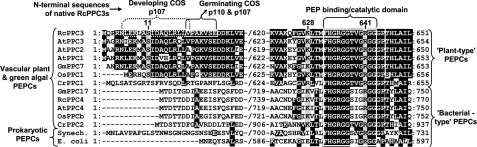
Amino acid sequence alignment of COS RcPPC3 domains subject to in vivo post-translational modification with representative plant and prokaryotic PEPCs. Identical amino acids are indicated by black or gray shading. N-terminal sequences obtained by Edman degradation of native Class-1 PEPC from developing COS (p107) (4) and germinated COS (p110 and p107) are outlined by dotted and solid boxes, respectively. The Ser-11 phosphorylation and Lys-628 monoubiquitination sites of RcPPC3 (as occurs in Class-1 PEPC from developing and germinated COS, respectively) are indicated. The 12-amino-acid sequence of the diglycine-branched tryptic peptide of the p110 subunit (Fig. 3) is underlined and overlaps with a conserved flexible loop region (enclosed in a box) essential for PEP binding and PEPC catalysis; Arg-641 is indispensable for catalytic activity (2). The abbreviated species name for each sequence follows: Rc, R. communis (castor); At, Arabidopsis thaliana; Os, Oryza sativa (rice); Gm, Glycine max (soybean); Cr, Chlamydomonas reinhardtii (green alga); Synech., Synechocystis sp. PCC6803 (cyanobacteria).
FIGURE 5.
FIGURE 5.
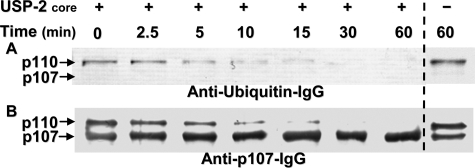
Incubation with the deubiquitinating enzyme USP-2 core converts the germinated COS p110:p107 PEPC heterotetramer into a p107 homotetramer. Purified germinated COS PEPC was incubated in the presence and absence of 1 μm USP-2 core. Aliquots were removed at various times and subjected to immunoblot analysis using anti-(bovine ubiquitin)-IgG (Millipore, catalog number 05-944) (1 μg of PEPC/lane) (A) or anti-(COS p107)-IgG (5) (0.1 μg of PEPC/lane) (B).

References

    1. Chollet, R., Vidal, J., and O'Leary, M. H. (1996) Annu. Rev. Plant Physiol. Plant Mol. Biol. 47 273–298 - PubMed
    1. Izui, K., Matsumura, H., Furumoto, T., and Kai, Y. (2004) Annu. Rev. Plant Biol. 55 69–84 - PubMed
    1. Plaxton, W. C., and Podestá, F. E. (2006) CRC Crit. Rev. Plant Sci. 25 159–198
    1. Blonde, J. D., and Plaxton, W. C. (2003) J. Biol. Chem. 278 11867–11873 - PubMed
    1. Crowley, V., Gennidakis, S., and Plaxton, W. C. (2005) Plant Cell Physiol. 46 1855–1862 - PubMed

Publication types

LinkOut - more resources