Review
. 2008 Dec;295(6):E1287-97.
doi: 10.1152/ajpendo.90604.2008. Epub 2008 Aug 26.

Metabolic cycling in control of glucose-stimulated insulin secretion

Affiliations
Review

Metabolic cycling in control of glucose-stimulated insulin secretion

Mette V Jensen et al. Am J Physiol Endocrinol Metab. 2008 Dec.

Abstract

Glucose-stimulated insulin secretion (GSIS) is central to normal control of metabolic fuel homeostasis, and its impairment is a key element of beta-cell failure in type 2 diabetes. Glucose exerts its effects on insulin secretion via its metabolism in beta-cells to generate stimulus/secretion coupling factors, including a rise in the ATP/ADP ratio, which serves to suppress ATP-sensitive K(+) (K(ATP)) channels and activate voltage-gated Ca(2+) channels, leading to stimulation of insulin granule exocytosis. Whereas this K(ATP) channel-dependent mechanism of GSIS has been broadly accepted for more than 30 years, it has become increasingly apparent that it does not fully describe the effects of glucose on insulin secretion. More recent studies have demonstrated an important role for cyclic pathways of pyruvate metabolism in control of insulin secretion. Three cycles occur in islet beta-cells: the pyruvate/malate, pyruvate/citrate, and pyruvate/isocitrate cycles. This review discusses recent work on the role of each of these pathways in control of insulin secretion and builds a case for the particular relevance of byproducts of the pyruvate/isocitrate cycle, NADPH and alpha-ketoglutarate, in control of GSIS.


Figures
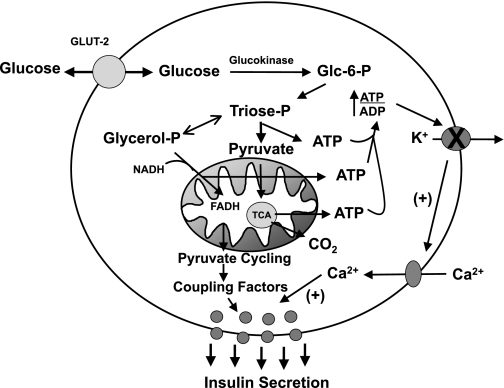
Fig. 1.
Fig. 1.
Overview of ATP-sensitive K+ (KATP) channel-dependent and -independent pathways of glucose-stimulated insulin secretion (GSIS). The canonical model of GSIS holds that an increase in β-cell glucose metabolism leads to production of ATP via glycolysis, pyruvate oxidation, and reducing equivalent shuttles, resulting in an increase in ATP/ADP ratio. This leads to suppression of KATP channels, membrane depolarization, and activation of voltage-gated Ca2+ channels and Ca2+-mediated activation of insulin granule exocytosis. However, multiple lines of evidence reviewed in this article support the idea that pyruvate cycling generates coupling factors in addition to ATP/ADP ratio changes that are essential for the full glucose response, as detailed in the text and in subsequent figures.
Fig. 2.
Fig. 2.
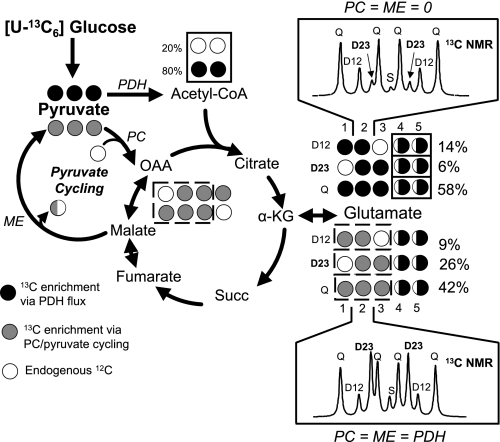
Schematic summary of 13C-NMR technique for measurement of pyruvate cycling. The technique involves incubation of β-cell lines with [U-13C6]glucose, extraction of glutamate and analysis of 13C isotopomers by 13C-NMR spectroscopy. Shown for example are spectra of carbon-2 of glutamate simulated using tcaSim (8, 28, 37) under two idealized situations. Top: the spectrum obtained if pyruvate dehydrogenase (PDH) is the sole pathway for pyruvate to enrich α-ketoglutarate (α-KG) and glutamate (20% unlabeled endogenous substrate is also assumed). Bottom: the spectrum obtained when PDH and pyruvate carboxylase (PC) flux contribute equally to pyruvate entry into the TCA cycle. Several changes in the glutamate isotopomer populations occur as result of PC activity. For example, notice that carboxylation of pyruvate by PC leads to the loss of enrichment in the C1 position and a dramatic increase in the isotopomer population detected as a D23 multiplet. In experimental data, the isotopomer populations determined by the 13C-NMR multiplets of all glutamate carbons are used to calculate relative flux through the oxidative (PDH) and anaplerotic (PC) entry points into the TCA cycle. It is assumed that pyruvate cycling is equivalent to PC flux. See text and refs. , , and for more details.
Fig. 3.
Fig. 3.
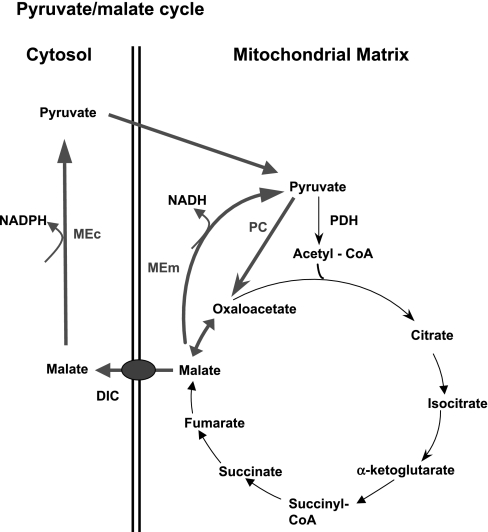
Pyruvate/malate cycle. In this cycle, pyruvate enters the TCA cycle via conversion to oxaloacetate by the anaplerotic enzyme PC. To exit the mitochondria, oxaloacetate is converted to malate. Malate can then either be recycled to pyruvate via the mitochondrial, NAD-dependent form of malic enzyme (MEm) or can be transported to the cytosol via the dicarboxylate carrier (DIC). If transported to the cytosol, malate can be reconverted to pyruvate by the cytosolic, NADP-dependent form of ME (MEc).
Fig. 4.
Fig. 4.
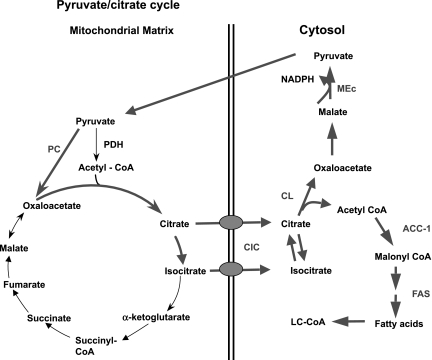
Pyruvate/citrate cycle. In this cycle, pyruvate also enters the TCA cycle via PC. The oxaloacetate formed in the PC reaction then condenses with acetyl-CoA to form citrate and isocitrate, which can exit the mitochondria via the citrate/isocitrate carrier (CIC). Once in the cytosol, citrate is cleaved to oxaloacetate and acetyl-CoA by ATP-citrate lyase (CL), with these two products being metabolized further by two separate pathways. Oxaloacetate is recycled to pyruvate via conversion to malate and engagement with the MEm or MEc to reform pyruvate. Acetyl-CoA goes on to form malonyl-CoA in the acetyl-CoA carboxylase-1 (ACC1) reaction and can then be used for synthesis of long-chain acyl-CoAs (LC-CoA) via fatty acid synthase (FAS).
Fig. 5.
Fig. 5.
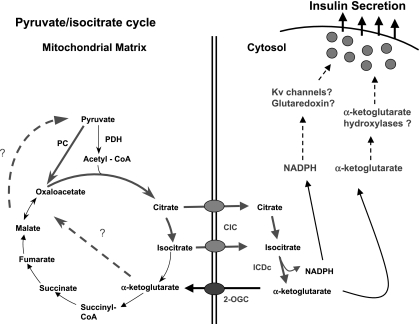
Pyruvate/isocitrate cycle. This cycle is again initiated by anaplerotic conversion of pyruvate to oxaloacetate by PC. As in the pyruvate/citrate cycle, citrate and isocitrate leave the mitochondria via CIC. Citrate is then converted to isocitrate by cytosolic aconitase, and isocitrate can then be converted to α-KG by cytosolic, NADP-dependent isocitrate dehydrogenase (ICDc). α-KG can then serve either as a direct signal for insulin secretion, for example by serving as a substrate for α-ketoglutarate hydroxylases, or can be recycled to pyruvate by one of several mitochondrial or cytosolic pathways that remain to be defined (shown as dashed lines). Another byproduct of the pyruvate/isocitrate cycle with potential as an insulin secretagogue is cytosolic NAPDH, possibly acting through Kv channels or the glutathione/glutaredoxin system, as discussed in the text.

References

    1. Aguilar-Bryan L, Nichols CG, Wechsler SW, Clement JPt Boyd 3rd AE, Gonzalez G, Herrera-Sosa H, Nguy K, Bryan J, Nelson DA. Cloning of the beta cell high-affinity sulfonylurea receptor: a regulator of insulin secretion. Science 268: 423–426, 1995. - PubMed
    1. Antinozzi PA, Segall L, Prentki M, McGarry JD, Newgard CB. Molecular or pharmacologic perturbation of the link between glucose and lipid metabolism is without effect on glucose-stimulated insulin secretion. A re-evaluation of the long-chain acyl-CoA hypothesis. J Biol Chem 273: 16146–16154, 1998. - PubMed
    1. Asfari M, Janjic D, Meda P, Li G, Halban PA, Wollheim CB. Establishment of 2-mercaptoethanol-dependent differentiated insulin-secreting cell lines. Endocrinology 130: 167–178, 1992. - PubMed
    1. Ashcroft FM, Harrison DE, Ashcroft SJ. Glucose induces closure of single potassium channels in isolated rat pancreatic beta-cells. Nature 312: 446–448, 1984. - PubMed
    1. Assimacopoulos-Jeannet F, Thumelin S, Roche E, Esser V, McGarry JD, Prentki M. Fatty acids rapidly induce the carnitine palmitoyltransferase I gene in the pancreatic beta-cell line INS-1. J Biol Chem 272: 1659–1664, 1997. - PubMed

Publication types