. 2008 Sep 2;99(5):741-9.
doi: 10.1038/sj.bjc.6604526. Epub 2008 Aug 19.

Mage-b vaccine delivered by recombinant Listeria monocytogenes is highly effective against breast cancer metastases

Affiliations

Mage-b vaccine delivered by recombinant Listeria monocytogenes is highly effective against breast cancer metastases

S H Kim et al. Br J Cancer. .

Abstract

New therapies are needed that target breast cancer metastases. In previous studies, we have shown that vaccination with pcDNA3.1-Mage-b DNA vaccine is effective against breast cancer metastases. In the study presented here, we have further enhanced the efficacy of Mage-b vaccination through the improved delivery of the vaccine using recombinant Listeria monocytogenes (LM). Three overlapping fragments of Mage-b as well as the complete protein-encoding region of Mage-b have been expressed as a fusion protein with a truncated non-cytolytic form of listeriolysin O (LLO) in recombinant LM. These different Mage-b vaccine strains were preventively tested for their efficacy against breast cancer metastases in a syngeneic mouse tumour model 4T1. The LM-LLO-Mage-b/2nd, expressing position 311-660 of the cDNA of Mage-b, was the most effective vaccine strain against metastases in the 4T1 mouse breast tumour model. Vaccination with LM-LLO-Mage-b/2nd dramatically reduced the number of metastases by 96% compared with the saline group and by 88% compared with the vector control group (LM-LLO), and this correlated with strong Mage-b-specific CD8 T-cell responses in the spleen, after restimulation with Mage-b. However, no effect of LM-LLO-Mage-b/2nd was observed on 4T1 primary tumours, which may be the result of a complete absence of Mage-b-specific immune responses in the draining lymph nodes. Vaccination with LM-LLO-Mage-b/2nd could be an excellent follow-up after removal of the primary tumour, to eliminate metastases and residual tumour cells.


Figures
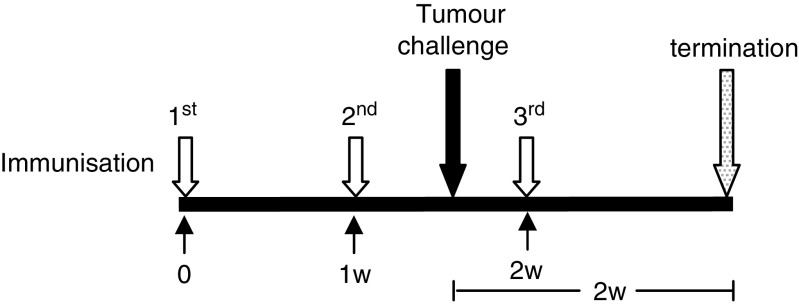
Figure 1
Figure 1
Schematic view of immunisations and tumour challenge. BALB/c mice were immunised three times intraperitoneally with 0.1 × LD50 of each Listeria-based Mage-b vaccine strain or with the vector control strain LM-LLO, or saline, with 1-week time intervals. Four days after the second immunization, mice were injected with 105 4T1 tumour cells in a mammary fat pad. Two weeks after tumour challenge, mice were euthanized and analysed.
Figure 2
Figure 2
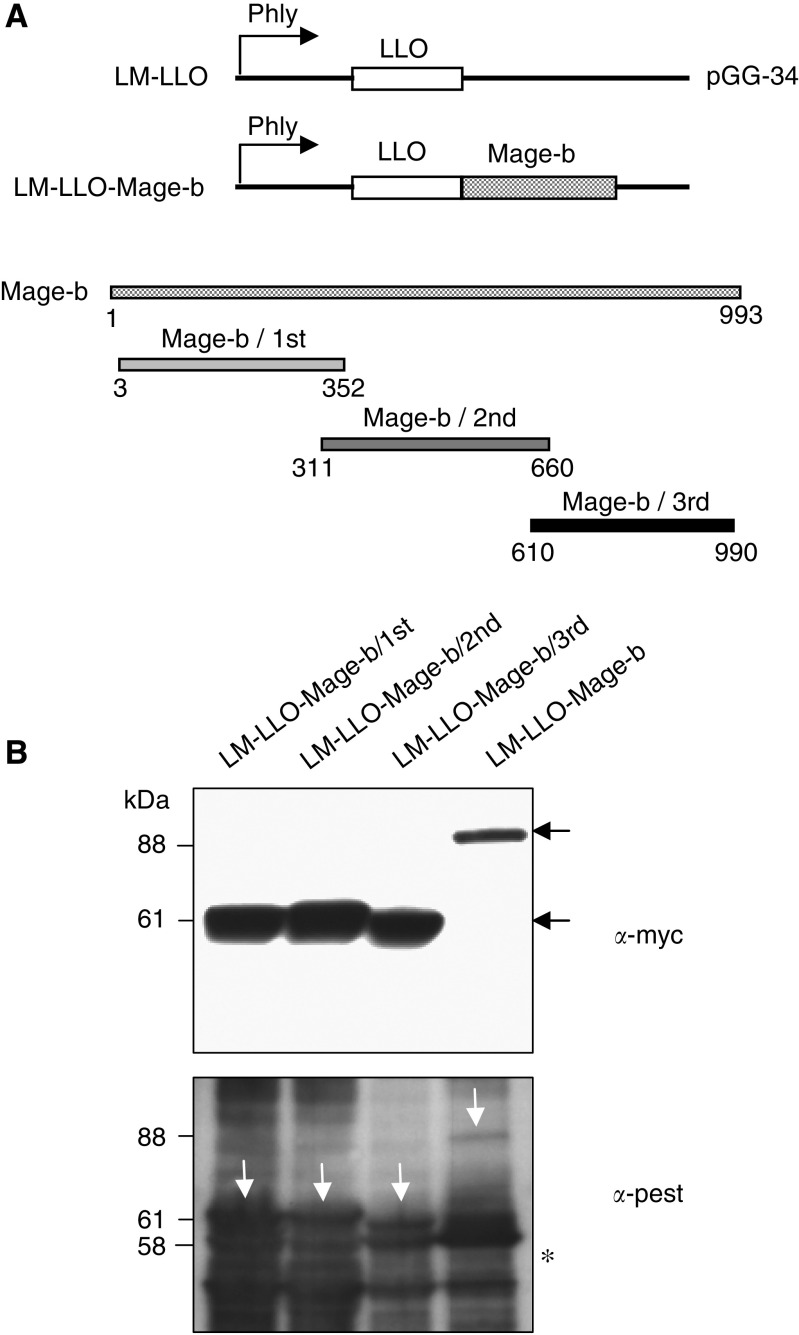
Construction and characterisation of Listeria-based Mage-b vaccine strains. (A) Three overlapping fragments of mouse Mage-b (homologous to human MAGE-B) were cloned as a fusion protein with a truncated non-cytolytic listeriolysin O (LLO) in the pGG-34 vector under the control of the listerial hemolysin promoter (Phly). (B) Secretion of LLO-Mage-b proteins by the Listeria-based vaccine strains was detected by western blotting using α-myc antibodies (top) and α-pest antibodies (bottom). In the western blot with α-myc antibodies, the LLO-Mage-b proteins are indicated by black arrows, and in the western blot with α-pest antibodies by white arrows. The complete Mage-b protein fused with truncated LLO represents a band of 88 kDa, whereas the three fragments of Mage-b fused with truncated LLO represent a band of 61 kDa. Endogenous LLO (58 KDa) secreted by all LM is indicated by a star.
Figure 3
Figure 3
Expression of Mage-b in 4T1 primary tumours and metastases. The Mage-b-specific RT–PCR product of 632 bp was detected by southern blotting using DNA probe encoding Mage-b. β-actin (285 bp) was used to determine RNA quality. The lanes were loaded as follows: lane 1: normal breast tissue; lane 2: 4T1 tumour; lane 3: 4T1 tumour; lane 4: metastasis in peritoneal cavity (PC); lane 5: metastasis in PC; lane 6: metastasis liver; lane 7: metastasis liver; lane 8: metastasis spleen; lane 9: metastasis spleen; lane 10: metastasis kidney; lane 11: metastasis kidney; lane 12: metastasis diaphragm; lane 13: metastasis diaphragm.
Figure 4
Figure 4
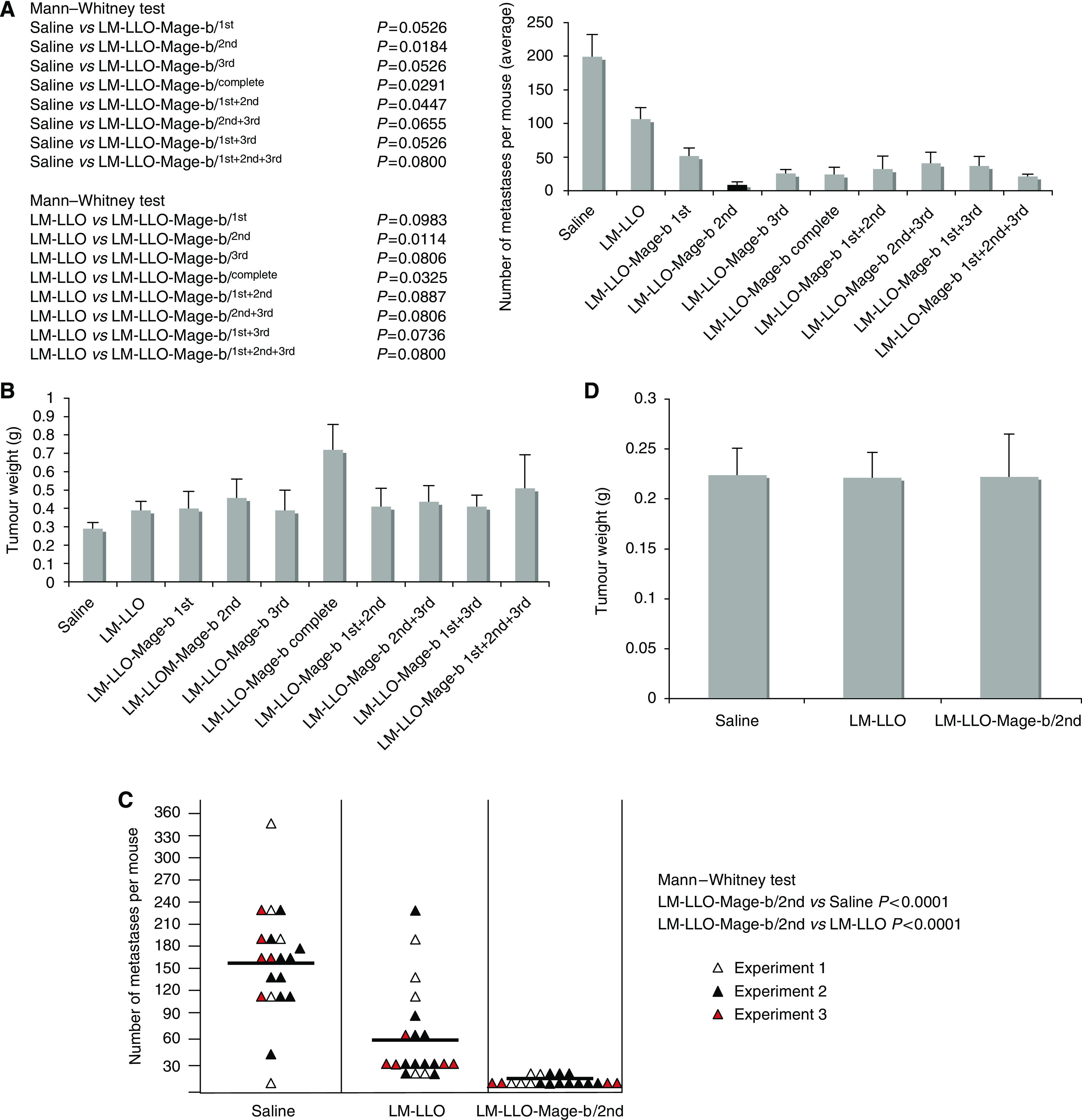
Strong effect of vaccination with LM-LLO-Mage-b/2nd on metastases but not on primary tumours in the 4T1 model. BALB/c mice were immunised with the various Listeria-based Mage-b vaccine strains and challenged with 4T1 tumour cells as outlined in Figure 1. Two weeks after tumour challenge, mice were euthanized and the number of metastases (A) and tumour size (B) was determined per mouse. LM-LLO-Mage-b/2nd was the most effective vaccine strain against 4T1 metastases, whereas none of the Listeria-based Mage-b vaccines had any inhibitory effect on tumour growth. These vaccine studies were repeated three times in independent experiments with the most effective vaccine strain, that is, the LM-LLO-Mage-b/2nd. Again, the number of metastases (C) and tumour size (D) was determined per mouse. Results were averaged and subjected to statistical analysis using Mann–Whitney test (n=5 mice per group in each experiment). The error bars represent the s.e.m. In panel C, each triangle represents the number of metastases per mouse, and the vertical bars represent the average number of metastases per mouse.
Figure 5
Figure 5
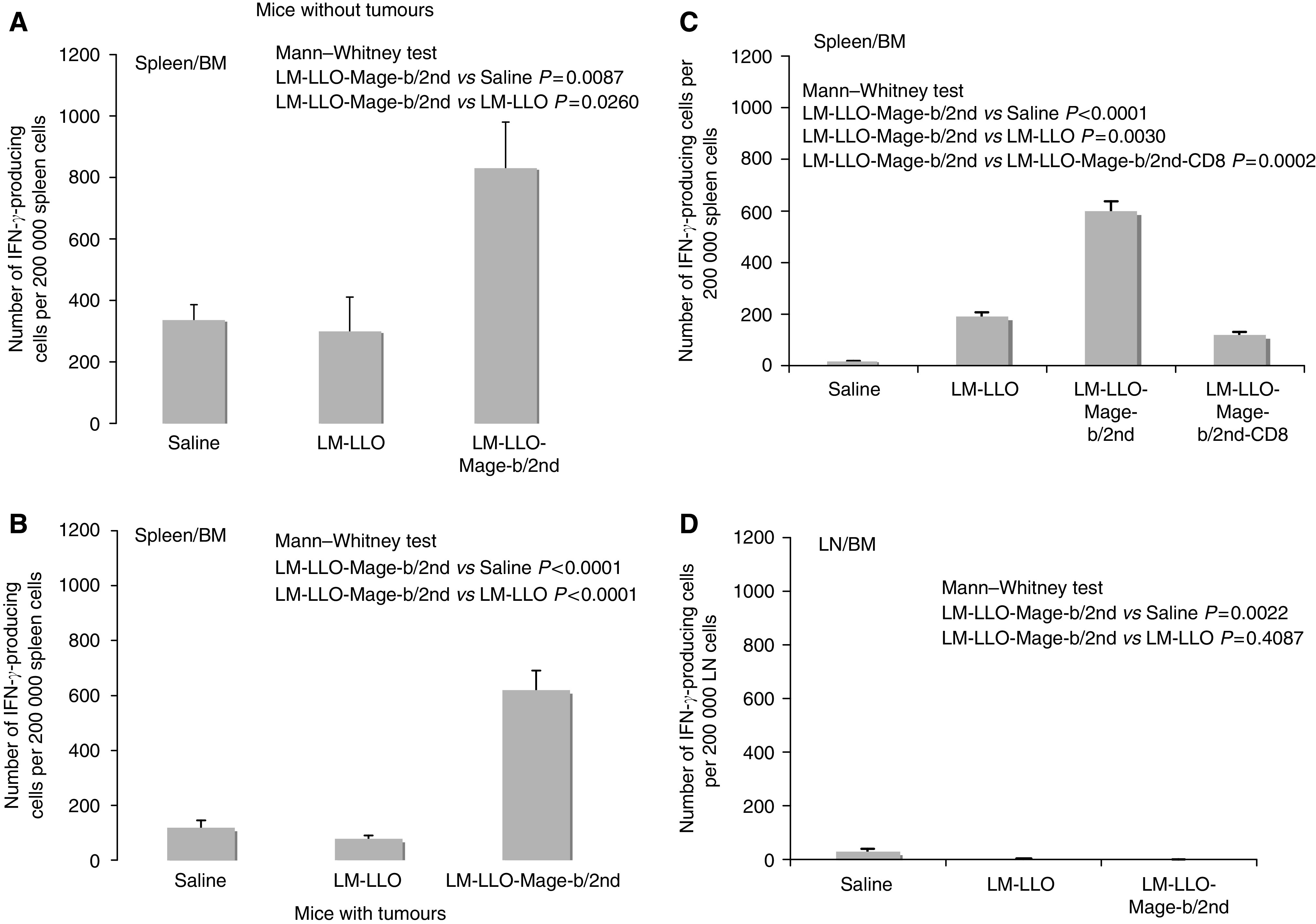
Mage-b-specific immune responses in vitro. BALB/c mice were immunised with the LM-LLO-Mage-b/2nd vaccine strain and challenged with 4T1 tumour cells as outlined in Figure 1, or not challenged with 4T1 tumour cells. Two weeks after tumour challenge, mice were euthanized and spleens and draining (inguinal) lymph nodes (LNs) were analysed for in vitro immune responses upon restimulation with Mage-b. For this purpose, the number of IFNγ-producing cells in spleens of mice without (A) and with (B) 4T1 tumours and metastases were compared. Again, the number of IFNγ-producing cells were determined in spleens (C) but now compared with the number of IFNγ-producing cells in the LNs (D) of mice bearing 4T1 tumours and metastases were compared. Lymph nodes and spleens were from the same mice, and tested in the same experiment. In panel C, spleen cells depleted for CD8 T cells are shown as well. All restimulation assays were performed with bone marrow (BM) cells transfected with pcDNA3.1-Mage-b and pCMV1-GM-CSF plasmid DNA. Two days later, Mage-b-specific immune responses were analysed by ELISPOT. Controls such as BM cells transfected with pcDNA3.1-Mage-b, or with pCMV-GM-CSF, or non-transfected BM cells did not produce IFN (data not shown). The LM-LLO-Mage-b/2nd vaccine was tested in three independent experiments. Results were averaged and subjected to statistical analysis using Mann–Whitney test (n=5 mice per group in each experiment). The error bars represent the s.e.m.
Figure 6
Figure 6
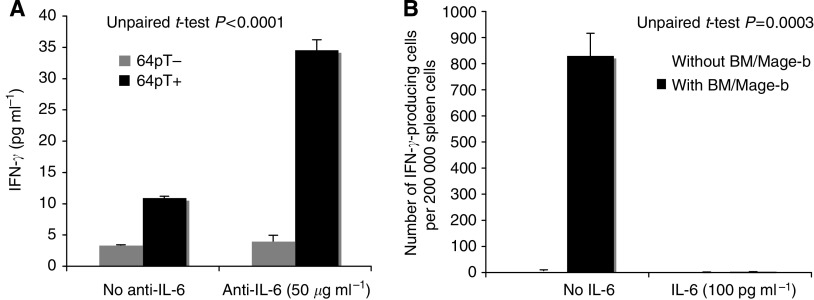
Effect of IL-6 on Mage-b-induced immune responses in vitro. To analyse the effect of IL-6 on Mage-b-specific immune responses in vitro, draining lymph nodes (LNs) of 4T1 tumour-bearing mice were cocultured with or without 64pT tumour cells, expressing highly Mage-b, and producing high levels of IL-6. These cocultures were performed in the absence or presence of anti-IL-6 antibodies (A). After 2 days of stimulation, the production of IFNγ was determined with quantitative ELISA. In this experiment, the lymph nodes (LNs) of 10 mice were pooled. In addition, spleen cells of 4T1 tumour-bearing mice were cocultured with or without autologous bone marrow (BM) cells transfected with pcDNA3.1-Mage-b and pCMV-GM-CSF. These cocultures were performed in the absence or presence of purified IL-6 (B). After 2 days of stimulation, the number of IFNγ-producing cells was determined with an ELISPOT reader. This experiment was performed twice with spleens of mice that received vaccination with LM-LLO-Mage-b/2nd. In each experiment, spleens of five mice were pooled. Controls such as BM cells transfected with pcDNA3.1-Mage-b and/or pCMV-GM-CSF, or non-transfected BM cells, did not produce IFNγ (data not shown). The results of both assays were subjected to statistical analysis using the unpaired t-test. The error bars represent the s.e.m.

References

    1. Alberg AJ, Singh S (2001) Epidemiology of breast cancer in older women: implications for future health care. Drugs Aging 18: 761–762 - PubMed
    1. Althuis MD, Dozier JM, Anderson WF, Devesa SS, Brinton LA (2005) Global trends in breast cancer incidence and mortality 1973–1997. Int J Epidemiol 34: 405–412 - PubMed
    1. Aslakson CJ, Miller FR (1992) Selective events in the metastatic process defined by analysis of the sequential dissemination of subpopulations of a mouse mammary tumor. Cancer Res 152: 1399 - PubMed
    1. Berkowitz N, Gupta S, Silberman G (2000) Estimates of the lifetime direct costs of treatment for metastatic breast cancer. Value Health 3: 23–30 - PubMed
    1. Celis JE, Moreira JMA, Cabezon T, Gromov P, Friis E, Rank F, Gromova I (2005) Identification of extracellular and intracellular signaling components of the mammary adipose tissue and its interstitial fluid in high risk breast cancer patients. Mol Cell Proteomics 4: 492–522 - PubMed

Publication types

MeSH terms