Searching for and finding meaning in collective trauma: results from a national longitudinal study of the 9/11 terrorist attacks
- PMID: 18729704
- PMCID: PMC2617710
- DOI: 10.1037/0022-3514.95.3.709
Searching for and finding meaning in collective trauma: results from a national longitudinal study of the 9/11 terrorist attacks
Abstract
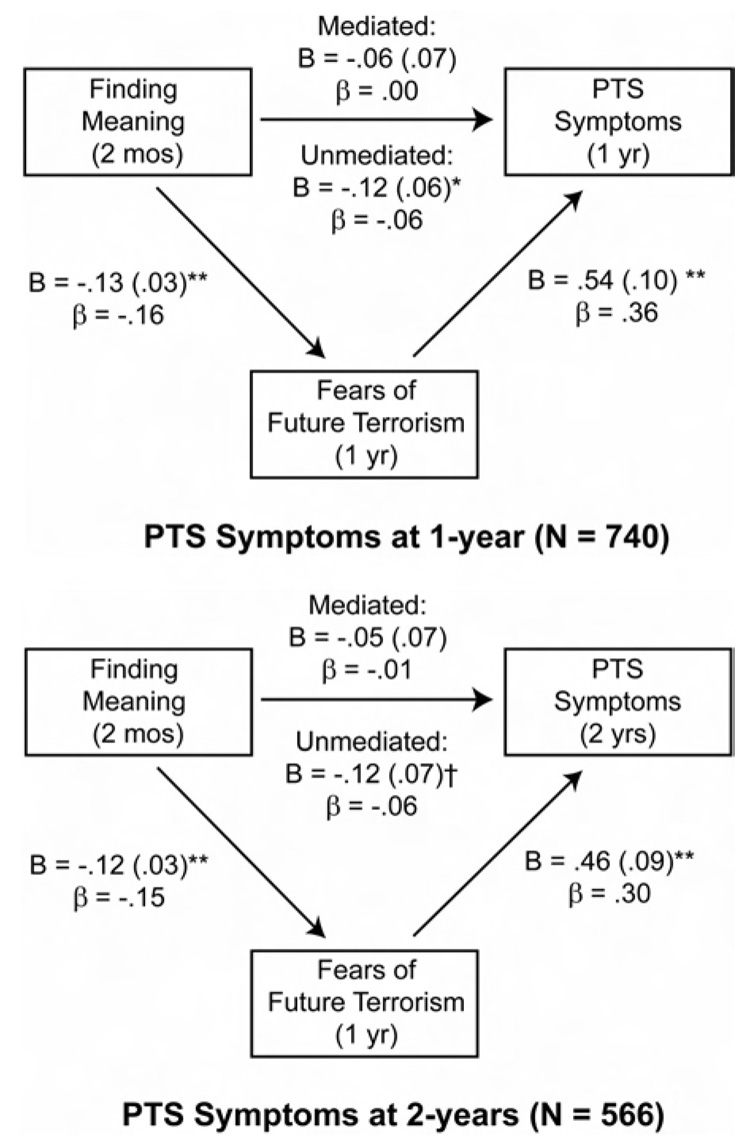
The ability to make sense of events in one's life has held a central role in theories of adaptation to adversity. However, there are few rigorous studies on the role of meaning in adjustment, and those that have been conducted have focused predominantly on direct personal trauma. The authors examined the predictors and long-term consequences of Americans' searching for and finding meaning in a widespread cultural upheaval--the terrorist attacks of September 11, 2001--among a national probability sample of U.S. adults (N=931). Searching for meaning at 2 months post-9/11 was predicted by demographics and high acute stress response. In contrast, finding meaning was predicted primarily by demographics and specific early coping strategies. Whereas searching for meaning predicted greater posttraumatic stress (PTS) symptoms across the following 2 years, finding meaning predicted lower PTS symptoms, even after controlling for pre-9/11 mental health, exposure to 9/11, and acute stress response. Mediation analyses suggest that finding meaning supported adjustment by reducing fears of future terrorism. Results highlight the role of meaning in adjustment following collective traumas that shatter people's fundamental assumptions about security and invulnerability.
Figures
References
-
- American Psychiatric Association. Diagnostic and statistical manual of mental disorders. 4th ed., text rev. Washington, DC: Author; 2000.
-
- Antonovsky A. Health, stress and coping. San Francisco: Jossey-Bass; 1979.
-
- Baker LC, Bundorf MK, Singer S, Wagner TH. Validity of the Survey of Health and the Internet and Knowledge Network’s panel and sampling. Stanford, CA: Stanford University; 2003.
-
- Ballinger GA. Using generalized estimating equations for longitudinal data analysis. Organizational Research Methods. 2004;7:127–150.
-
- Baron RM, Kenny DA. The moderator–mediator variable distinction in social psychological research: Conceptual, strategic and statistical considerations. Journal of Personality and Social Psychology. 1986;51:1173–1182. - PubMed