Review
. 2009:4:49-70.
doi: 10.1146/annurev.pathol.4.110807.092158.

Molecular pathology of head and neck cancer: implications for diagnosis, prognosis, and treatment

Affiliations
Review

Molecular pathology of head and neck cancer: implications for diagnosis, prognosis, and treatment

Sara I Pai et al. Annu Rev Pathol. 2009.

Abstract

The prototypic head and neck squamous cell carcinoma (HNSCC) arises from the mucosal lining of the upper aerodigestive tract, demonstrates squamous differentiation microscopically, involves older men with a long history of cigarette smoking and alcohol consumption, and is treated by multimodality therapy. HNSCC has long been regarded as a uniform disease process requiring a methodical and unwavering therapeutic approach. Divergence in epidemiologic trends among HNSCCs arising from different anatomic sites has introduced a view that, morphologic repetition aside, head and neck cancers form a heterogeneous group. This view has been supported at the molecular genetic level. A more complete understanding of the molecular genetics of head and neck cancer is providing new insights into long-held but poorly comprehended concepts such as field cancerization and is introducing various biomarkers with potential application for diagnosing, staging, monitoring, and prognosticating HNSCC.


Figures

Figure 1
Figure 1
General incident trends of head and neck squamous cell carcinoma (HNSCC) as a function of yearly cigarette consumption. In the United States, the overall incidence of HNSCC (orange arrow) has paralleled the yearly annual cigarette consumption, with a peak incidence in the 1970s. A distinct departure from this trend has been noted among white males under 60, in whom the incidence of oropharyngeal carcinoma (red arrow) has been on the rise since the early 1970s.
Figure 2
Figure 2
(a) Topography of the human palatine tonsil. The surface epithelium of the palatine tonsil deeply invaginates into a lymphoid stroma as blind-ending and ramifying crypts (boxed area) that increase the surface area of the tonsil by nearly 700%. Drawing by Max Brödel. Used with permission from Art as Applied to Medicine, the Johns Hopkins University School of Medicine. (b) The specialized reticulated epithelium lining the tonsillar crypts. The zones of squamous epithelium—the basal, intermediate, and superficial layers—are interrupted by migrating nonepithelial cells including lymphocytes and antigen-presenting cells. Loss of structural integrity leaves the basement membrane exposed to deposition of viral particles. Drawing by T. Phelps. Abbreviations: APG, antigen presenting group; HPV, human papillomavirus.
Figure 3
Figure 3
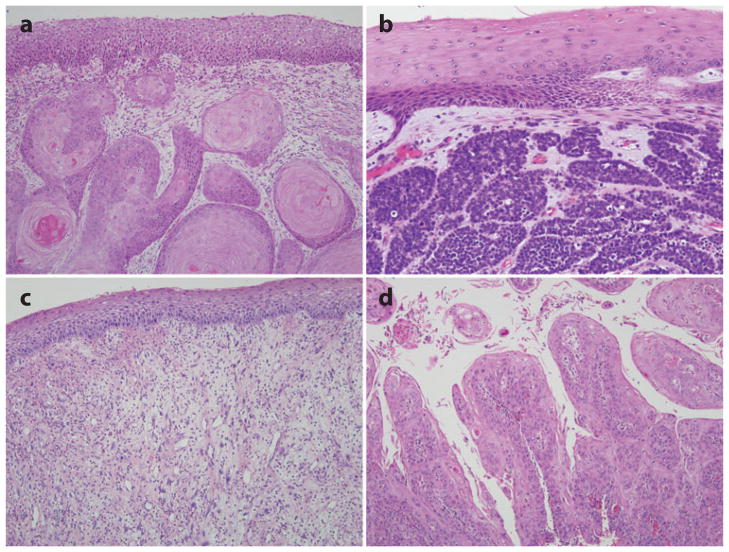
Histologic features of head and neck squamous cell carcinoma (HNSCC). The prototypic HNSCC is characterized by nests of squamous cells with pink cytoplasm, intercellular bridges and keratin pearl formation set in a background of stromal fibrosis (a). Subtypes of HNSCC include the basaloid variant (b), the spindle-cell variant (c), and the papillary variant (d ).
Figure 4
Figure 4
Genetic progression model of head and neck tumorigenesis. Clinical and histologic progression from simple squamous hyperplasia through the advancing stages of squamous dysplasia to invasive squamous cell carcinoma is driven by the progressive accumulation of genetic alterations. Some alterations, such as loss of heterozygosity (LOH) at chromosomal loci 3p and 9p, occur earlier in this sequence than do other alterations. Figure illustrated by Robert Morreale, CMI and contributed by Joseph Califano, MD. Reproduced with permission from New England Journal of Medicine.
Figure 5
Figure 5
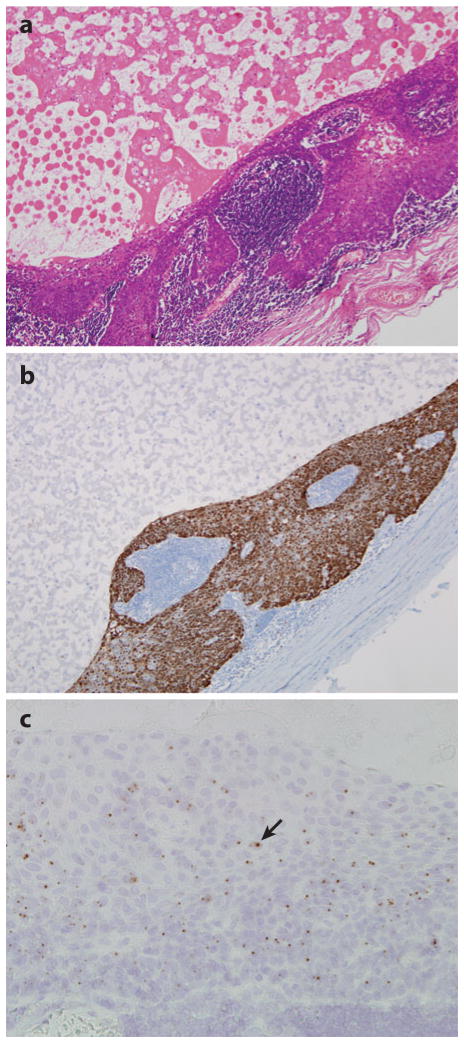
Metastatic head and neck squamous cell carcinoma from an unknown primary involving a cervical lymph node. This cystic metastasis with hematoxylin and eosin stain (a) shows P16 overexpression by immunohistochemical staining (b), andHPV-16 in-situ hybridization (c) demonstrates the presence of punctuate hybridization signals within the nuclei of tumor cells (arrow). The presence ofHPV- 16 points to the lingual or palatine tonsil as a highly likely site of tumor origin.
Figure 6
Figure 6
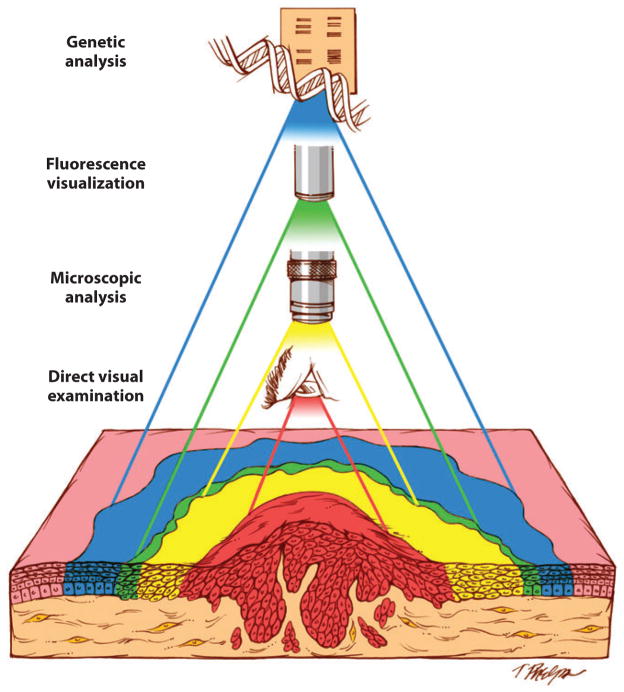
Invasive head and neck squamous cell carcinomas (HNSCCs) arise from genetically altered cells distributed throughout tracts of the mucosa. The aim of surgery is to remove the entire neoplastic field, but the ability to discern its boundaries in the operating room depends on the method of detection. Direct visualization examination (red zone) underestimates the full extent of histologic alterations as detected by intraoperative frozen section histology ( yellow zone). Fluorescence visualization ( green zone) is a simple, real-time method for visualizing optic changes associated with subclinical premalignant disease. The boundaries established by fluorescence visualization may even extend beyond the zone of histologic changes to more fully encompass the field of genetic alterations (blue zone). Figure reproduced with permission from Clinical Cancer Research.

References

    1. Parkin DM, Bray F, Ferlay J, Pisani P. Global cancer statistics, 2002. CA Cancer J Clin. 2005;55:74–108. - PubMed
    1. Jemal A, Siegel R, Ward E, Murray T, Xu J, Thun MJ. Cancer statistics, 2007. CA Cancer J Clin. 2007;57:43–66. - PubMed
    1. Carvalho AL, Nishimoto IN, Califano JA, Kowalski LP. Trends in incidence and prognosis for head and neck cancer in the United States: a site-specific analysis of the SEER database. Int J Cancer. 2005;114:806–16. - PubMed
    1. Sturgis EM, Cinciripini PM. Trends in head and neck cancer incidence in relation to smoking prevalence: an emerging epidemic of human papillomavirus–associated cancers? Cancer. 2007;110:1429–35. - PubMed
    1. Hammarstedt L, Dahlstrand H, Lindquist D, Onelov L, Ryott M, et al. The incidence of tonsillar cancer in Sweden is increasing. Acta Otolaryngol. 2007;127:988–92. - PubMed

MeSH terms

Substances