


Extent and determinants of error in physicians' prognoses in terminally ill patients: prospective cohort study
- PMID: 18751282
- PMCID: PMC1070876
- DOI: 10.1136/ewjm.172.5.310
Extent and determinants of error in physicians' prognoses in terminally ill patients: prospective cohort study
Abstract
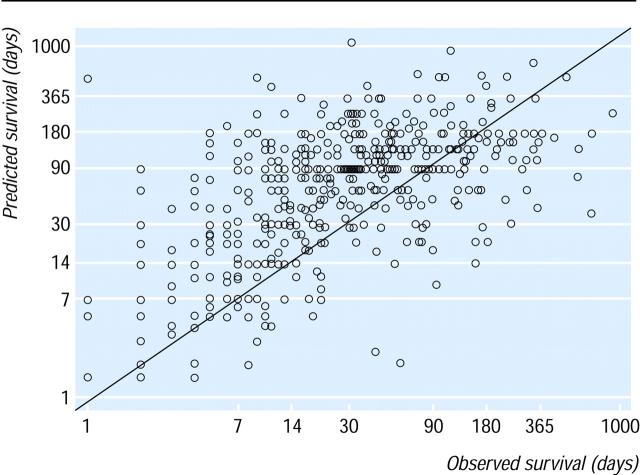
Objectives To describe physicians' prognostic accuracy in terminally ill patients and to evaluate the determinants of that accuracy. Design Prospective cohort study. Setting Five outpatient hospice programs in Chicago. Participants A total of 343 physicians provided survival estimates for 468 terminally ill patients at the time of hospice referral. Main outcome measures Patients' estimated and actual survival. Results Median survival was 24 days. Of 468 predictions, only 92 (20%) were accurate (within 33% of actual survival); 295 (63%) were overoptimistic, and 81 (17%) were overpessimistic. Overall, physicians overestimated survival by a factor of 5.3. Few patient or physician characteristics were associated with prognostic accuracy. Male patients were 58% less likely to have overpessimistic predictions. Medical specialists excluding oncologists were 326% more likely than general internists to make overpessimistic predictions. Physicians in the upper quartile of practice experience were the most accurate. As the duration of the doctor-patient relationship increased and time since last contact decreased, prognostic accuracy decreased. Conclusions Physicians are inaccurate in their prognoses for terminally ill patients, and the error is systematically optimistic. The inaccuracy is, in general, not restricted to certain kinds of physicians or patients. These phenomena may be adversely affecting the quality of care given to patients near the end of life.
Figures
References
-
- Christakis NA, Iwashyna TJ. Attitude and self-reported practice regarding prognostication in a national sample of internists. Arch Intern Med 1998;158: 2389-2395. - PubMed
-
- Christakis NA. Death Foretold: Prophecy and Prognosis in Medical Care. Chicago: University of Chicago Press; 1999.
-
- Christakis NA. The ellipsis of prognosis in modern medical thought. Soc Sci Med 1997;44: 301-305. - PubMed
-
- Fletcher SW, Fletcher RH, Greganti MA. Clinical research trends in general medical journals, 1946-1976. In: Roberts EB, Levy RI, Finkelstein SN, Moskowitz J, Sondik EJ, eds. Biomedical Innovation. Cambridge, MA: MIT Press; 1981.
LinkOut - more resources
Full Text Sources