


Ethnically diverse causes of Walker-Warburg syndrome (WWS): FCMD mutations are a more common cause of WWS outside of the Middle East
- PMID: 18752264
- PMCID: PMC2577713
- DOI: 10.1002/humu.20844
Ethnically diverse causes of Walker-Warburg syndrome (WWS): FCMD mutations are a more common cause of WWS outside of the Middle East
Abstract
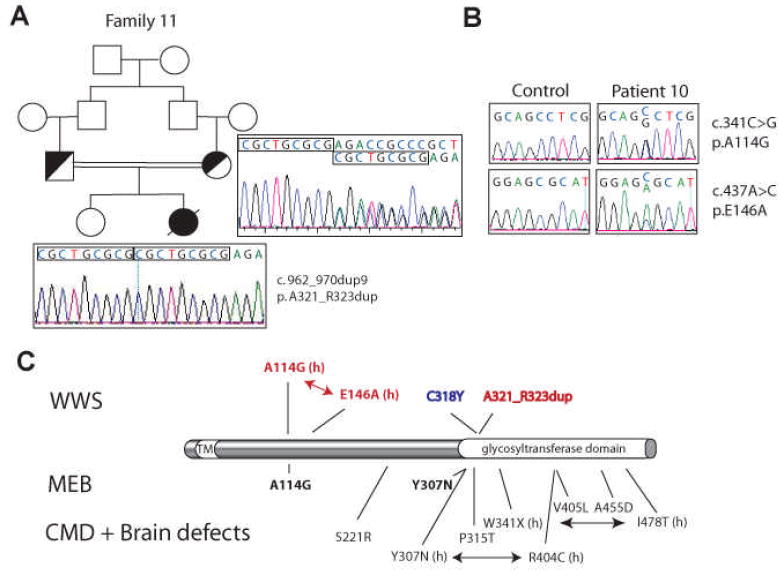
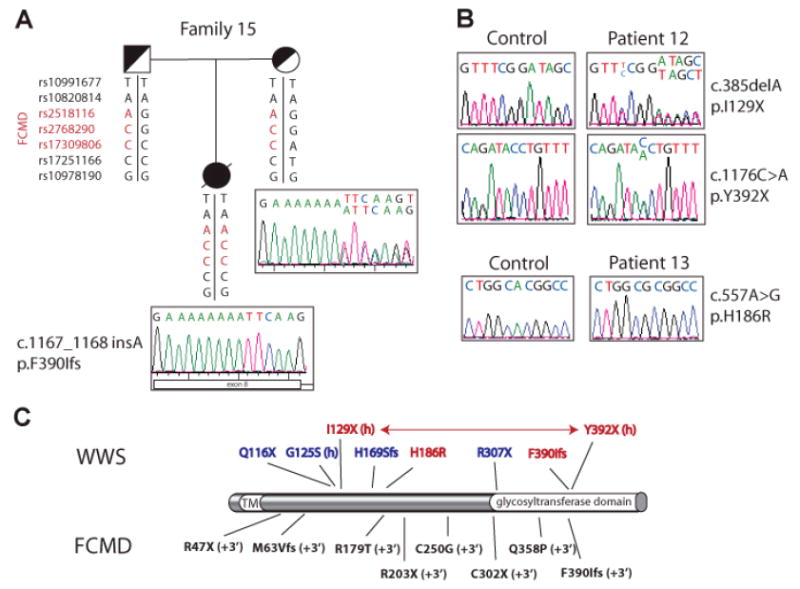
Walker-Warburg syndrome (WWS) is a genetically heterogeneous autosomal recessive disease characterized by congenital muscular dystrophy, cobblestone lissencephaly, and ocular malformations. Mutations in six genes involved in the glycosylation of á-dystroglycan (POMT1, POMT2, POMGNT1, FCMD, FKRP and LARGE) have been identified in WWS patients, but account for only a portion of WWS cases. To better understand the genetics of WWS and establish the frequency and distribution of mutations across WWS genes, we genotyped all known loci in a cohort of 43 WWS patients of varying geographical and ethnic origin. Surprisingly, we reached a molecular diagnosis for 40% of our patients and found mutations in POMT1, POMT2, FCMD and FKRP, many of which were novel alleles, but no mutations in POMGNT1 or LARGE. Notably, the FCMD gene was a more common cause of WWS than previously expected in the European/American subset of our cohort, including all Ashkenazi Jewish cases, who carried the same founder mutation.
(c) 2008 Wiley-Liss, Inc.
Figures
References
-
- Akasaka-Manya K, Manya H, Nakajima A, Kawakita M, Endo T. Physical and functional association of human protein O-mannosyltransferases 1 and 2. J Biol Chem. 2006;281(28):19339–45. - PubMed
-
- Barresi R, Campbell KP. Dystroglycan: from biosynthesis to pathogenesis of human disease. J Cell Sci. 2006;119:199–207. - PubMed
-
- Beltran-Valero de Bernabe D, Currier S, Steinbrecher A, Celli J, van Beusekom E, van der Zwaag B, Kayserili H, Merlini L, Chitayat D, Dobyns WB, Cormand B, Lehesjoki AE, Cruces J, Voit T, Walsh CA, van Bokhoven H, Brunner HG. Mutations in the O-mannosyltransferase gene POMT1 give rise to the severe neuronal migration disorder Walker-Warburg syndrome. Am J Hum Genet. 2002;71(5):1033–43. - PMC - PubMed
-
- Beltran-Valero de Bernabe D, van Bokhoven H, van Beusekom E, Van den Akker W, Kant S, Dobyns WB, Cormand B, Currier S, Hamel B, Talim B, Topaloglu H, Brunner HG. A homozygous nonsense mutation in the fukutin gene causes a Walker-Warburg syndrome phenotype. J Med Genet. 2003;40(11):845–8. - PMC - PubMed
-
- Beltran-Valero de Bernabe D, Voit T, Longman C, Steinbrecher A, Straub V, Yuva Y, Herrmann R, Sperner J, Korenke C, Diesen C, Dobyns WB, Brunner HG, van Bokhoven H, Brockington M, Muntoni F. Mutations in the FKRP gene can cause muscle-eye-brain disease and Walker-Warburg syndrome. J Med Genet. 2004;41(5):e61. - PMC - PubMed
Publication types
MeSH terms
Substances
Grants and funding
LinkOut - more resources
Full Text Sources
