Comment
doi: 10.1371/journal.pbio.0060220.
Whisker-mediated texture discrimination
Affiliations
- PMID: 18752356
- PMCID: PMC2525693
- DOI: 10.1371/journal.pbio.0060220
Item in Clipboard
Comment
Whisker-mediated texture discrimination
PLoS Biol.
.
Abstract
Rats use their whiskers to rapidly and accurately measure the texture of objects. The authors evaluate recent evidence about how whisker movement across a surface produces texture-specific motion signals, and how the signals are represented by the brain.
Figures
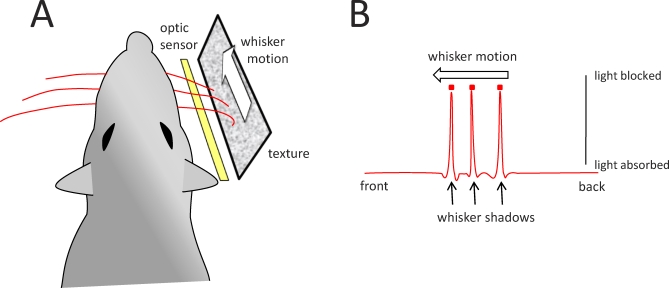
(A) An optic sensor was placed below the textured plate; the rat palpated the texture with its whiskers. (B) The position of each whisker (red square centered at peak of the whisker shadow) was measured at 4 kHz frame rate and ~5 micron spatial resolution. Adapted from [12].
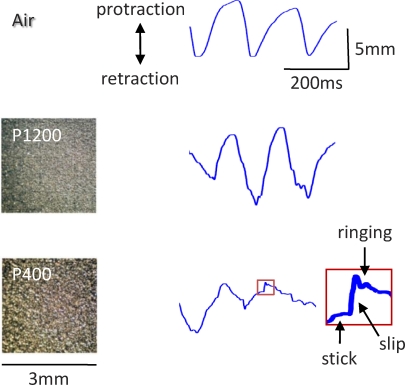
Whisker trajectory measured when the whiskers moved through the air with no texture present (upper trace) and when the whiskers contacted texture P1200 (middle trace) and texture P400 (lower trace). Adapted from [12]. Texture photographs from [10].
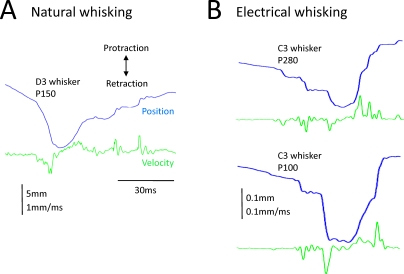
Kinetic signatures are apparent in position (blue traces) and velocity (green traces), and these are conserved across experimental conditions. (A) Contact of D3 whisker with texture P150, measured ~10 mm from the base (adapted from [12]). (B) Contact of C3 whisker with texture P280 (upper panel) and with texture P100 (lower panel), both measured 1 mm from the base (adapted from [10]).
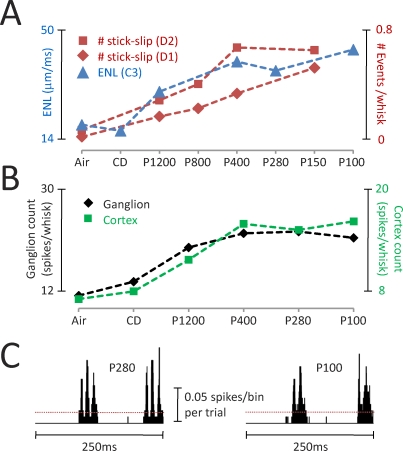
(A) In two different studies, progressively coarser textures evoked kinetic signatures with higher magnitude kinetic events. Red marks are slip-stick events from [12] measured for whiskers D1 and D2; blue marks are ENL from [10] measured for whisker C3. (B) Higher ENLs led to higher firing rates in the trigeminal ganglion (black diamonds) and barrel cortex (green squares). Adapted from [10]. (C) Texture-specific spike patterns. Peristimulus time histogram (2 ms bins; 100 trials) of a ganglion cell for two whisks on textures P280 (left) and P100 (right). Mean firing rate (dashed red lines) were similar, suggesting temporal firing pattern as a critical coding mechanism.
Comment on
-
Texture coding in the rat whisker system: slip-stick versus differential resonance.PLoS Biol. 2008 Aug 26;6(8):e215. doi: 10.1371/journal.pbio.0060215. PLoS Biol. 2008. PMID: 18752354 Free PMC article.
References
-
- Johnson KO, Hsiao SS. Neural mechanisms of tactual form and texture perception. Annu Rev Neurosci. 1992;15:227–250. - PubMed
-
- von Heimendahl M, Itskov PM, Arabzadeh E, Diamond ME. Neuronal activity in rat barrel cortex underlying texture discrimination. PLoS Biol. 2007;5(11):e305. doi: 10.1371/journal.pbio.0050305. - DOI - PMC - PubMed
-
- Woolsey TA, van der Loos H. The structural organization of layer iv in the somatosensory region (si) of mouse cerebral cortex. the description of a cortical field composed of discrete cytoarchitectonic units. Brain Res. 1970;17:205–242. - PubMed
-
- Guic-Robles E, Jenkins WM, Bravo H. Vibrissal roughness discrimination is barrelcortex-dependent. Behav Brain Res. 1992;48:145–152. - PubMed
Publication types
MeSH terms
LinkOut - more resources
Full Text Sources