Enhancement of human antigen-specific memory T-cell responses by interleukin-7 may improve accuracy in diagnosing tuberculosis
- PMID: 18753334
- PMCID: PMC2565935
- DOI: 10.1128/CVI.00185-08
Enhancement of human antigen-specific memory T-cell responses by interleukin-7 may improve accuracy in diagnosing tuberculosis
Abstract
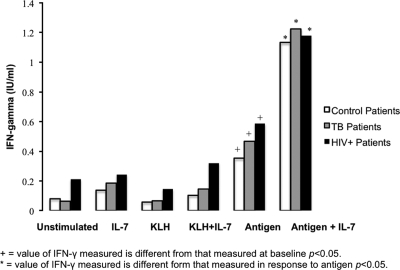
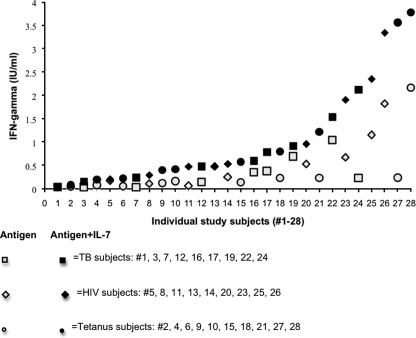
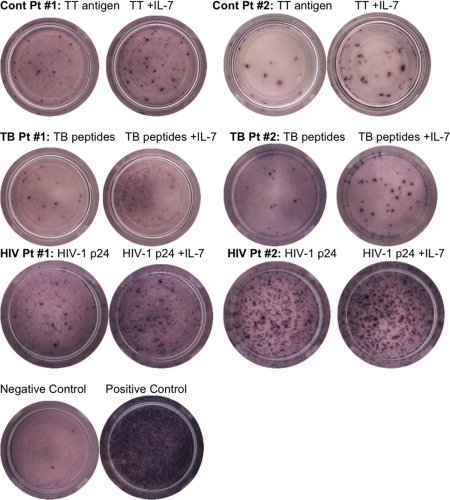
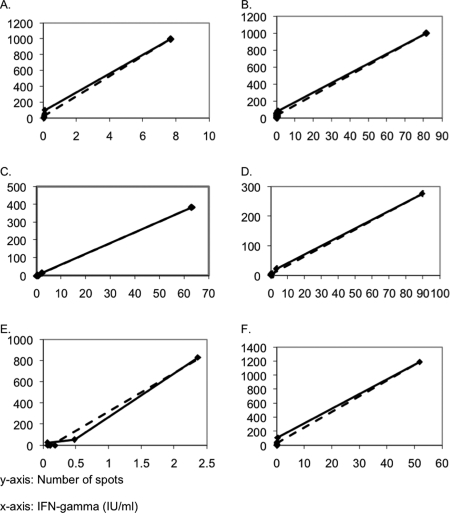
Children and immunocompromised adults are at an increased risk of tuberculosis (TB), but diagnosis is more challenging. Recently developed gamma interferon (IFN-gamma) release assays provide increased sensitivity and specificity for diagnosis of latent TB, but their use is not FDA approved in immunocompromised or pediatric populations. Both populations have reduced numbers of T cells, which are major producers of IFN-gamma. Interleukin 7 (IL-7), a survival cytokine, stabilizes IFN-gamma message and increases protein production. IL-7 was added to antigen-stimulated lymphocytes to improve IFN-gamma responses as measured by enzyme-linked immunosorbent assay (ELISA) and enzyme-linked immunospot (ELISPOT) assay. Antigens used were tetanus toxoid (n = 10), p24 (from human immunodeficiency virus [HIV], n = 9), and TB peptides (n = 15). Keyhole limpet hemocyanin was used as a negative control, and phytohemagglutinin was the positive control. IL-7 improved antigen-specific responses to all antigens tested including tetanus toxoid, HIV type 1 p24, and TB peptides (ESAT-6 and CFP-10) with up to a 14-fold increase (mean = 3.8), as measured by ELISA. Increased IFN-gamma responses from controls, HIV-positive patients, and TB patients were statistically significant, with P values of <0.05, 0.01, and 0.05, respectively. ELISPOT assay results confirmed ELISA findings (P values of <0.01, 0.02, and 0.03, respectively), with a strong correlation between the two tests (R(2) = 0.82 to 0.99). Based on average background levels, IL-7 increased detection of IFN-gamma by 39% compared to the level with antigen alone. Increased production of IFN-gamma induced by IL-7 improves sensitivity of ELISA and ELISPOT assays for all antigens tested. Further enhancement of IFN-gamma-based assays might improve TB diagnosis in those populations at highest risk for TB.
Figures
References
-
- Arend, S. M., A. Geluk, K. E. van Meijgaarden, J. T. van Dissel, M. Theisen, P. Andersen, and T. H. Ottenhoff. 2000. Antigenic equivalence of human T-cell responses to Mycobacterium tuberculosis-specific RD1-encoded protein antigens ESAT-6 and culture filtrate protein 10 and to mixtures of synthetic peptides. Infect. Immun. 68:3314-3321. - PMC - PubMed
-
- Arend, S. M., S. F. T. Thijsen, E. M. S. Leyten, J. J. M. Bouwman, W. P. J. Franken, B. F. Koster, F. G. J. Cobelens, A. J. van Houte, and A. W. J. Bossink. 2007. Comparison of two interferon-gamma assays and tuberculin skin test for tracing tuberculosis contacts. Am. J. Respir. Crit. Care Med. 175:618-627. - PubMed
-
- Borger, P., H. F. Kauffman, D. S. Postma, and E. Vellenga. 1996. IL-7 differentially modulates the expression of IFN-gamma and IL-4 in activated human T lymphocytes by transcriptional and post-transcriptional mechanisms. J. Immunol. 156:1333-1338. - PubMed
-
- Chapman, A. L. N., M. Munkanta, K. A. Wilkinson, A. A. Pathan, K. Ewer, H. Ayles, W. H. Reece, A. Mwinga, P. Godfrey-Faussett, and A. Lalvani. 2002. Rapid detection of active and latent tuberculosis infection in HIV-positive individuals by enumeration of Mycobacterium tuberculosis-specific T cells. AIDS 16:2285-2293. - PubMed
MeSH terms
Substances
Grants and funding
LinkOut - more resources
Full Text Sources
Other Literature Sources
Medical
Miscellaneous