


Impact of Trichomonas vaginalis transcription-mediated amplification-based analyte-specific-reagent testing in a metropolitan setting of high sexually transmitted disease prevalence
- PMID: 18753347
- PMCID: PMC2566100
- DOI: 10.1128/JCM.00564-08
Impact of Trichomonas vaginalis transcription-mediated amplification-based analyte-specific-reagent testing in a metropolitan setting of high sexually transmitted disease prevalence
Abstract
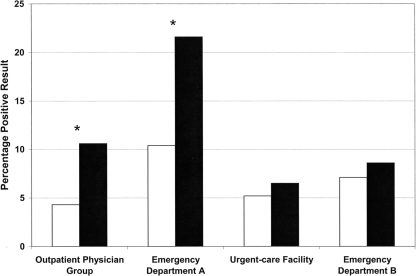
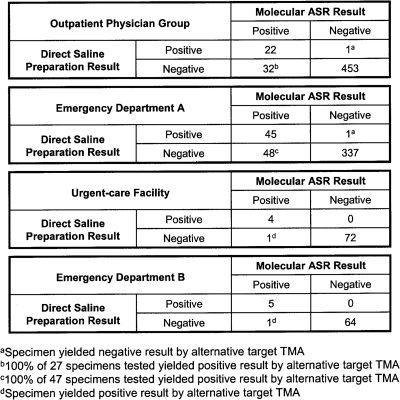
Trichomoniasis is a significant sexually transmitted disease (STD) in the spectrum of public health and primary care because of its association with agents such as human immunodeficiency virus and Neisseria gonorrhoeae. However, its true significance may be underestimated due to diagnostic modalities that exhibit poor sensitivity. A total of 1,086 genital specimens from two urban emergency departments, a suburban urgent-care facility, and a metropolitan outpatient physician group were subjected to transcription-mediated amplification-based Trichomonas vaginalis analyte-specific-reagent (ASR) testing (Gen-Probe, Inc.). The rate of positive molecular ASR results (14.5%) doubled that of direct saline preparation (7.0%; P < 0.0002). Analogous increases were observed at one emergency department and within the outpatient physician group (P < 0.0002). No significant increase in the rate of positive molecular ASR results was observed from the facilities that encountered a lower frequency of black/African American patients. While positive T. vaginalis findings via direct saline preparation did not have a significant association with concomitant Chlamydia trachomatis or N. gonorrhoeae infection overall, a positive T. vaginalis ASR result was a better predictor of concomitant C. trachomatis or N. gonorrhoeae infection (odds ratios of 2.34 and 4.46, respectively; P < 0.0001). The increased rate of positive T. vaginalis ASR results was observed in both point-of-care (P = 0.02 versus direct saline preparation) and laboratory (P = 0.003) testing. Highly sensitive T. vaginalis molecular ASR not only transcends issues of specimen integrity and microscopic acumen but also has an increased ability to predict the likelihood of additional STDs in defined populations.
Figures
References
-
- Arroyo, R., A. Gonzalez-Robles, A. Martinez-Palomo, and J. F. Aldrete. 1993. Signalling of Trichomonas vaginalis for amoeboid transformation and adhesion synthesis follows cytoadherence. Mol. Microbiol. 7299-309. - PubMed
-
- Bruckner, D. A. 2004. Urogenital specimens: direct saline mount, p. 9.6.6.1-9.6.6.4. In H. D. Isenberg (ed.), Clinical microbiology procedures handbook, 2nd ed. ASM Press, Washington, DC.
-
- Burch, T. A., C. W. Rees, and L. Reardon. 1959. Diagnosis of Trichomonas vaginalis vaginitis. Am. J. Obstet. Gynecol. 77309-313. - PubMed
-
- Cates, W., Jr. 1999. Estimates of the incidence and prevalence of sexually transmitted diseases in the United States. The American Social Health Association Panel. Sex. Transm. Dis. 26(Suppl. 4)S2-S7. - PubMed
Publication types
MeSH terms
LinkOut - more resources
Full Text Sources
Medical
Research Materials
