


Epidemiology and clinical associations of human parechovirus respiratory infections
- PMID: 18753351
- PMCID: PMC2566073
- DOI: 10.1128/JCM.01207-08
Epidemiology and clinical associations of human parechovirus respiratory infections
Abstract
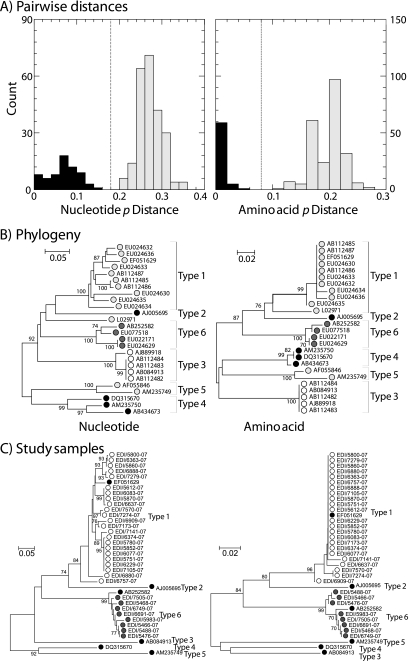
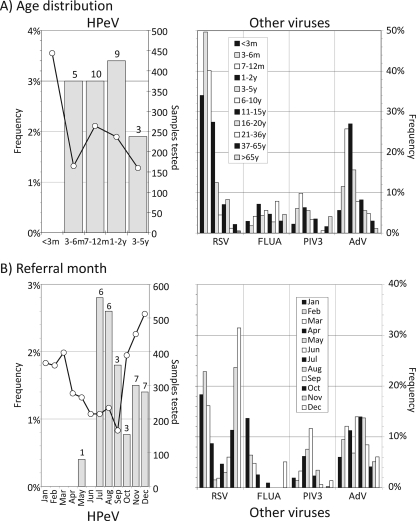
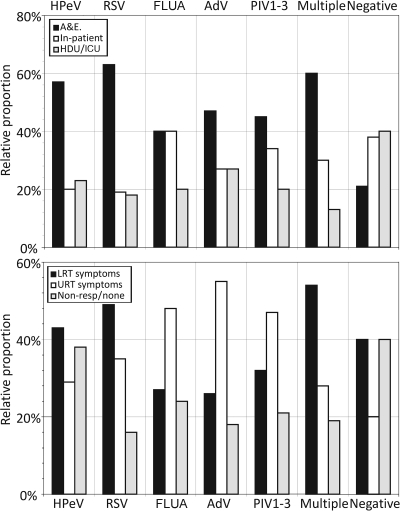
Infections with human parechoviruses (HPeVs) are prevalent in young children and have been associated with mild gastroenteritis and, less frequently, with meningitis and neonatal sepsis. To investigate the involvement of these viruses in respiratory disease, a highly sensitive nested PCR was used to screen a large archive of respiratory specimens, collected between January and December 2007. Respiratory samples had previously been tested for eight respiratory viruses, including respiratory syncytial virus and adenovirus, by PCR. HPeV was detected in 34 of 3,844 specimens, representing 27 of 2,220 study subjects (1.2%). HPeV types were identified by sequencing the VP3/VP1 junction amplified by PCR directly from clinical specimens. The assay could amplify all HPeV types examined with high sensitivity (types 1 and 3 to 6) and also identified HPeV types in all but one of the screen-positive study specimens (25 HPeV1 and eight HPeV6 specimens). Infections with both HPeV1 and HPeV6 were seasonal, with highest frequencies in July and August, and restricted to children aged between 6 months and 5 years. Other respiratory viruses were frequently codetected in HPeV-positive specimens, with significant overrepresentation of adenovirus coinfections (37%). Most HPeV-positive specimens were referred from emergency departments, although no association with specific respiratory symptoms or disease was found. In summary, the low frequency of detection and lack of clear disease associations indicate that HPeV1 and -6 are not major pathogens in individuals presenting with respiratory disease. However, the screening and typing methods developed will be of value in further HPeV testing, including testing for meningitis cases and other suspected HPeV-associated disease presentations.
Figures
Similar articles
-
Prevalence, types, and RNA concentrations of human parechoviruses, including a sixth parechovirus type, in stool samples from patients with acute enteritis.J Clin Microbiol. 2008 Jan;46(1):242-8. doi: 10.1128/JCM.01468-07. Epub 2007 Dec 5. J Clin Microbiol. 2008. PMID: 18057123 Free PMC article.
-
[Human parechovirus associated sepsis and central nervous system infections in hospitalized children].Zhonghua Er Ke Za Zhi. 2014 Jun;52(6):444-8. Zhonghua Er Ke Za Zhi. 2014. PMID: 25190165 Chinese.
-
Human parechovirus-3 infection in children, South Korea.J Clin Virol. 2013 Sep;58(1):194-9. doi: 10.1016/j.jcv.2013.05.023. Epub 2013 Jun 22. J Clin Virol. 2013. PMID: 23800693
-
Comparison of human parechovirus and enterovirus detection frequencies in cerebrospinal fluid samples collected over a 5-year period in edinburgh: HPeV type 3 identified as the most common picornavirus type.J Med Virol. 2011 May;83(5):889-96. doi: 10.1002/jmv.22023. J Med Virol. 2011. PMID: 21412796
-
Pediatric parechovirus infections.J Clin Virol. 2014 Jun;60(2):84-9. doi: 10.1016/j.jcv.2014.03.003. Epub 2014 Mar 13. J Clin Virol. 2014. PMID: 24690382 Review.
Cited by
-
Elucidation and clinical role of emerging viral respiratory tract infections in children.Adv Exp Med Biol. 2013;764:191-204. doi: 10.1007/978-1-4614-4726-9_16. Adv Exp Med Biol. 2013. PMID: 23654068 Free PMC article. Review.
-
Parechovirus A Circulation and Testing Capacities in Europe, 2015-2021.Emerg Infect Dis. 2024 Feb;30(2):234-244. doi: 10.3201/eid3002.230647. Emerg Infect Dis. 2024. PMID: 38270192 Free PMC article. Review.
-
Prevalence of rhinoviruses in young children of an unselected birth cohort from the Netherlands.Clin Microbiol Infect. 2016 Aug;22(8):736.e9-736.e15. doi: 10.1016/j.cmi.2016.05.022. Epub 2016 Jun 3. Clin Microbiol Infect. 2016. PMID: 27265373 Free PMC article.
-
Two cases of primary human parechovirus pneumonia in adults.Respir Med Case Rep. 2019 Oct 16;28:100949. doi: 10.1016/j.rmcr.2019.100949. eCollection 2019. Respir Med Case Rep. 2019. PMID: 31709139 Free PMC article.
-
High frequency and diversity of parechovirus A in a cohort of Malawian children.Arch Virol. 2019 Mar;164(3):799-806. doi: 10.1007/s00705-018-04131-7. Epub 2019 Jan 22. Arch Virol. 2019. PMID: 30666460 Free PMC article.
References
-
- Abed, Y., and G. Boivin. 2005. Molecular characterization of a Canadian human parechovirus (HPeV)-3 isolate and its relationship to other HPeVs. J. Med. Virol. 77566-570. - PubMed
-
- Baumgarte, S., L. K. Souza Luna, K. Grywna, M. Panning, J. F. Drexler, C. Karsten, H. I. Huppertz, and C. Drosten. 2008. Prevalence, types, and RNA concentrations of human parechoviruses, including a sixth parechovirus type, in stool samples from patients with acute enteritis. J. Clin. Microbiol. 46242-248. - PMC - PubMed
-
- Benschop, K., R. Molenkamp, A. van der Ham, K. Wolthers, and M. Beld. 2008. Rapid detection of human parechoviruses in clinical samples by real-time PCR. J. Clin. Virol. 4169-74. - PubMed
Publication types
MeSH terms
Substances
Associated data
- Actions
- Actions
- Actions
- Actions
- Actions
- Actions
- Actions
- Actions
- Actions
- Actions
- Actions
- Actions
- Actions
- Actions
- Actions
- Actions
- Actions
- Actions
- Actions
- Actions
- Actions
- Actions
- Actions
- Actions
- Actions
- Actions
- Actions
- Actions
- Actions
- Actions
- Actions
LinkOut - more resources
Full Text Sources
