. 2008 Aug 27;28(35):8810-20.
doi: 10.1523/JNEUROSCI.2095-08.2008.

Multiple mechanisms for integrating proprioceptive inputs that converge on the same motor pattern-generating network

Affiliations

Multiple mechanisms for integrating proprioceptive inputs that converge on the same motor pattern-generating network

Gregory Barrière et al. J Neurosci. .

Abstract

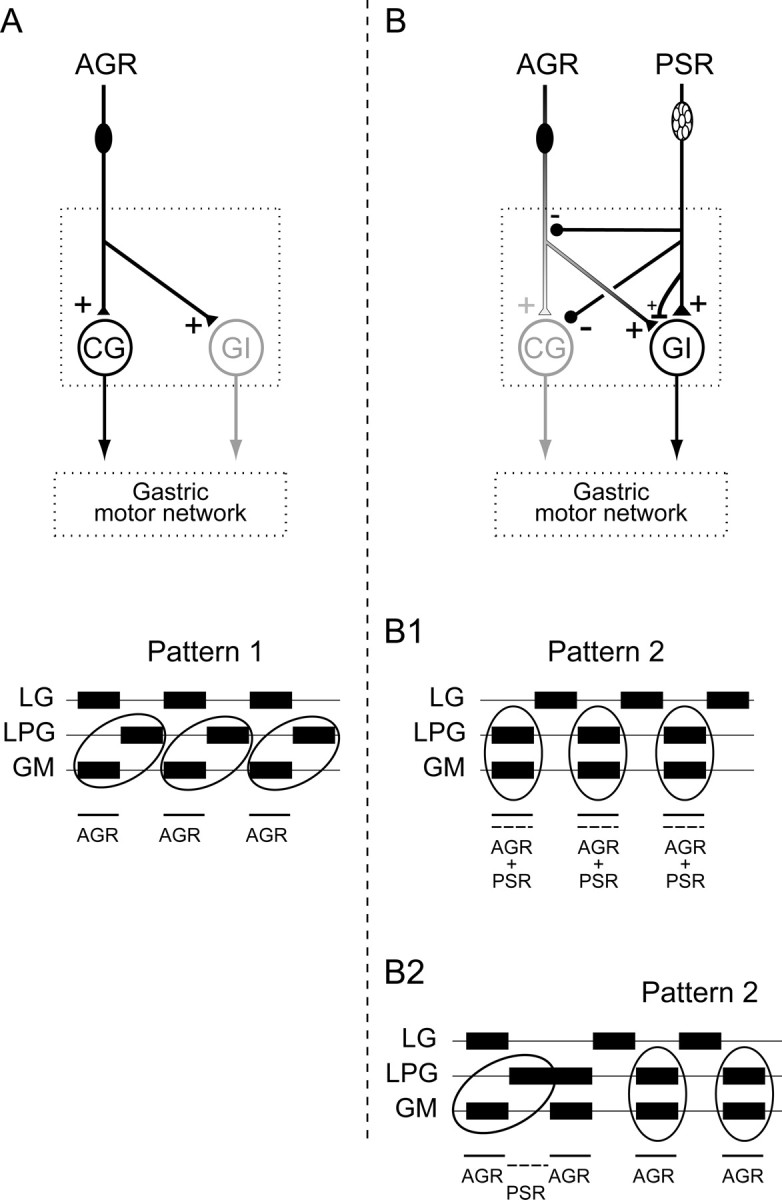
Movement-derived sensory feedback adapts centrally generated motor programs to changing behavioral demands. Motor circuit output may also be shaped by distinct proprioceptive systems with different central actions, although little is known about the integrative processes by which such convergent sensorimotor regulation occurs. Here, we explore the combined actions of two previously identified proprioceptors on the gastric mill motor network in the lobster stomatogastric nervous system. Both mechanoreceptors [anterior gastric receptor (AGR) and posterior stomach receptor (PSR)] access the gastric circuit via the same pair of identified projection interneurons that either excite [commissural gastric (CG)] or inhibit [gastric inhibitor (GI)] different subsets of gastric network neurons. Mechanosensory information from the two receptors is integrated upstream to the gastric circuit at two levels: (1) postsynaptically, where both receptors excite the GI neuron while exerting opposing effects on the CG neuron, and (2) presynaptically, where PSR reduces AGR's excitation of the CG projection neuron. Concomitantly PSR selectively enhances AGR's activation of the GI neuron, possibly also via a presynaptic action. PSR's influences also far outlast its transient synaptic effects, indicating the additional involvement of modulatory processes. Consequently, PSR activation causes parallel input from AGR to be conveyed preferentially via the GI interneuron, resulting in a prolonged switch in the pattern of gastric circuit output. Therefore, via a combination of short- and long-lasting, presynaptic and postsynaptic actions, one proprioceptive system is able to promote its impact on a target motor network by biasing the access of a different sensory system to the same circuit.


Figures
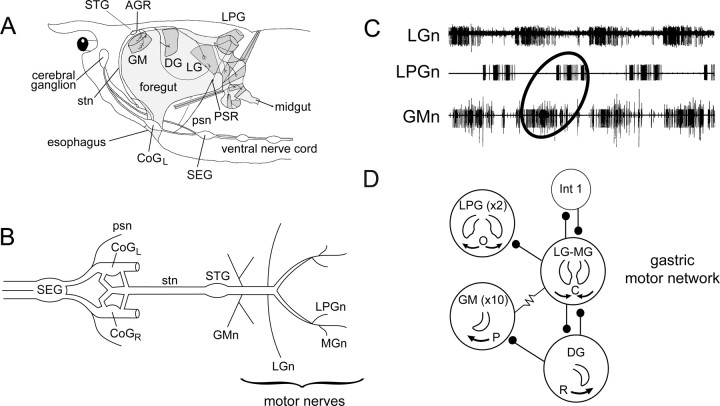
Figure 1.
Figure 1.
The STNS and gastric mill network of the lobster Homarus gammarus. A, Lateral view showing location of the foregut, gastric mill muscles, and STNS in situ. B, Isolated STNS in vitro. The gastric mill motor circuit, including the GM, LG–MG, DG, and LPG motoneurons, is located in the STG, from which their axons project caudally in separate bilateral nerve branches. The STG is connected to the two CoGs and the SEG via the single stn. C, Typical gastric mill output pattern recorded extracellularly from indicated gastric motor nerves (n) in an isolated STNS. GM motoneurons fire in antiphase with LPG motoneurons and in phase with the LG motoneuron. D, Synaptic connectivity of the gastric mill network. Stick and ball symbols, Chemical inhibitory synapses; resistor symbol, electrical coupling. Numbers of neurons of each type are indicated in parentheses, when involving more than a single neuron. Neurons of each functional group are electrically coupled, including the LG–MG neurons. Gastric teeth movements driven by each neuron type is also indicated. GM and DG motoneurons are responsible for protraction (P) and retraction (R) of the medial tooth, whereas LPG and LG–MG neurons drive opening (O) and closing (C) of the lateral teeth. The gastric mill network also contains a single interneuron, Int 1. CoGL, Left CoG. CoGR, Right CoG.
Figure 2.
Figure 2.
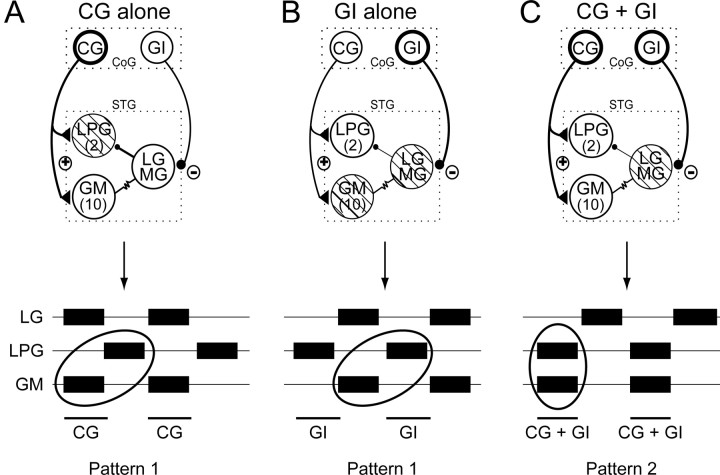
Two different gastric motor patterns elicited in vitro by cyclic activation of the CG and/or GI projection interneurons. Top schematics, Previously identified synaptic relationships between the CG and GI neurons and the gastric network (Combes et al., 1999a). The CG neuron excites the LPG and GM neurons, whereas the GI neuron inhibits the LG–MG neurons. Open circles in each schematic denote motoneuron subtypes that are coactive with the rhythmically stimulated interneuron(s) (indicated with bold connections). Hatched circles indicate motoneurons that fire in antiphase with the stimulated projection neuron(s). Bottom, Motoneuron burst phase relationships in output patterns elicited by activation of either one or both interneurons. A, Cyclic activation of a CG neuron alone generates a type 1 pattern (i.e., with LPG and GM neurons firing in phase opposition; ellipse). B, Cyclic activation of a GI neuron alone also produces a type 1 pattern. C, Simultaneous activation of the CG and GI interneurons drives gastric mill activity in a type 2 pattern in which LPG and GM motoneurons discharge in synchrony with the projection neurons (ellipse). Data are summarized from Combes et al. (1999a).
Figure 3.
Figure 3.
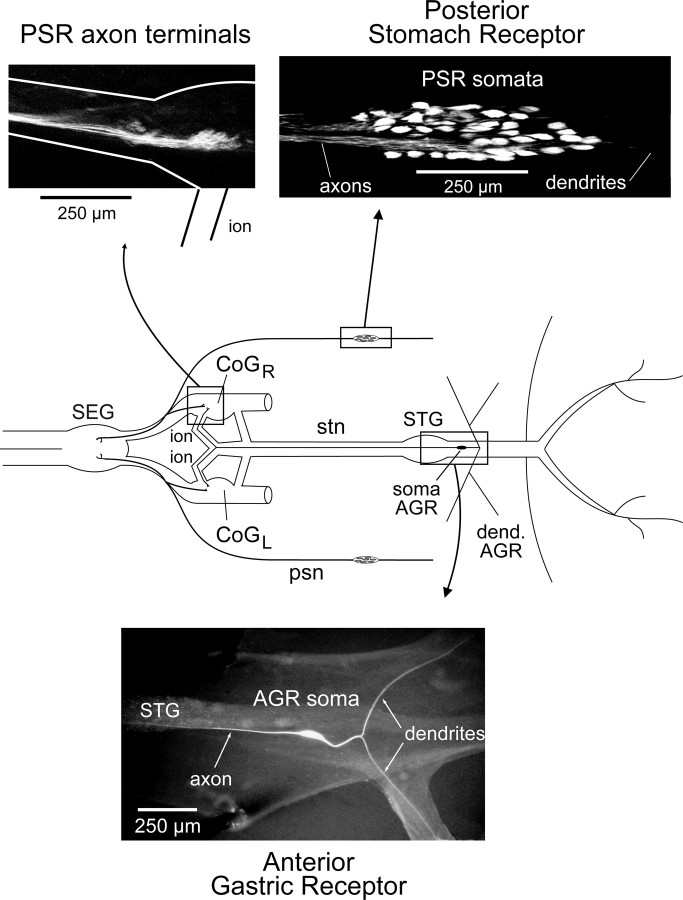
Location and morphology of the PSR and the AGR in the STNS. Top left, Rhodamine-stained terminals of PSR axons in the ipsilateral CoG (see STNS schematic). Branches of PSR axons also terminate in the SEG. Top right, Somata of PSR neurons in the distal region of the psn. Bottom, Lucifer-yellow-injected AGR showing its single bipolar soma, bilateral dendrites, and an ascending axon in the stn, which terminates in the bilateral CoGs. CoGL, Left CoG. CoGR, Right CoG; dend, dendrite.
Figure 4.
Figure 4.
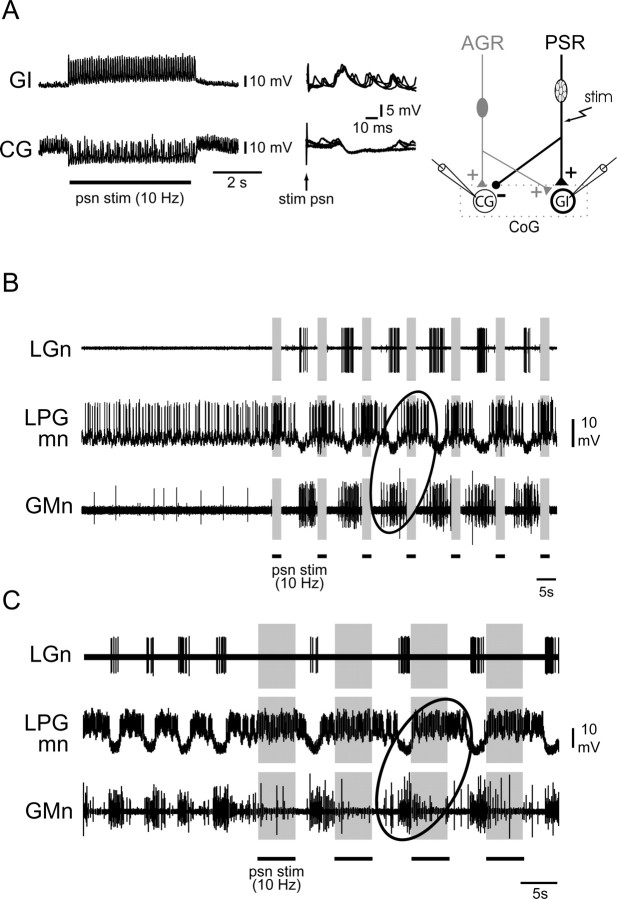
Effects of PSR stimulation (stim) on the GI and CG neurons and on gastric mill network activity. A, Stimulation (10 Hz for 5 s) of a psn excites an intracellularly recorded GI neuron via discrete, constant-latency EPSPs (see 5 superimposed sweeps at top right), whereas a simultaneously recorded CG interneuron in the same CoG was hyperpolarized by discrete IPSPs (see 5 superimposed sweeps at bottom right). These PSR synaptic influences are summarized in the schematic at right, which also includes (in gray) previously identified AGR inputs to the same projection neurons (Combes et al., 1999b). B, Cyclic psn stimulation (3 s train at 10 Hz every 10 s) in the absence of spontaneous gastric rhythmicity elicits a type 1 gastric motor pattern in which GM neurons recorded extracellularly in the corresponding motor nerves (n) and an intracellularly recorded LPG motoneuron (mn) fire alternating bursts (ellipse). C, During spontaneous gastric network rhythmicity, cyclic psn stimulation (5 s trains at 10 Hz every 10 s) prolongs LPG bursts and the ongoing gastric cycle period, and entrains the rhythm without altering LPG and GM antiphase firing (ellipse).
Figure 5.
Figure 5.
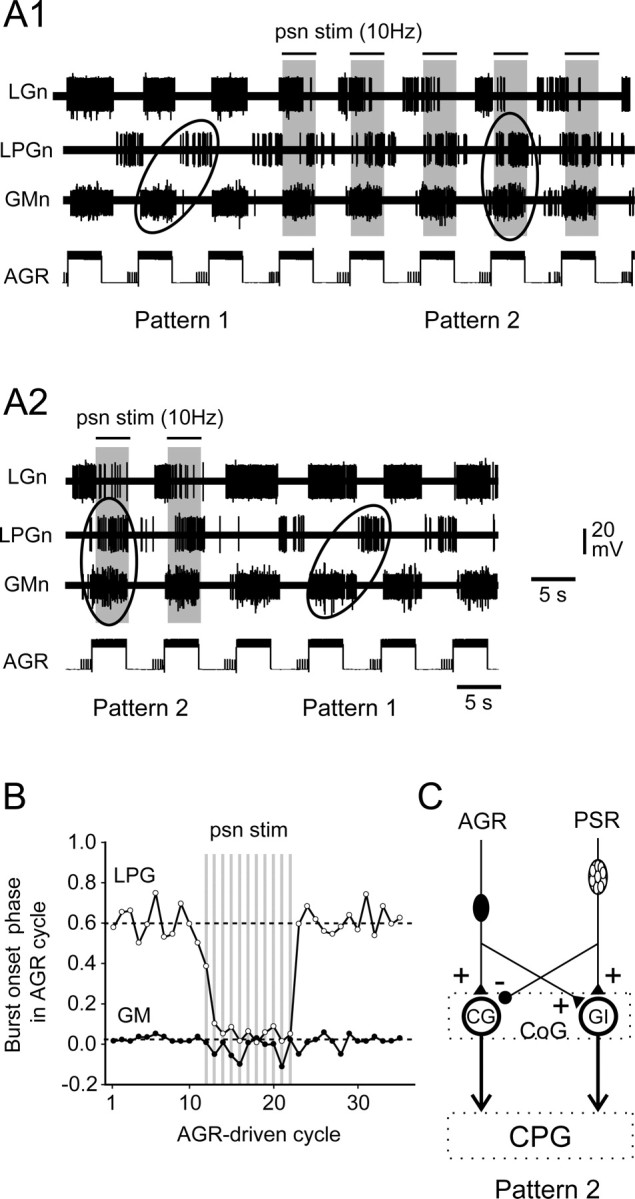
Ability of combined PSR and AGR activation to elicit switching between different patterns of gastric mill output. A1, Cyclic stimulation of AGR by intrasomatic current injection elicited a type 1 gastric motor pattern [in which nerve (n)-recorded LPG and GM motoneurons fired in antiphase]. When psn was conjointly stimulated (indicated by bars above traces) with AGR, gastric activity switched to a type 2 pattern within two to three stimulus cycles. A2, Continuation of recordings in A1. When psn stimulation (stim) ceased, gastric activity driven by AGR alone returned immediately to the type 1 pattern. B, Analysis of the AGR+PSR stimulation sequence in A. Each vertically aligned pair of points indicates the phases of burst onset in the GM (filled circles) and LPG (open circles) motoneurons relative to AGR stimulation onset over 35 successive stimulus cycles. Additional rhythmic PSR stimulation (10 Hz, 8 s per cycle) is indicated by shaded vertical bars. Note the PSR-elicited switch in LPG/GM phase relationships from approximately phase opposition (pattern 1) to same phase (pattern 2). C, Summary schematic of the synaptic actions of costimulated AGR and PSR on the CG and GI projection neurons, which lead to the interneurons being coactivated (in bold) and a resultant switch in motor burst phase relationships from a type 1 to a type 2 pattern.
Figure 6.
Figure 6.
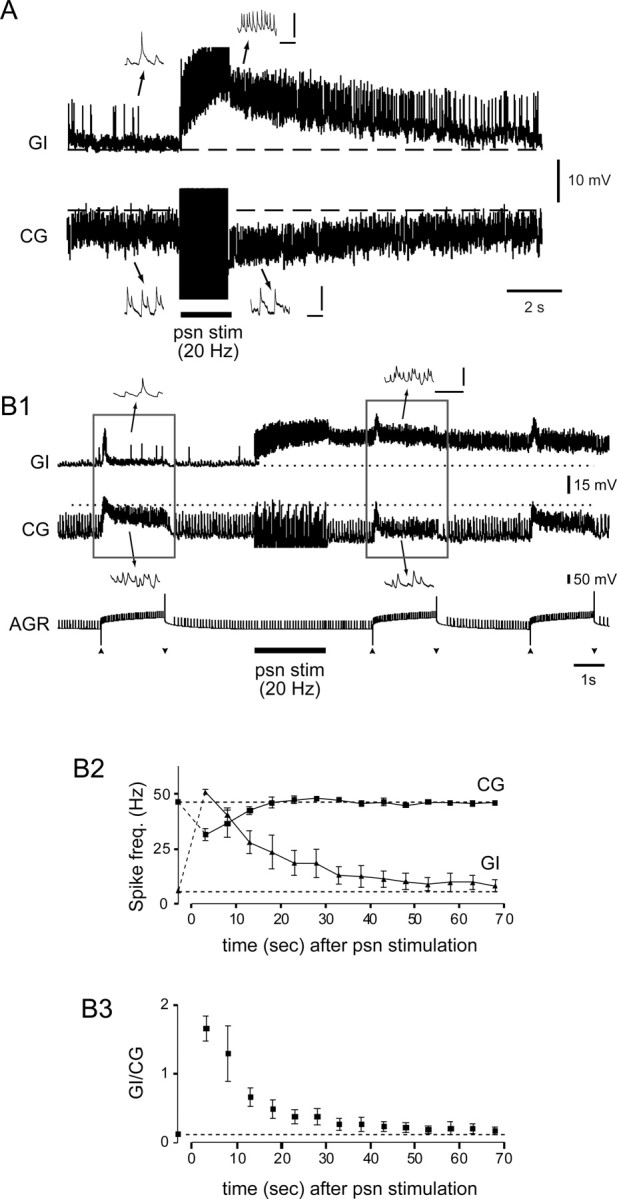
Long-lasting influences of PSR on the GI and CG neurons, and the consequences for input from AGR. A, Prolonged synaptic depolarization and hyperpolarization, respectively, of intracellularly recorded GI and CG neurons in response to a 2 s (20 Hz) psn stimulation (stim). Insets, Expanded time-base samples from positions indicated on the main recordings. B, psn stimulation-evoked changes in responsiveness of the two projection neurons to subsequent AGR activation. B1, Sample recordings from GI and CG during AGR activation (by depolarizing current injection between arrowheads) before and after a single-train (20 Hz) stimulation of psn. AGR's excitation of the interneurons is modulated according the long-lasting psn-evoked excitation and inhibition of GI and CG, respectively. B2, Mean spike frequency (freq.) of GI and CG during successive AGR activations (as in B1) before and after psn stimulation. Before psn stimulation, the CG neuron's mean firing frequency increased to ∼46 Hz (indicated by top dotted line) during AGR activation, whereas GI was only weakly excited (∼6 Hz, bottom dotted line). After psn stimulation, CG was less activated by AGR over the ensuing 15 s, whereas GI was more sensitive to AGR activation for >50 s. B3, As a result of these changes, the balance of firing between the two interneurons (GI vs CG) switched from CG to GI dominance after psn stimulation, with control discharge ratios returning after ∼45 s. A, B1, Insets, Calibration: 10 mV, 100 ms.
Figure 7.
Figure 7.
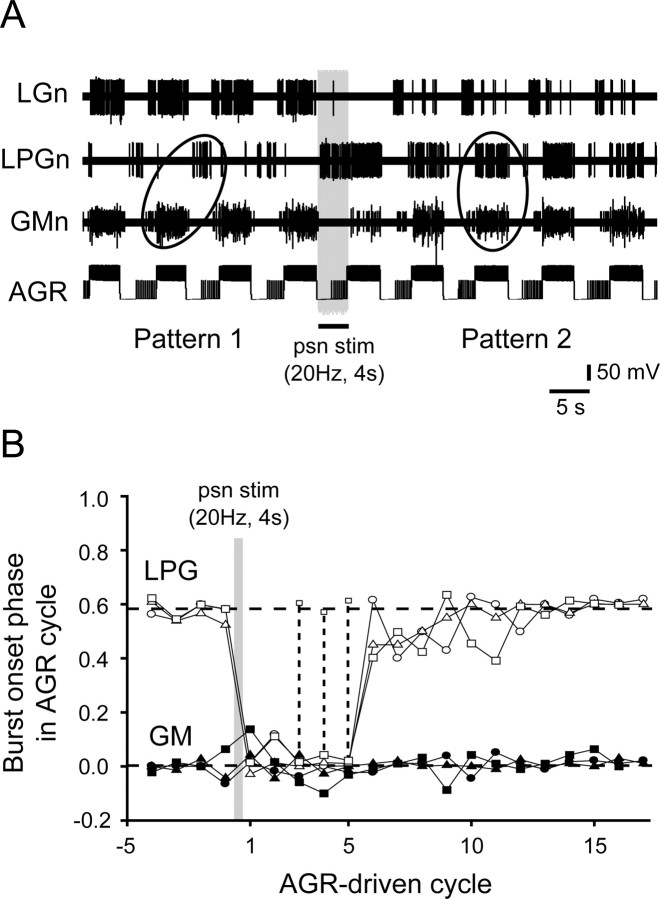
PSR can elicit a long-lasting modification of AGR's action on the gastric mill network. A, Before a single-train psn stimulation (stim), rhythmic AGR stimulation drives a type 1 gastric pattern (left ellipse), whereas after psn stimulation (20 Hz for 4 s), ongoing AGR activation elicits for several cycles a type 2 burst pattern (right ellipse). B, Time course of LPG and GM burst onset phase relationships with cyclic AGR stimulation before (cycles −5 to 0) and after (cycles 1–17) psn stimulation (gray bar). Data are from three trials in the same preparation as in A. Horizontal dotted lines indicate mean phase values for LPG (top) and GM (bottom) burst onsets during AGR stimulation alone. Data points for LPG and GM pairs have the same symbol (open for LPG, filled for GM). Note that in one trial (squares and dashed vertical lines), in the post-psn stimulus period LPG fired transitional double bursts that were both in and out of phase with GM activity before control antiphase activity returned. n, Nerve.
Figure 8.
Figure 8.
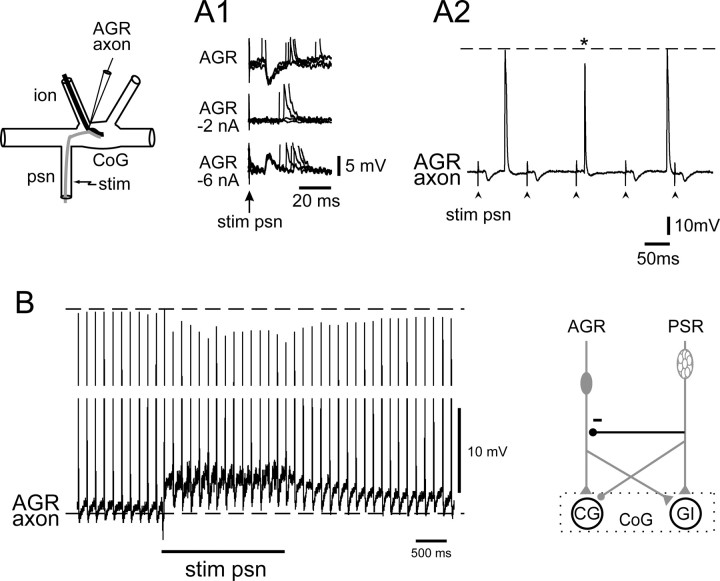
Transient synaptic and modulatory actions of PSR on AGR's axon terminals. A, Intracellular recordings from near to AGR's axon terminals in a CoG (see schematic) showing IPSPs occurring at constant latency after single-pulse psn stimulation (stim), which were diminished and then reversed by tonic AGR hyperpolarizing current injection (A1). A2, These psn-elicited IPSPs (by psn stimulation at arrowheads) attenuated spontaneous AGR when the IPSP and impulse coincided (asterisk). B, Slower time-base recording showing that psn train stimulation (20 Hz, 2 s) caused a sustained membrane depolarization (compare with bottom dotted line) and attenuation of spontaneous spikes (top dotted line) in a recorded AGR axon terminal, with both effects outlasting the psn stimulation. The presynaptic inhibition of AGR by psn is indicated with a stick and ball symbol (in bold) in the schematic at bottom right.
Figure 9.
Figure 9.
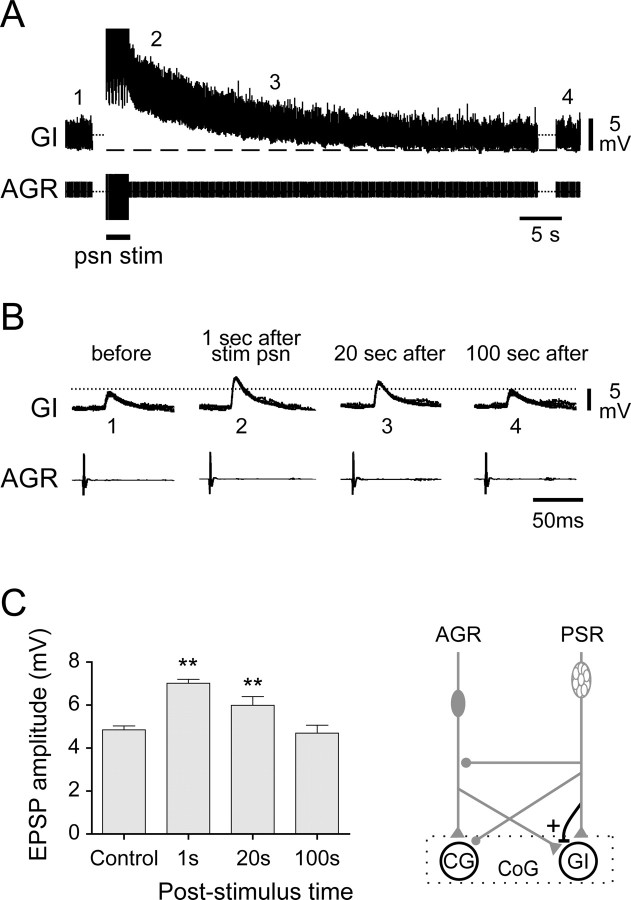
PSR causes long-lasting facilitation of AGR's excitatory input to the GI interneuron. A, A 10 s, 20 Hz psn stimulation (stim) elicited a slowly decaying membrane depolarization of an intracellularly recorded GI neuron. B, Superimposed (5 sweeps per panel) AGR spike-evoked EPSPs (from recording in A, indicated by numbers) showing a long-lasting psn-induced increase in their amplitude. Note that the intracellular traces were aligned horizontally to the same baseline for amplitude comparison. C, Group analysis from three trials showing a significant increase (**p < 0.01, Dunnett's ANOVA posttest) in GI EPSP amplitude that lasted >20 s after psn stimulation. This facilitating action of PSR on the AGR-to-GI synapse is shown (in bold) in the schematic at bottom right.
Figure 10.
Figure 10.
Summary of convergent proprioceptor-mediated regulation of gastric network activity. A, Moderate AGR discharge drives a type 1 gastric pattern principally via excitation of the intercalated CG projection neuron (see also Fig. 2A). B, Coincident AGR and PSR activity excites both the CG and GI projection neurons and elicits a type 2 gastric pattern (B1; see Fig. 5). Because of long-lasting actions of PSR at different presynaptic and postsynaptic loci, moderate AGR input after a recent PSR discharge leads to a prolonged switch to the type 2 gastric pattern (B2; see Fig. 7).

References

    1. Beenhakker MP, Blitz DM, Nusbaum MP. Long-lasting activation of rhythmic neuronal activity by a novel mechanosensory system in the crustacean stomatogastric nervous system. J Neurophysiol. 2004;91:78–91. - PMC - PubMed
    1. Beenhakker MP, DeLong ND, Saideman SR, Nadim F, Nusbaum MP. Proprioceptor regulation of motor circuit activity by presynaptic inhibition of a modulatory projection neuron. J Neurosci. 2005;25:8794–8806. - PMC - PubMed
    1. Beenhakker MP, Kirby MS, Nusbaum MP. Mechanosensory gating of proprioceptor input to modulatory projection neurons. J Neurosci. 2007;27:14308–14316. - PMC - PubMed
    1. Blitz DM, Beenhakker MP, Nusbaum MP. Different sensory systems share projection neurons but elicit distinct motor patterns. J Neurosci. 2004;24:11381–11390. - PMC - PubMed
    1. Burrows M, Laurent G. Synaptic potentials in the central terminals of locust proprioceptive afferents generated by other afferents from the same sense organ. J Neurosci. 1993;13:808–819. - PMC - PubMed

MeSH terms