Review
. 2008 Aug;99(8):1515-22.
doi: 10.1111/j.1349-7006.2008.00854.x.

Intracellular zinc homeostasis and zinc signaling

Affiliations
Review

Intracellular zinc homeostasis and zinc signaling

Masaaki Murakami et al. Cancer Sci. 2008 Aug.

Abstract

Zinc (Zn) is an essential heavy metal that is incorporated into a number of human Zn metalloproteins. Zn plays important roles in nucleic acid metabolism, cell replication, and tissue repair and growth. Zn deficiency is associated with a range of pathological conditions, including impaired immunity, retarded growth, brain development disorders and delayed wound healing. Moreover, many reports have suggested that Zn is involved in cancer development and levels of Zn in serum and malignant tissues of patients with various types of cancer are abnormal. Zn may directly affect tumor cells by regulating gene expression profiles and/or cell viability, both of which are mediated in part by tumor-induced changes in Zn transporter expression. On the other hand, Zn may indirectly influence tumor cells by affecting processes within the cancer microenvironment, including immune responses; the functions and/or activity levels of immune cells that attack tumor cells are influenced by the intracellular Zn concentrations within those cells. In both cases, Zn contributes to intracellular metal homeostasis and/or signal transduction in tumor and immune cells. In this review article, we will summarize the current understanding of the roles of Zn homeostasis and signaling primarily in immune cells, with a discussion of the contributions of these processes to oncogenesis.


Figures
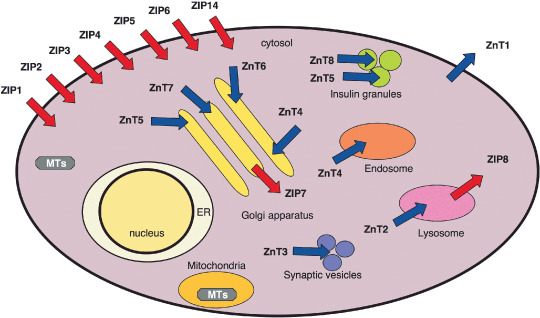
Figure 1
Figure 1
Subcellular localization of zinc (Zn) transporters. Subcellular localization and potential function of members of the ZIP and Zn transporter (ZnT) families are shown based on currently available information.( 92 , 98 , 99 , 100 , 101 , 102 , 103 , 104 ) Predicted directions of Zn mobilization are indicated with arrows. ER, endoplasmic reticulum; MT, metallothionein; MTF‐1, metal‐responsive element‐binding transcription factor‐1.
Figure 2
Figure 2
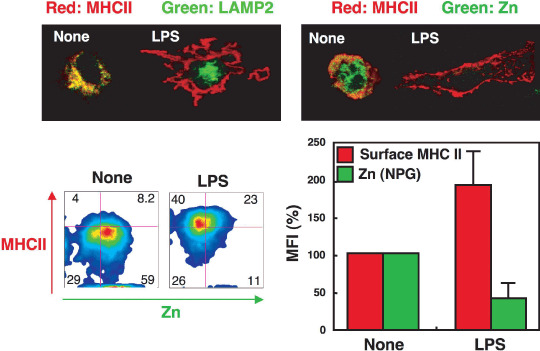
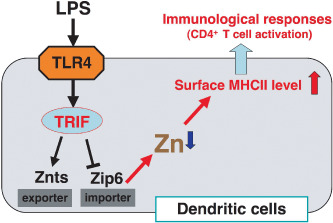
Decreased levels of intracellular free zinc (Zn) in dendritic cells are critical for lipopolysaccharide (LPS)‐mediated CD4+ T‐cell activation. LPS, a component of the Gram‐negative bacterial cell wall, transduces a signal that activates dendritic cells (DC). LPS binds to the TLR4 receptor on DC, resulting in MYD88‐ and TRIF‐mediated signaling. We showed that TRIF‐mediated signaling via TLR4 increased the level of Zn transporter (ZnT) family (Zn exporters) mRNA but decreased the mRNA expression of members of the Zip family (Zn importers), resulting in decreased levels of intracellular free Zn in DC. We also demonstrated that the reduction of the intracellular free Zn concentration in DC is critical for the surface expression of major histocompatibility complex (MHC) class II molecules, which are important for the activation of CD4+ T cells.
Figure 3
Figure 3
Summary of the roles of zinc (Zn) in dendritic cells. LPS, lipopolysaccharide; MHC, major histocompatibility complex.
Figure 4
Figure 4
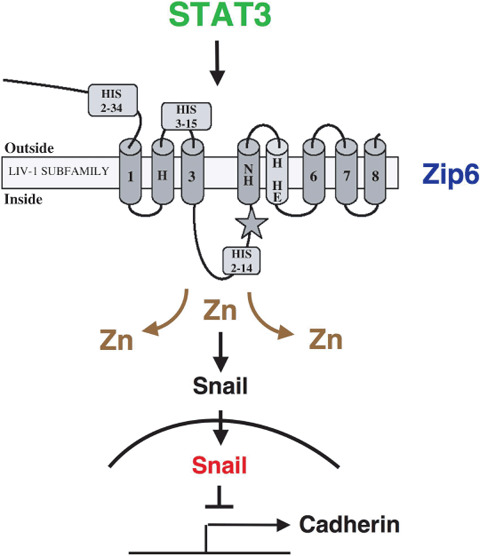
STAT3‐induced movement of organizer cells is dependent on ZIP6 expression. The STAT3–ZIP6 signaling cascade is critically involved in the epithelial–mesenchymal transition of the organizer cells, which is required for the nuclear localization of Snail, a Zn finger (ZnF)‐containing repressor of cadherin expression.
Figure 5
Figure 5
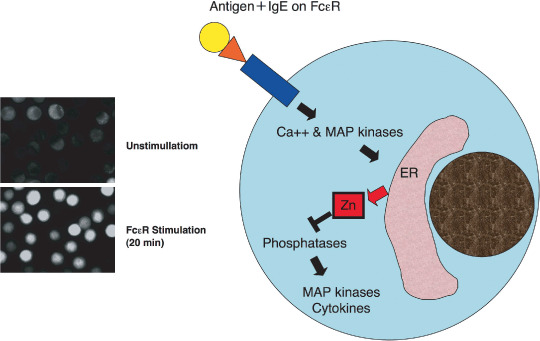
A zinc (Zn) wave is induced by FceRI‐mediated mast cell activation. FceRI stimulation via antigen plus immunoglobulin (Ig)E induces mast cell activation, including degranulation and cytokine production. Intracellular Zn levels, which can be detected using FluoZin‐3, increased within 20 min after FceRI stimulation. We have named this increase the ‘Zn wave’ and showed that these waves are dependent on Ca2+ influx and mitogen‐activated protein (MAP) kinase activation via FceRI stimulation. The Zn wave appears to originate in the endoplasmic reticulum (ER) and suppresses phosphatase activity, which is followed by MAP kinase activation and cytokine expression.
Figure 6
Figure 6
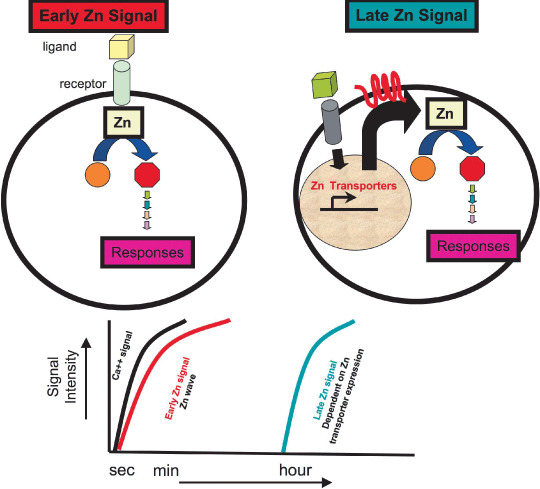
Early and late zinc (Zn) signaling. Intracellular Zn signaling can be classified as early signaling, such as the Zn wave, which is directly induced by extracellular stimuli, and late signaling, which is dependent on transcriptional regulation of Zn transporter expression.

References

    1. Raulin J. Chemical studies on vegetation. Annales des Sci Naturelles 1869; 11: 93–9.
    1. Todd WR, Elvehjem CA, Hart EB. Zinc in the nutrition of the rat. Am J Physiol 1933; 107: 146–56.
    1. Fujii T. Presence of zinc in nucleoli and its possible role in mitosis. Nature 1954; 174: 1108–9. - PubMed
    1. Fujii T, Utida S, Mizuno T. Reaction of starfish spermatozoa to histidine and certain other substances considered in relation to zinc. Nature 1955; 176: 1068–9. - PubMed
    1. Prasad AS, Halsted JA, Nadimi M. Syndrome of iron deficiency anemia, hepatosplenomegaly, hypogonadism, dwarfism and geophagia. Am J Med 1961; 31: 532–46. - PubMed