


Phospholipase A(2), reactive oxygen species, and lipid peroxidation in CNS pathologies
- PMID: 18755070
- PMCID: PMC2920609
- DOI: 10.5483/bmbrep.2008.41.8.560
Phospholipase A(2), reactive oxygen species, and lipid peroxidation in CNS pathologies
Abstract
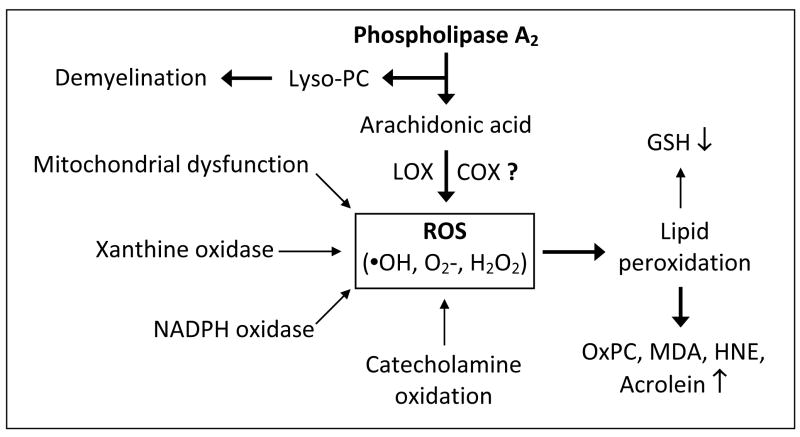
The importance of lipids in cell signaling and tissue physiology is demonstrated by the many CNS pathologies involving deregulated lipid metabolism. One such critical metabolic event is the activation of phospholipase A(2) (PLA(2)), which results in the hydrolysis of membrane phospholipids and the release of free fatty acids, including arachidonic acid, a precursor for essential cell-signaling eicosanoids. Reactive oxygen species (ROS, a product of arachidonic acid metabolism) react with cellular lipids to generate lipid peroxides, which are degraded to reactive aldehydes (oxidized phospholipid, 4-hydroxynonenal, and acrolein) that bind covalently to proteins, thereby altering their function and inducing cellular damage. Dissecting the contribution of PLA(2) to lipid peroxidation in CNS injury and disorders is a challenging proposition due to the multiple forms of PLA(2), the diverse sources of ROS, and the lack of specific PLA(2) inhibitors. In this review, we summarize the role of PLA(2) in CNS pathologies, including stroke, spinal cord injury, Alzheimer's, Parkinson's, Multiple sclerosis-Experimental autoimmune encephalomyelitis and Wallerian degeneration.
Figures

References
-
- Adibhatla RM, Hatcher JF. An odyssey of plaque to stroke: a lipid perspective. 2008. www.athero.org.
-
- Wymann MP, Schneiter R. Lipid signalling in disease. Nat Rev Mol Cell Biol. 2008;9:162–176. - PubMed
-
- Adibhatla RM, Hatcher JF. Phospholipase A2, reactive oxygen species, and lipid peroxidation in cerebral ischemia. Free Radic Biol Med. 2006;40:376–387. - PubMed
