


7-Deaza-6-benzylthioinosine analogues as subversive substrate of Toxoplasma gondii adenosine kinase: activities and selective toxicities
- PMID: 18755159
- PMCID: PMC2581922
- DOI: 10.1016/j.bcp.2008.07.035
7-Deaza-6-benzylthioinosine analogues as subversive substrate of Toxoplasma gondii adenosine kinase: activities and selective toxicities
Abstract
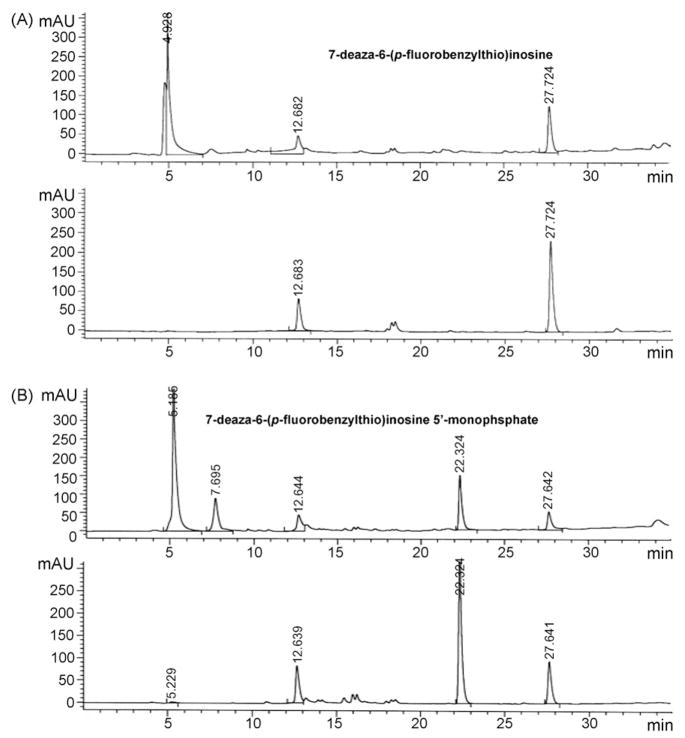
Toxoplasma gondii adenosine kinase (EC.2.7.1.20) is the major route of adenosine metabolism in this parasite. The enzyme is significantly more active than any other enzyme of the purine salvage in T. gondii and has been established as a potential chemotherapeutic target for the treatment of toxoplasmosis. Certain 6-benzylthioinosines act as subversive substrates of T. gondii, but not human, adenosine kinase. Therefore, these compounds are preferentially metabolized to their respective nucleotides and become selectively toxic against the parasites but not their host. Moreover, 7-deazaadenosine (tubercidin) was shown to be an excellent ligand of T. gondii adenosine kinase. Therefore, we synthesized 7-deaza-6-benzylthioinosine, and analogues with various substitutions at their phenyl ring, to increase the binding affinity of the 6-benzylthioinosines to T. gondii adenosine kinase. Indeed, the 7-deaza-6-benzylthioinosine analogues were better ligands of T. gondii adenosine kinase than the parent compounds, 6-benzylthioinosine and 7-deazainosine. Herein, we report the testing of the metabolism of these newly synthesized 7-deaza-6-benzylthioinosines, as well as their efficacy as anti-toxoplasmic agents in cell culture. All the 7-deaza-6-benzylthioinosine analogues were metabolized to their 5'-monophosphate derivatives, albeit to different degrees. These results indicate that these compounds are not only ligands but also substrates of T. gondii adenosine kinase. All the 7-deaza-6-benzylthioinosine analogues showed a selective antitoxoplasmic effect against wild type parasites, but not mutants lacking adenosine kinase. The efficacy of these compounds varied with the position and nature of the substitution on their phenyl ring. Moreover, none of these analogues exhibited host toxicity. The best compounds were 7-deaza-6-(p-methoxybenzylthio)inosine (IC(50)=4.6 microM), 7-deaza-6-(p-methoxycarbonylbenzylthio)inosine (IC(50)=5.0 microM), and 7-deaza-6-(p-cyanobenzylthio)inosine (IC(50)=5.3 microM). These results further confirm that T. gondii adenosine kinase is an excellent target for chemotherapy and that 7-deaza-6-benzylthioinosines are potential antitoxoplasmic agents.
Figures

References
-
- Dubey JP, Beattie CP. Toxoplasmosis of animals and man. Boca Raton, FL: CRC Press; 1988.
-
- Luft BJ. Toxoplasma gondii. In: Walzer PD, Genta RM, editors. Parasitic infections in the compromised host. New York: Marcel Dekker; 1989. pp. 179–279.
-
- Remington JS, McLeond R, Desmonts G. Toxoplasmosis. In: Remington JS, Klein JO, editors. Infectious diseases of the fetus and newborn infant. Philadelphia: W.B. Saunders Company; 1995. pp. 140–267.
-
- Subauste CS, Remington JS. Immunity to Toxoplasma gondii. Curr Opin Immunol. 1993;5:532–7. - PubMed
-
- Wong S, Remington JS. Biology of Toxoplasma gondii. AIDS. 1993;7:299–316. - PubMed
Publication types
MeSH terms
Substances
Grants and funding
LinkOut - more resources
Full Text Sources
Other Literature Sources
Medical
