. 2008 Sep 9;105(36):13292-7.
doi: 10.1073/pnas.0801207105. Epub 2008 Aug 29.

Built-in loops allow versatility in domain-domain interactions: lessons from self-interacting domains

Affiliations

Built-in loops allow versatility in domain-domain interactions: lessons from self-interacting domains

Eyal Akiva et al. Proc Natl Acad Sci U S A. .

Abstract

Compilations of domain-domain interactions based on solved structures suggest there are distinct domain pairs that are used repeatedly in different protein contexts to mediate protein-protein interactions. However, not all protein pairs with the corresponding domains that can potentially mediate interaction do interact, even when they are colocalized and coexpressed. It is conceivable that there are structural and sequence features, below the domain level, that play a role in determining the potential of domains to mediate protein-protein interactions. Here, we discover such features by comparing domains that, on the one hand, mediate homodimerization of proteins and, on the other, occur in different proteins that are documented as monomers. Intriguingly, this comparison uncovered surface loops that can be considered as determinants of the interactions. There are enabling loops, which mediate the domain interactions, and disabling loops that prevent the interactions. The presence of the enabling/disabling loops is consistent with the fulfillment/prevention of the interaction and is highly preserved in evolution. This suggests that, along with the preservation of structural elements that enable interaction, evolution maintains elements intended to prevent unwanted interactions. The enabling and disabling loops discovered in this study have implications in prediction of protein-protein interactions, by pointing to the protein regions that determine the interaction. Our results extend the hierarchy of attributes that collectively establish the modularity of domain-mediated protein-protein interactions.


Conflict of interest statement

The authors declare no conflict of interest.

Figures
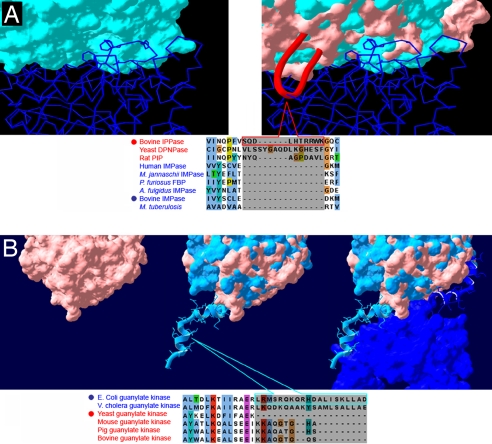
Fig. 1.
Fig. 1.
Examples of enabling and disabling loops. (A) Disabling loop. (Upper) Structural superimposition of homodimeric bovine Inositol monophosphatase and the monomeric bovine Inositol polyphosphate 1-phosphatase. On the left, the two subunits of the homodimer are shown, one as a cyan surface and the other as a blue backbone. On the right, the monomer (pink surface) is superimposed onto the cyan homodimer subunit. A red ribbon represents a disabling loop, protruding out of the pseudointerface of the monomer. Clearly, this loop abolishes the self-interaction of the domain. (Lower) A structure-based MSA of the monomer and the homodimer sequences. Sequences whose structures are shown (Upper) are marked with filled circles. Red and blue accessions represent monomers and homodimers, respectively. The disabling loop is represented by the shaded block in the MSA. (B) Enabling loop. (Upper) Structural superimposition of homodimeric Escherichia coli Guanylate kinase and the monomeric Saccharomyces cerevisiae Guanylate kinase. On the left, only the monomer is shown (pink surface). In the middle, a superimposition is shown of the monomer and one subunit of the homodimer (cyan surface). Note the C-terminal extension that protrudes out of the homodimer subunit. On the right, the second subunit of the homodimer is added (blue surface), mediating the self-interaction of the domain. (Lower) A structure-based MSA between the monomer and the homodimer along with other Guanylate kinases. Colors of protein names and filled circles are as in A. The enabling loop is represented by a shaded block in the MSA. The correspondence between the presence of the loop and the oligomeric state is evident.
Fig. 2.
Fig. 2.
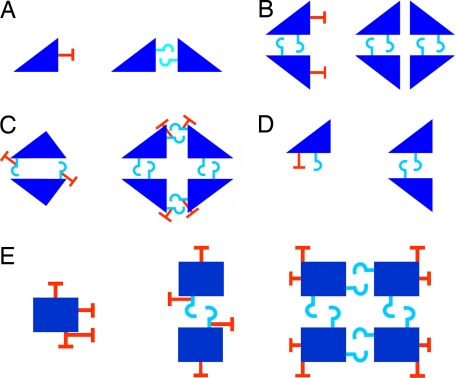
Enabling/disabling loops on the interface determine the interaction potential of a domain. A schematic representation of enabling/disabling loops that play a role in assisting/preventing homo-oligomerization. Subunits are depicted as blue triangles or rectangles. Enabling loops are illustrated as cyan hooks, whereas disabling loops are shown as red “T” signs. For the sake of clarity, not all loops are illustrated. (A) Disabling loops in monomers and enabling loops in homodimers. An illustration of the loops in the Dihydropholate reductase domain, which is present in the monomeric Dihydrofolate reductase from Pneumocystis carinii (PDB ID code: 1S3Y, on the left) and in the homodimeric Dihydrofolate reductase from Bacteriophage T4 (PDB ID code 1JUV, on the right). In the homodimer, self-interaction is mediated by an enabling loop, 1JUV [Y96-P110]. In the monomer, the enabling loop is missing and self-interaction is prevented by a disabling loop, 1S3Y [H135-P136]. (B) Disabling loops in homodimers that prevent homotetramerization. An illustration of the Phosphoglycerate mutase domain, which is present in the homodimeric human Bisphosphoglycerate mutase (PDB ID code: 1T8P, on the left) and in the homotetrameric Phosphoglycerate mutase of Mycobacterium tuberculosis (PDB ID code: 1RII, on the right). One interface is common to both structures, where the interaction is mediated by an enabling loop, 1T8P [I126-R153], 1RII [I127-L149]. The second interface, used by the homotetramer (with no enabling loop) becomes disabled in the homodimer, because of a small disabling loop, 1T8P [C145-D146]. (C) Loops that govern two interfaces and are both enabling and disabling. Illustrated are two human proteins that include the Trypsin domain: the homodimeric Granzyme A (PDB ID code: 1ORF, on the left), and the homotetrameric Tryptase beta-2 (PDB ID code: 1A0L, on the right). A single loop, 1ORF [N180-I191], both enables Granzyme A's homodimerization and disables tetramerization. A single loop, 1A0L [K171-V176] both enables one of the tetramerization interactions and disables the Tryptase dimerization interface. (D) Dominant disabling loops and recessive enabling loops. Illustrated are two proteins of the Metallo-beta-lactamase domain, the homodimeric Ribonuclease Z of Bacillus subtilis (PDB ID code: 1Y44, on the right) and the monomeric Beta-lactamase type II from Bacteroides fragilis (PDB ID code 1HLK, on the left). The homodimer has an enabling loop that mediates the self-interaction of the domain, 1Y44 [A10-A16]. When superimposing it with the monomer, it is apparent that the enabling loop, 1HLK [A44-M51], is present in the pseudointerface, but in the same surface, a disabling loop is also present, 1HLK [D74-Q76]. The overall effect is that the disabling loop interferes with the homodimerization potential of the monomer. (E) Multiple prevention of potential interaction interfaces. Illustrated are proteins with the Histidine acid phosphatase domain. This domain has multiple potential self-interacting interfaces, as displayed by the tetrameric 3-phytase B from Aspergillus niger (PDB ID code 1QFX, on the right), the homodimeric Prostatic acid phosphatase from rat (PDB ID code 1RPA, in the center) and the monomeric 4-phytase from E. coli (PDB ID code: 1DKM, on the left). The potential of three interfaces is abolished in the monomeric protein, because of three disabling loops.
Fig. 3.
Fig. 3.
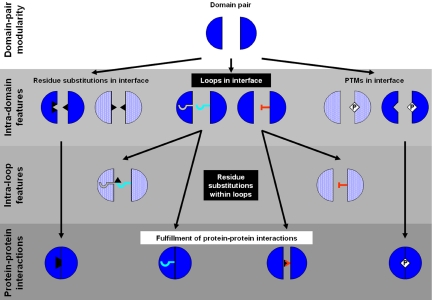
PPI modularity is achieved by a hierarchy of features. Domain pairs are at the top level in the hierarchy of features that yield the modularity of PPIs. Intradomain features define additional levels of modularity below the domain level, including enabling and disabling loops. Intra-loop features may define yet an additional level of modularity. Half circles represent potential interaction domains. Filled shapes represent fulfilled interactions, whereas dotted shapes represent interactions that are not fulfilled. Black triangles stand for sequence variations. PTMs, posttranslational modifications.

References

    1. Sprinzak E, Margalit H. Correlated sequence-signatures as markers of protein-protein interaction. J Mol Biol. 2001;311:681–692. - PubMed
    1. Ng SK, Zhang Z, Tan SH. Integrative approach for computationally inferring protein domain interactions. Bioinformatics. 2003;19:923–929. - PubMed
    1. Deng M, Mehta S, Sun F, Chen T. Inferring domain-domain interactions from protein-protein interactions. Genome Res. 2002;12:1540–1548. - PMC - PubMed
    1. Gomez SM, Noble WS, Rzhetsky A. Learning to predict protein-protein interactions from protein sequences. Bioinformatics. 2003;19:1875–1881. - PubMed
    1. Finn RD, Marshall M, Bateman A. iPfam: Visualization of protein-protein interactions in PDB at domain and amino acid resolutions. Bioinformatics. 2005;21:410–412. - PubMed

Publication types

LinkOut - more resources