


IQ and non-clinical psychotic symptoms in 12-year-olds: results from the ALSPAC birth cohort
- PMID: 18757973
- PMCID: PMC2806573
- DOI: 10.1192/bjp.bp.108.051904
IQ and non-clinical psychotic symptoms in 12-year-olds: results from the ALSPAC birth cohort
Abstract
Background: Non-clinical psychotic symptoms appear common in children, but it is possible that a proportion of reported symptoms result from misinterpretation. There is a well-established association between pre-morbid low IQ score and schizophrenia. Psychosis-like symptoms in children may also be a risk factor for psychotic disorder but their relationship with IQ is unclear.
Aims: To investigate the prevalence, nature and frequency of psychosis-like symptoms in 12-year-old children and study their relationship with IQ.
Method: Longitudinal study using the Avon Longitudinal Study of Parents and Children (ALSPAC) birth cohort. A total of 6455 children completed screening questions for 12 psychotic symptoms followed by a semi-structured clinical assessment. IQ was assessed at 8 years of age using the Wechsler Intelligence Scale for Children (3rd UK edition).
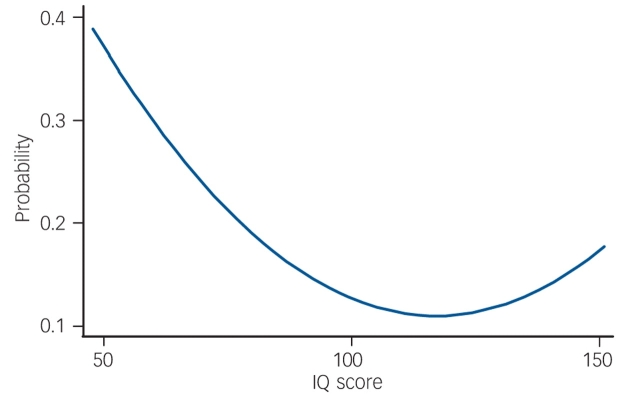
Results: The 6-month period prevalence for one or more symptoms was 13.7% (95% CI 12.8-14.5). After adjustment for confounding variables, there was a non-linear association between IQ score and psychosis-like symptoms, such that only those with below average IQ score had an increased risk of reporting such symptoms.
Conclusions: Non-clinical psychotic symptoms occur in a significant proportion of 12-year-olds. Symptoms are associated with low IQ and also less strongly with a high IQ score. The pattern of association with IQ differs from that observed in schizophrenia.
Figures
References
-
- Bijl R, Ravelli A, van Zessen G. Prevalence of psychiatric disorder in the general population: results of the Netherlands Mental Health Survey and Incidence Study (NEMESIS). Soc Psychiatry Psychiatr Epidemiol 1998; 33: 587–95. - PubMed
-
- Jenkins R, Bebbington P, Brugha T, Farrell M, Gill B, Lewis G, Meltzer H, Petticrew M. The National Psychiatric Morbidity Surveys of Great Britain – strategy and methods. Int Rev Psychiatry 2003; 15: 5–13. - PubMed
-
- Kendler KS, Gallagher TJ, Abelson JM, Kessler RC. Lifetime prevalence, demographic risk factors, and diagnostic validity of nonaffective psychosis as assessed in a US community sample. The National Comorbidity Survey. Arch Gen Psychiatry 1996; 53: 1022–31. - PubMed
-
- Kessler RC, McGonagle KA, Zhao S, Nelson CB, Hughes M, Eshleman S, Wittchen HU, Kendler KS. Lifetime and 12-month prevalence of DSM-III-R psychiatric disorders in the United States. Results from the National Comorbidity Survey. Arch Gen Psychiatry 1994; 51: 8–19. - PubMed
-
- Offord D, Boyle M, Campbell D, Goering P, Racine Y. One-year prevalence of psychiatric disorder in Ontarians 15 to 64 years of age. Can J Psychiatry 1996; 41: 559–63. - PubMed
Publication types
MeSH terms
Grants and funding
LinkOut - more resources
Full Text Sources
Medical
