. 2009 Mar;457(5):1079-91.
doi: 10.1007/s00424-008-0579-1. Epub 2008 Aug 29.

Defective jejunal and colonic salt absorption and alteredNa(+)/H (+) exchanger 3 (NHE3) activity in NHE regulatory factor 1 (NHERF1) adaptor protein-deficient mice

Affiliations

Defective jejunal and colonic salt absorption and alteredNa(+)/H (+) exchanger 3 (NHE3) activity in NHE regulatory factor 1 (NHERF1) adaptor protein-deficient mice

N Broere et al. Pflugers Arch. 2009 Mar.

Abstract

We investigated the role of the Na(+)/H(+) exchanger regulatory factor 1 (NHERF1) on intestinal salt and water absorption, brush border membrane (BBM) morphology, and on the NHE3 mRNA expression, protein abundance, and transport activity in the murine intestine. NHERF1-deficient mice displayed reduced jejunal fluid absorption in vivo, as well as an attenuated in vitro Na(+) absorption in isolated jejunal and colonic, but not of ileal, mucosa. However, cAMP-mediated inhibition of both parameters remained intact. Acid-activated NHE3 transport rate was reduced in surface colonocytes, while its inhibition by cAMP and cGMP was normal. Immunodetection of NHE3 revealed normal NHE3 localization in the BBM of NHERF1 null mice, but NHE3 abundance, as measured by Western blot, was significantly reduced in isolated BBM from the small and large intestines. Furthermore, the microvilli in the proximal colon, but not in the small intestine, were significantly shorter in NHERF1 null mice. Additional knockout of PDZK1 (NHERF3), another member of the NHERF family of adaptor proteins, which binds to both NHE3 and NHERF1, further reduced basal NHE3 activity and caused complete loss of cAMP-mediated NHE3 inhibition. An activator of the exchange protein activated by cAMP (EPAC) had no effect on jejunal fluid absorption in vivo, but slightly inhibited NHE3 activity in surface colonocytes in vitro. In conclusion, NHERF1 has segment-specific effects on intestinal salt absorption, NHE3 transport rates, and NHE3 membrane abundance without affecting mRNA levels. However, unlike PDZK1, NHERF1 is not required for NHE3 regulation by cyclic nucleotides.


Figures
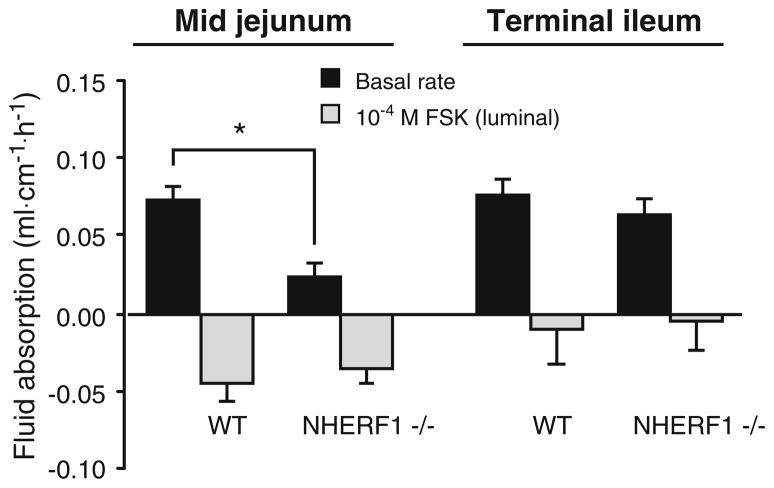
Fig. 1
Fig. 1
Fluid transport in the basal state and after FSK stimulation in the jejunum and ileum of anesthetized NHERF1+/+ and NHERF1−/−mice in vivo. Approximately 5 cm of jejunum (left) or ileum (right) was perfused for 30 min and the amount of fluid absorbed was measured at the end of the experiment. Positive numbers indicate that fluid was absorbed and negative numbers denote secretion. The fluid absorption rate in the basal state in NHERF1 null mice was significantly reduced in the jejunum, but not in the ileum (black bars, * p<0.05). In addition, the change in jejunal fluid transport from absorption to secretion was significantly less in the NHERF1-deficient mice than the WT mice (gray bars). Data represent values from five independent experiments and are expressed as mean±SE
Fig. 2
Fig. 2
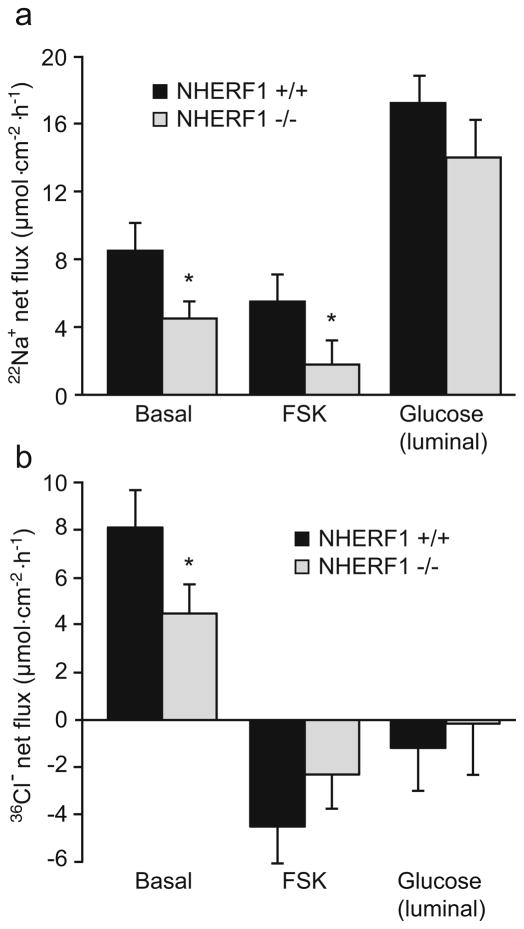
Net 22Na+ (a) and 36Cl (b) fluxes in isolated NHERF1+/+ and NHERF1−/− midjejunal mucosa. Fluxes were calculated by subtraction of the individual serosal to mucosal flux values from the mucosal to serosal fluxes for each paired tissue sample as determined in NHERF1+/+ (black bars) and NHERF1−/− mice (gray bars). Measurements were performed in the basal state and after the addition of 10−5 M FSK or 25 mM glucose, as indicated. Basal as well as FSK-inhibited Na+ absorption was reduced in NHERF1−/− mice (*p<0.05), but the relative inhibition by FSK was similar. The response to 25 mM luminal glucose, added to stimulate the Na+–glucose cotransporter, was similar (n=9). The net 36Cl flux was reduced in the basal state of NHERF1−/− jejunum, and the effect of FSK on the flux change was diminished. Isc values are given in the text (n=8)
Fig. 3
Fig. 3
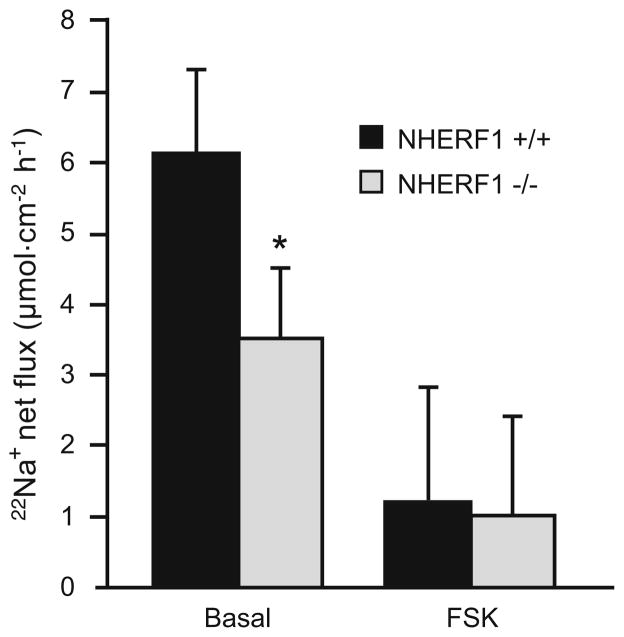
Net 22Na+ flux in isolated NHERF1+/+ and NHERF1−/−proximal colonic mucosa. The net 22Na+ flux in colonic mucosa from NHERF1−/− mice (gray bars) was significantly reduced compared with NHERF1+/+ littermates (black bars; *p<0.05); 10−5 M FSK in the serosal compartment reduced the absorption in both NHERF1+/+ and NHERF1−/− mucosa (n=9)
Fig. 4
Fig. 4
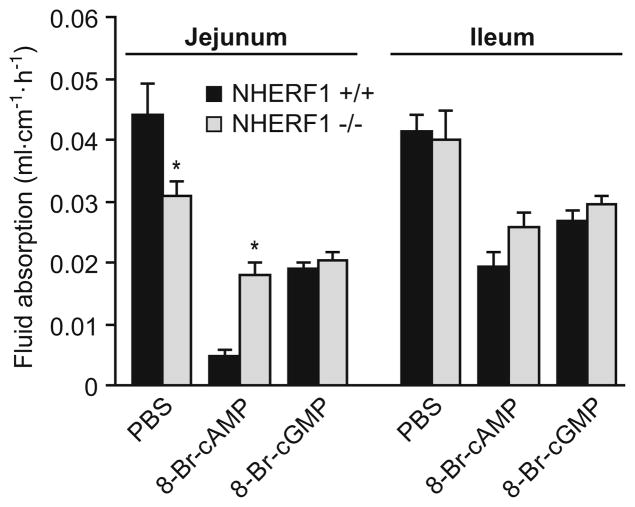
Closed loop experiments confirm segmental differences in absorptive rates in NHERF1+/+ and NHERF1−/− mice. Fluid absorption was measured simultaneously in closed intestinal loops from the jejunum and ileum of the same mouse. In the jejunum, but not in the ileum, fluid absorption was reduced in the NHERF1-deficient mice, and the inhibition of absorption by the cAMP analog was attenuated. n=8; *p<0.05
Fig. 5
Fig. 5
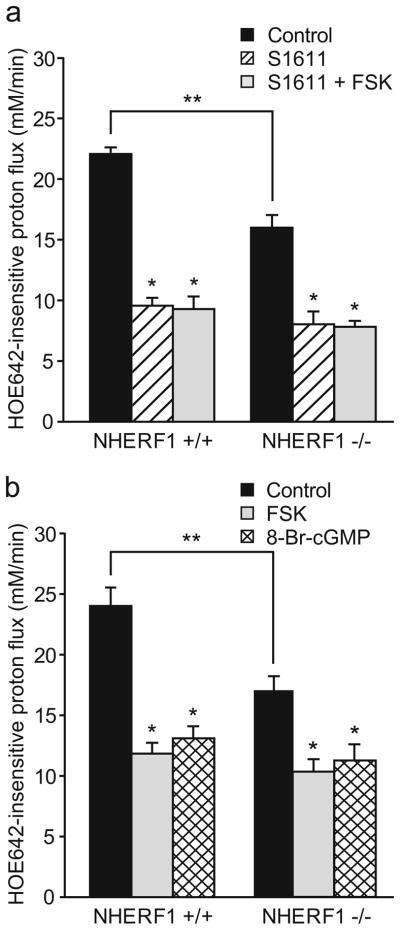
Fluorometric assessment of NHE3 activity in surface enterocytes. The HOE642-insensitive, Na+-dependent acid-activated proton flux was measured in BCECF-loaded cells of the cryptal opening from isolated colonic crypts of NHERF1+/+ and NHERF1−/− mice. a In NHERF1−/−surface enterocytes, the HOE642-insensitive proton flux was significantly reduced (**p<0.05). Furthermore, this significant reduction of the HOE642-insensitive, Na+-dependent, acid-activated proton flux rates was observed in the absence but not the presence of 10 μM S1611 (*p<0.05), indicating a reduction of NHE3 activity. In the presence of S1611, FSK did not exert an additional inhibitory effect, indicating that the inhibitory effect of FSK on the proton flux was due to NHE3 inhibition (n=6). b Both 10−5 M FSK and 2×10⁻⁴ M 8-Br-cGMP significantly inhibited acid-activated proton efflux rates in NHERF1+/+ and NHERF1−/− colonocytes (*p<0.05 vs. control; n=6)
Fig. 6
Fig. 6
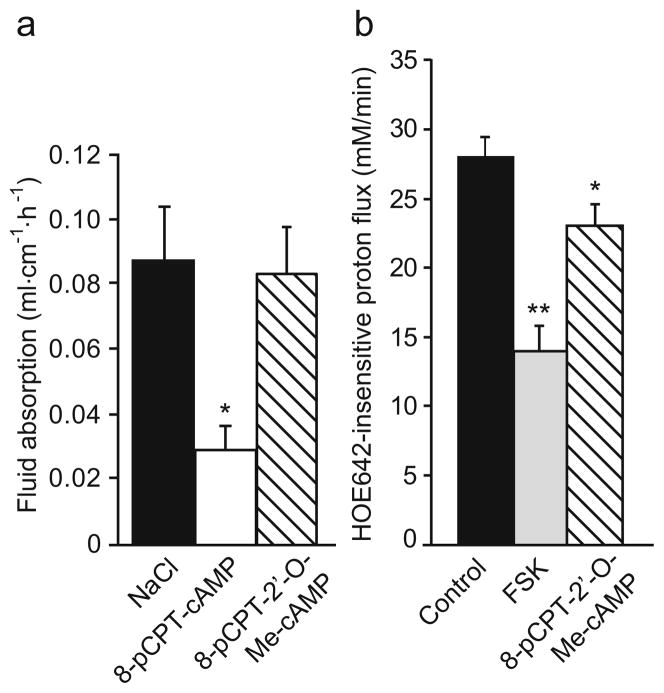
Effect of EPAC activation on jejunal fluid absorption and surface colonocyte NHE3 activity in WT mice. a Whereas 200 μM 8-pCPT-cAMP caused a significant inhibition of jejunal fluid absorption (*p<0.05), the same concentration of the structurally related selective EPAC activator 8-pCPT-2′-O-Me-cAMP had no effect (n=5). b In surface colonocytes, 100 μM 8-pCPT-2′-O-Me-cAMP had a small but significant inhibitory effect on the proton flux (*p<0.05), but full activation of adenylate cyclase by FSK caused a much more pronounced inhibition (**p<0.05; n=6)
Fig. 7
Fig. 7
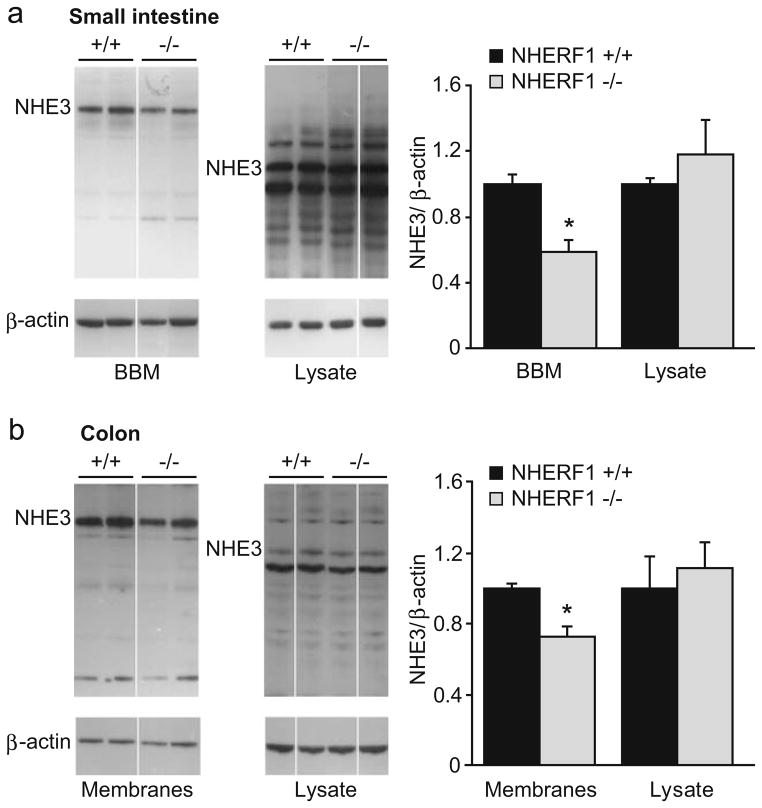
Western blot analysis of NHE3 protein in the BBM and the enterocyte lysate from small and large intestine of NHERF1+/+ and NHERF1−/−mice. a NHE3 protein abundance was significantly reduced in BBM preparations from the small intestine from NHERF1−/−mice (gray bars, n=11) compared with WT littermates (black bars, n=19, *p<0.05), whereas no difference was seen in the enterocyte lysates (n=7). Representative examples of Western blots are shown at the left and the average intensities of NHE3 (relative to β-actin) are shown in the bar graph. b Similar results were obtained in the colon (n=4–6)
Fig. 8
Fig. 8
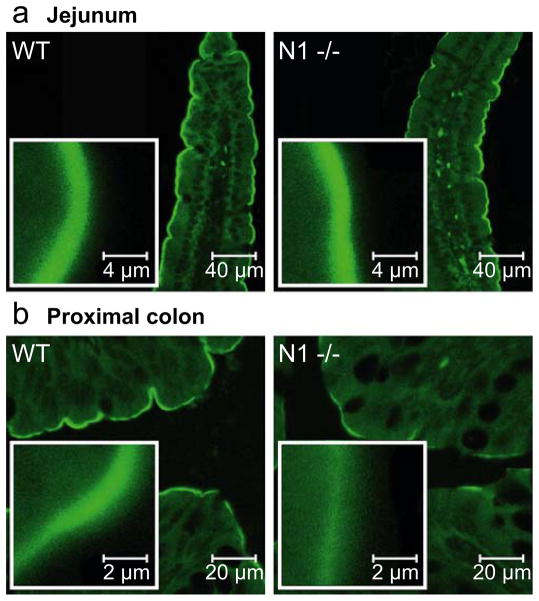
Immunohistochemical NHE3 staining reveals normal localization of NHE3 in jejunal and colonic apical membrane of NHERF1−/−mice. The NHE3 localization at the apical border of the jejunum (a) and colon (b) was qualitatively similar in WT (left panels) and NHERF1−/− (right panels) mice with considerable variability in the signal intensity within each group of mice. Images are representative examples from five independent experiments using tissue from three different mouse couples. Inserts show a ×10 magnification of a part from the image shown in the larger panels
Fig. 9
Fig. 9
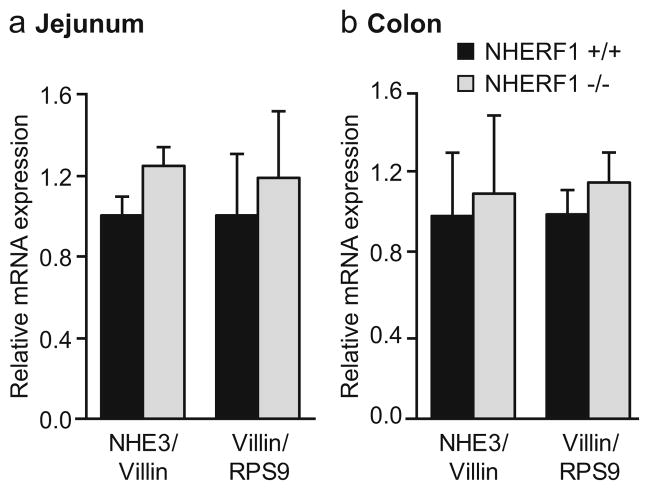
Expression of NHE3 and villin mRNA determined by quantitative RT-PCR. No changes in NHE3 mRNA expression levels (relative to the structural brush border protein villin) were observed between NHERF1 +/+ and NHERF1−/− in the small (a) and large (b) intestine. In addition, no changes in villin expression levels (relative to the ribosomal protein RPS9) were observed in NHERF1−/− mice compared with WT mice. Data represent average values from three separate measurements in three pairs of NHERF1+/+ and NHERF1−/−mice. The expression levels in the NHERF1−/− tissues are relative to the WT expression set at 1
Fig. 10
Fig. 10
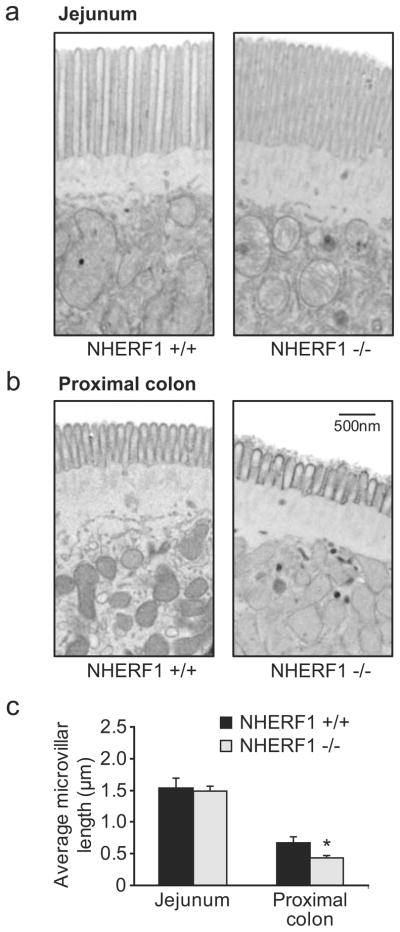
Reduced microvillar length in the colon but not in the jejunum of NHERF1 null mice. a The ultrastructure of jejunal enterocytes from NHERF1 null mice and WT controls was indistinguishable. b In contrast, the microvilli from colonic enterocytes from NHERF1-deficient mice (right panel) were significantly shortened. Images are representative examples of sections made from three age-and sex-matched mice in each group
Fig. 11
Fig. 11
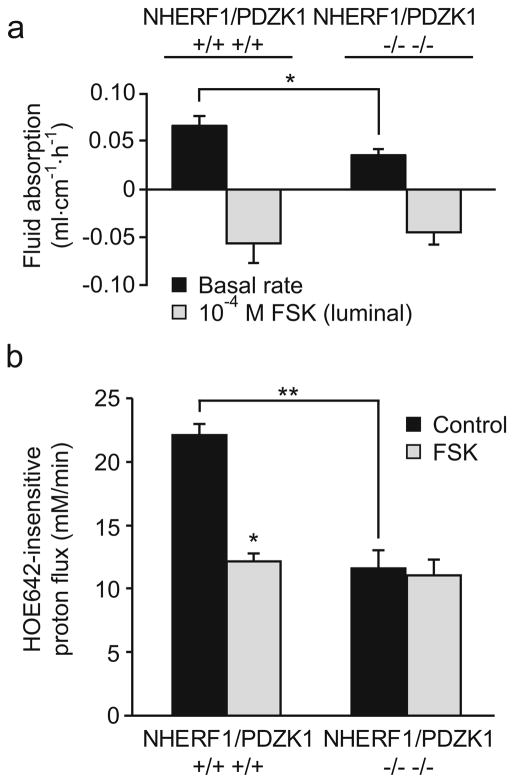
In vivo jejunal fluid movement and NHE3 activity in surface colonocytes in NHERF1/PDZK1 double-deficient mice. a Fluid absorption under basal conditions (black bars) and in the presence of FSK (gray bars) was determined in NHERF1/PDZK1−/− jejunum. The reduced basal fluid absorption (p<0.05) and the reduced response to FSK was similar to what was observed in the NHERF1−/− jejunum as shown in Fig. 1a (n=5). b In contrast, the reduction of the basal acid-activated NHE3 transport rate (black bars) in colon surface enterocytes was significantly larger (**p<0.05) in NHERF1/PDZK1 double-deficient mice than in NHERF1-deficient mice (see Fig. 5). Furthermore, inhibition by FSK was completely abrogated (n=6)

References

    1. Bachmann O, Riederer B, Rossmann H, Groos S, Schultheis PJ, Shull GE, Gregor M, Manns MP, Seidler U. The Na+/H+ exchanger isoform 2 is the predominant NHE isoform in murine colonic crypts and its lack causes NHE3 upregulation. Am J Physiol Gastrointest Liver Physiol. 2004;287:G125–G133. - PubMed
    1. Bachmann O, Rossmann H, Berger UV, Colledge WH, Ratcliff R, Evans MJ, Gregor M, Seidler U. cAMP-mediated regulation of murine intestinal/pancreatic Na+/HCO3− cotransporter subtype pNBC1. Am J Physiol Gastrointest Liver Physiol. 2003;284:G37–G45. - PubMed
    1. Bachmann O, Wuchner K, Rossmann H, Leipziger J, Osikowska B, Colledge WH, Ratcliff R, Evans MJ, Gregor M, Seidler U. Expression and regulation of the Na+–K+–2Cl− cotrans-porter NKCC1 in the normal and CFTR-deficient murine colon. J Physiol. 2003;549:525–536. - PMC - PubMed
    1. Boyarsky G, Ganz MB, Sterzel RB, Boron WF. pH regulation in single glomerular mesangial cells. I. Acid extrusion in absence and presence of HCO3−. Am J Physiol. 1988;255:C844–C856. - PubMed
    1. Broere N, Hillesheim J, Tuo B, Jorna H, Houtsmuller AB, Shenolikar S, Weinman EJ, Donowitz M, Seidler U, de Jonge HR, Hogema BM. Cystic fibrosis transmembrane conductance regulator activation is reduced in the small intestine of Na+/H+ exchanger 3 regulatory factor 1 (NHERF-1) but not NHERF-2-deficient mice. J Biol Chem. 2007;282:37575–37584. - PubMed

Publication types

LinkOut - more resources