


Review
doi: 10.1007/s10741-008-9103-0.
Epub 2008 Aug 29.
Sleep-disordered breathing in patients with decompensated heart failure
Affiliations
- PMID: 18758944
- PMCID: PMC2698948
- DOI: 10.1007/s10741-008-9103-0
Item in Clipboard
Review
Sleep-disordered breathing in patients with decompensated heart failure
Heart Fail Rev.
2009 Sep.
Abstract
Sleep-disordered breathing (SDB) has a higher prevalence in patients with heart failure than in the general middle-aged population. Obstructive sleep apnea (OSA), one of the forms of SBD, promotes poorly controlled hypertension, coronary events, and atrial fibrillation events that can lead to acutely decompensated heart failure (ADHF), and evidence suggests that untreated OSA increases mortality in patients with heart failure. Cheyne-Stokes respiration and central sleep apnea (CSA) have long been associated with heart failure and, in many patients, can coexist with OSA. In this article, we propose a systematic approach to diagnose and treat OSA in patients with ADHF based on current evidence.
Figures
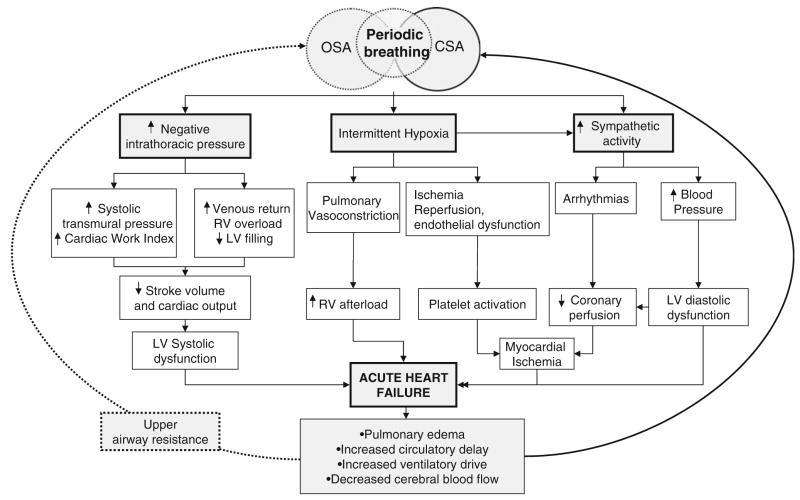
The reciprocal relationship between SDB and acute heart failure syndrome. OSA: obstructive sleep apnea; CSA: central sleep apnea; RV: right ventricle; LV: left ventricle; ↑: increased; ↓: decreased
References
-
- Shahar E, et al. Sleep-disordered breathing and cardiovascular disease: cross-sectional results of the Sleep Heart Health Study. Am J Respir Crit Care Med. 2001;163(1):19–25. - PubMed
-
- Parker JD, et al. Acute and chronic effects of airway obstruction on canine left ventricular performance. Am J Respir Crit Care Med. 1999;160(6):1888–1896. - PubMed
-
- Marin JM, et al. Long-term cardiovascular outcomes in men with obstructive sleep apnoea-hypopnoea with or without treatment with continuous positive airway pressure: an observational study. Lancet. 2005;365(9464):1046–1053. - PubMed
Publication types
MeSH terms
Grants and funding
LinkOut - more resources
Full Text Sources
Medical
