


Review
doi: 10.1007/s10741-008-9101-2.
Epub 2008 Aug 29.
OSA: the new cardiovascular disease: part II: Overview of cardiovascular diseases associated with obstructive sleep apnea
Affiliations
- PMID: 18758946
- PMCID: PMC2698954
- DOI: 10.1007/s10741-008-9101-2
Item in Clipboard
Review
OSA: the new cardiovascular disease: part II: Overview of cardiovascular diseases associated with obstructive sleep apnea
Heart Fail Rev.
2009 Sep.
Abstract
Obstructive sleep apnea (OSA), present in 5-15% of adults, is strongly associated with the incidence and poor outcome of hypertension, coronary artery disease, arrhythmia, heart failure, and stroke. Treatment of OSA completely reverses its cardiovascular consequences. In this review, we discuss the clinical evidence for the strong association between OSA and cardiovascular disease and present an argument for approaching OSA as a cardiovascular disease. We particularly focus on the causative relationship between OSA and hypertension, and on the increasingly recognized relationship between OSA and heart failure.
Figures
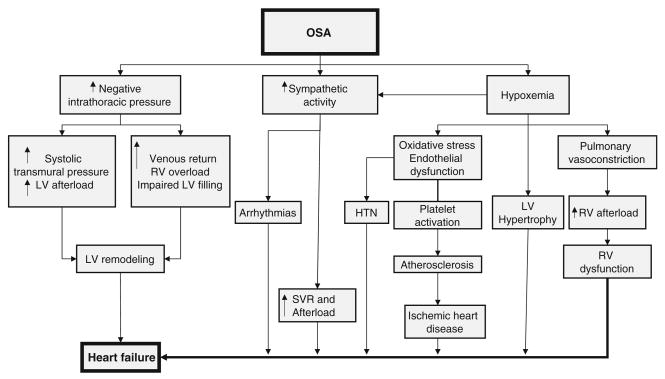
Chronic cardiovascular consequences of OSA; LV = left ventricle, RV = right ventricle, SVR = systemic vascular resistance, ↑ = increased
References
-
- Center for Disease Control and Prevention. N.C.f.h.S.; U.D.o.H.a.H. Services. Health. National Health Interview Survey: US Census; 2006.
-
- Marin JM, et al. Long-term cardiovascular outcomes in men with obstructive sleep apnoea-hypopnoea with or without treatment with continuous positive airway pressure: an observational study. Lancet. 2005;365(9464):1046–1053. - PubMed
Publication types
MeSH terms
Grants and funding
LinkOut - more resources
Full Text Sources
Medical
