


Effect of therapeutic exercise for hip osteoarthritis pain: results of a meta-analysis
- PMID: 18759315
- PMCID: PMC2758534
- DOI: 10.1002/art.24010
Effect of therapeutic exercise for hip osteoarthritis pain: results of a meta-analysis
Abstract
Objective: Recommendations for lower extremity osteoarthritis (OA) and exercise have been primarily based on knee studies. To provide more targeted recommendations for the hip, we gathered evidence for the efficacy of exercise for hip OA from randomized controlled trials.
Methods: A bibliographic search identified trials that were randomized, controlled, completed by >or=60% of subjects, and involved an exercise group (strengthening and/or aerobic) versus a non exercise control group for pain relief in hip OA. Two reviewers independently performed the data extraction and contacted the authors when necessary. Effect sizes (ES) of treatment versus control and the I(2) statistic to assess heterogeneity across trials were calculated. Trial data were combined using a random-effects meta-analysis.
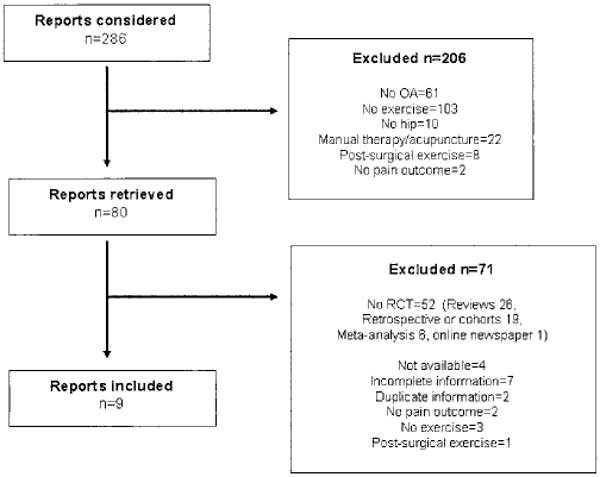
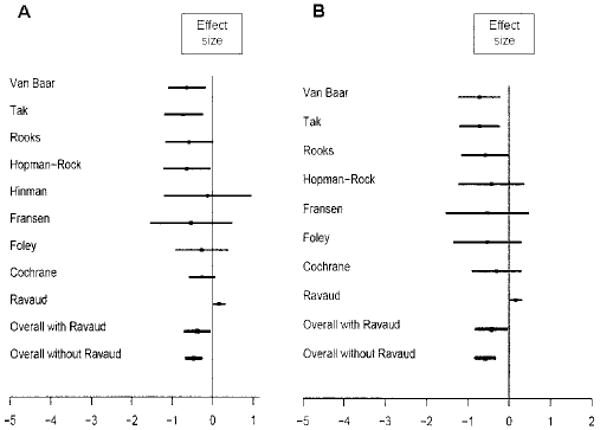
Results: Nine trials met the inclusion criteria (1,234 subjects), 7 of which combined hip and knee OA; therefore, we contacted the authors who provided the data on hip OA patients. In comparing exercise treatment versus control, we found a beneficial effect of exercise with an ES of -0.38 (95% confidence interval [95% CI] -0.68, -0.08; P = 0.01), but with high heterogeneity (I(2) = 75%) among trials. Heterogeneity was caused by 1 trial consisting of an exercise intervention that was not administered in person. Removing this study left 8 trials (n = 493) with similar exercise strategy (specialized hands-on exercise training, all of which included at least some element of muscle strengthening), and demonstrated exercise benefit with an ES of -0.46 (95% CI -0.64, -0.28; P < 0.0001).
Conclusion: Therapeutic exercise, especially with an element of strengthening, is an efficacious treatment for hip OA.
Figures
Comment in
-
Review: exercise helps relieve pain in patients with hip osteoarthritis.Evid Based Med. 2009 Apr;14(2):41. doi: 10.1136/ebm.14.2.41. Evid Based Med. 2009. PMID: 19332597 No abstract available.
References
-
- Felson DT. An update on the pathogenesis and epidemiology of osteoarthritis. Radiol Clin North Am. 2004;42:1–9. - PubMed
-
- Dawson J, Linsell L, Zondervan K, Rose P, Randall T, Carr A, et al. Epidemiology of hip and knee pain and its impact on overall health status in older adults. Rheumatology (Oxford) 2004;43:497–504. - PubMed
-
- Di Domenica F, Sarzi-Puttini P, Cazzola M, Atzeni F, Cappadonia C, Caserta A, et al. Physical and rehabilitative approaches in osteoarthritis. Semin Arthritis Rheum. 2005;34(6 Suppl 2):62–9. - PubMed
-
- Minor M. Impact of exercise on osteoarthritis outcomes. J Rheumatol. 2004;31 70:81–6. - PubMed
-
- American College of Rheumatology Subcommittee on Osteoarthritis Guidelines. Recommendations for the medical management of osteoarthritis of the hip and knee: 2000 update. Arthritis Rheum. 2000;43:1905–15. - PubMed
Publication types
MeSH terms
Grants and funding
LinkOut - more resources
Full Text Sources
Medical
Miscellaneous
