


Variable contributions of fat content and distribution to metabolic syndrome risk factors
- PMID: 18759660
- PMCID: PMC3190266
- DOI: 10.1089/met.2008.0026
Variable contributions of fat content and distribution to metabolic syndrome risk factors
Abstract
Background: Previous reports indicate that both distribution and amount of body fat confers susceptibility to metabolic syndrome. However, the relative contributions of these two different parameters of body fat to the various components of the metabolic syndrome have not been well defined.
Methods: Dual-energy X-ray absorptiometry (DXA) was used to measure and compare the relative amounts of total body fat, truncal fat, and lower body fat in a representative sample of 2587 black, white, and Hispanic men and women from the Dallas Heart Study (DHS). The relationships among these variables and fasting plasma levels of lipids, glucose, insulin, C-reactive protein (CRP), and leptin as well as blood pressure were analyzed.
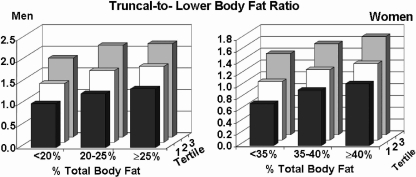
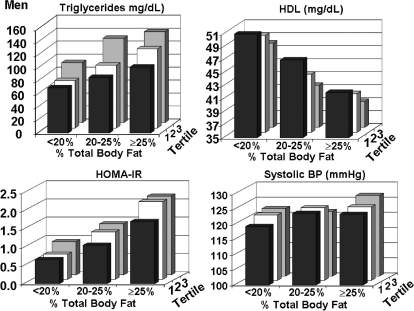
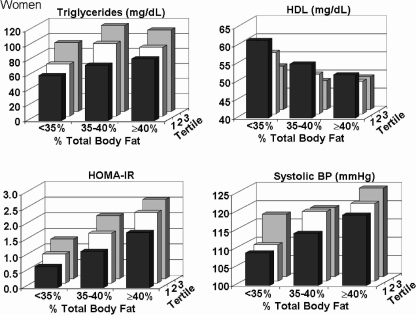
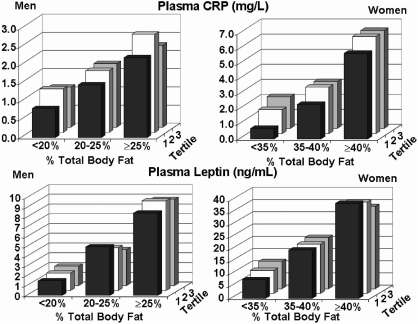
Results: Beyond total body fat, fat distribution had the greatest impact on plasma triglycerides in all subjects and on high-density lipoprotein cholesterol (HDL-C) levels in women only. An intermediate effect of fat distribution was observed for homeostasis model assessment of insulin resistance (HOMA-IR) and for blood pressure. Plasma CRP levels were much more sensitive to body fat content than to body fat distribution and leptin levels were determined almost exclusively by body fat content. Although there were minor differences among the different ethnic groups, the major relationship patterns between these variables were similar.
Conclusion: For most metabolic risk factors, both body fat content and distribution independently contributed to levels, although significant differences were seen between the relative contributions of each variable to individual risk factors.
Figures
References
-
- Grundy SM. Cleeman JI. Daniels SR. Donato KA. Eckel RH. Franklin BA. Gordon DJ. Krauss RM. Savage PJ. Smith SC., Jr Spertus JA. Costa F. Diagnosis and Management of the Metabolic Syndrome. An American Heart Association/National Heart, Lung, and Blood Institute Scientific Statement. Circulation. 2005;112:2735–2752. - PubMed
-
- Vega GL. Adams-Huet B. Peshock R. Willett D. Shah B. Grundy SM. Influence of body fat content and distribution on variation in metabolic risk. J Clin Endocrinol Metab. 2006;91:4459–4466. - PubMed
-
- Victor RG. Haley RW. Willett DL. Peshock RM. Vaeth PC. Leonard D. Basit M. Cooper RS. Iannacchione VG. Visscher WA. Staab JM. Hobbs HH Dallas Heart Study Investigators. The Dallas Heart Study: a population-based probability sample for the multidisciplinary study of ethnic differences in cardiovascular health. Am J Cardiol. 2004;93:1473–1480. - PubMed
-
- Wallace TM. Levy JC. Matthews DR. Use and abuse of HOMA modeling. Diabetes Care. 2004;27:1487–1495. - PubMed
Publication types
MeSH terms
Substances
Grants and funding
LinkOut - more resources
Full Text Sources
Medical
Research Materials
Miscellaneous