


Identifiability and estimation of causal effects in randomized trials with noncompliance and completely nonignorable missing data
- PMID: 18759847
- PMCID: PMC3631588
- DOI: 10.1111/j.1541-0420.2008.01120.x
Identifiability and estimation of causal effects in randomized trials with noncompliance and completely nonignorable missing data
Abstract
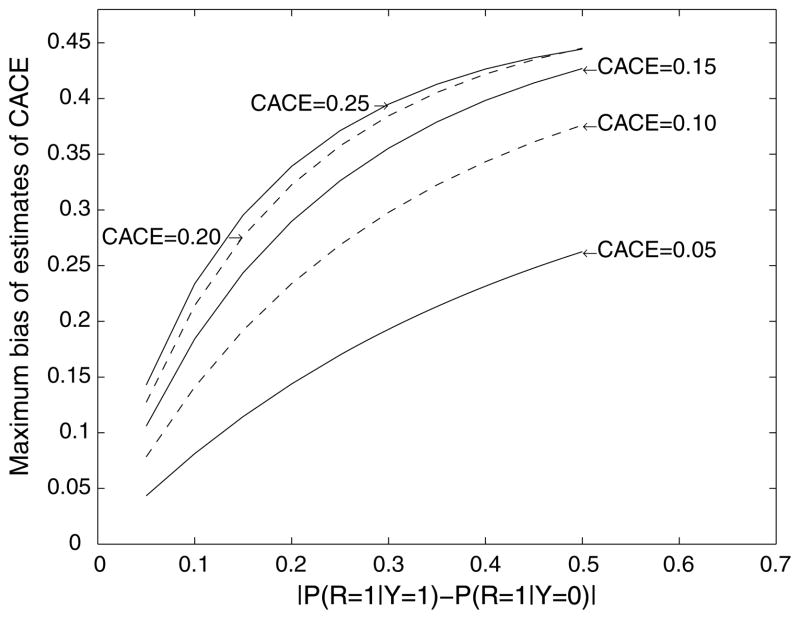
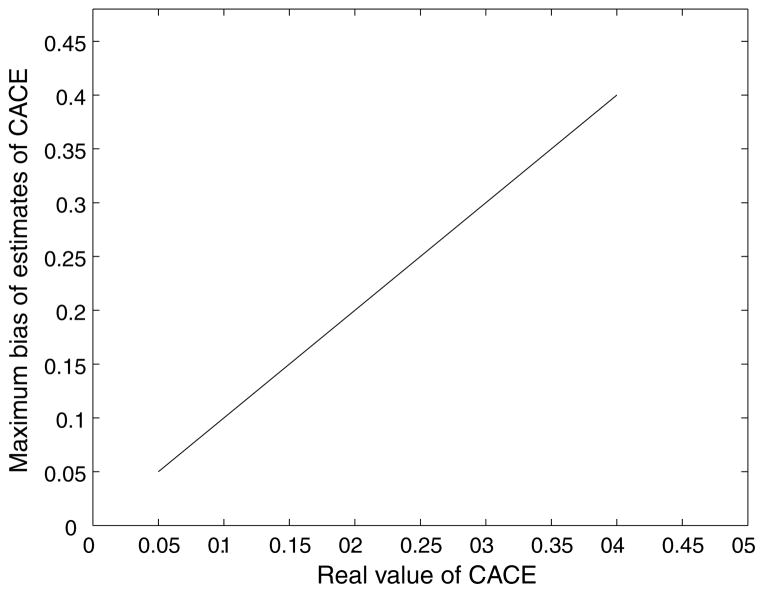
In this article, we first study parameter identifiability in randomized clinical trials with noncompliance and missing outcomes. We show that under certain conditions the parameters of interest are identifiable even under different types of completely nonignorable missing data: that is, the missing mechanism depends on the outcome. We then derive their maximum likelihood and moment estimators and evaluate their finite-sample properties in simulation studies in terms of bias, efficiency, and robustness. Our sensitivity analysis shows that the assumed nonignorable missing-data model has an important impact on the estimated complier average causal effect (CACE) parameter. Our new method provides some new and useful alternative nonignorable missing-data models over the existing latent ignorable model, which guarantees parameter identifiability, for estimating the CACE in a randomized clinical trial with noncompliance and missing data.
Figures
Comment in
-
Discussions.Biometrics. 2009 Sep;65(3):686-9; discussion 689-91. doi: 10.1111/j.1541-0420.2008.01122.x. Epub 2008 Aug 28. Biometrics. 2009. PMID: 18759845 No abstract available.
-
Discussion of "Identifiability and estimation of causal effects in randomized trials with noncompliance and completely nonignorable missing data".Biometrics. 2009 Sep;65(3):682-6; discussion 689-91. doi: 10.1111/j.1541-0420.2008.01121.x. Epub 2008 Aug 28. Biometrics. 2009. PMID: 18759846 No abstract available.
References
-
- Angrist JD, Imbens GW, Rubin DB. Identification of causal effects using instrumental variables (with Discussion) Journal of the American Statistical Association. 1996;91:444–472.
-
- Bickel PJ, Doksum KA. Mathematical Statistics. Oakland, California: Holden-Day; 1977.
-
- Brown CH. Protecting against nonrandomly missing data in longitudinal studies. Biometrics. 1990;46:143–155. - PubMed
-
- Frangakis CE, Rubin DB. Addressing complications of intention-to-treat analysis in the combined presence of all-or-none treatment-noncompliance and subsequent missing outcomes. Biometrika. 1999;86:365–379.
-
- Imbens GW, Rubin DB. Bayesian inference for causal effects in randomized experiments with noncompliance. The Annals of Statistics. 1997;25:305–327.
Publication types
MeSH terms
Grants and funding
LinkOut - more resources
Full Text Sources
