. 2008 Sep;14(9):1375-82.
doi: 10.3201/eid1409.071196.

Forest fragmentation as cause of bacterial transmission among nonhuman primates, humans, and livestock, Uganda

Affiliations

Forest fragmentation as cause of bacterial transmission among nonhuman primates, humans, and livestock, Uganda

Tony L Goldberg et al. Emerg Infect Dis. 2008 Sep.

Erratum in

  • Emerg Infect Dis. 2008 Nov;14(11):1825

Abstract

We conducted a prospective study of bacterial transmission among humans, nonhuman primates (primates hereafter), and livestock in western Uganda. Humans living near forest fragments harbored Escherichia coli bacteria that were approximately 75% more similar to bacteria from primates in those fragments than to bacteria from primates in nearby undisturbed forests. Genetic similarity between human/livestock and primate bacteria increased approximately 3-fold as anthropogenic disturbance within forest fragments increased from moderate to high. Bacteria harbored by humans and livestock were approximately twice as similar to those of red-tailed guenons, which habitually enter human settlements to raid crops, than to bacteria of other primate species. Tending livestock, experiencing gastrointestinal symptoms, and residing near a disturbed forest fragment increased genetic similarity between a participant's bacteria and those of nearby primates. Forest fragmentation, anthropogenic disturbance within fragments, primate ecology, and human behavior all influence bidirectional, interspecific bacterial transmission. Targeted interventions on any of these levels should reduce disease transmission and emergence.


Figures
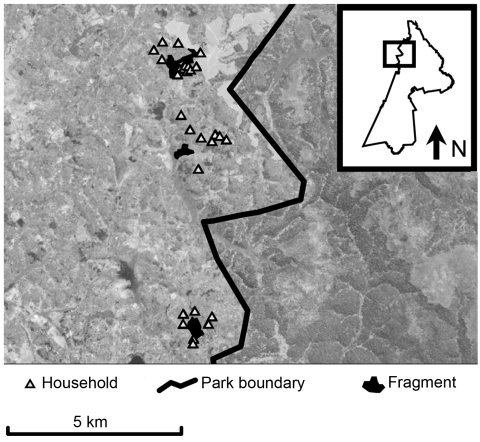
Figure 1
Figure 1
Map of study area within Kibale National Park, western Uganda (box) and forest fragments and households included in the study. Fragments are (from north to south) Kiko 1, Bugembe, Rurama (see Table 1 for details). Households, park boundary, and fragments are superimposed on a Landsat satellite image (30-m resolution).
Figure 2
Figure 2
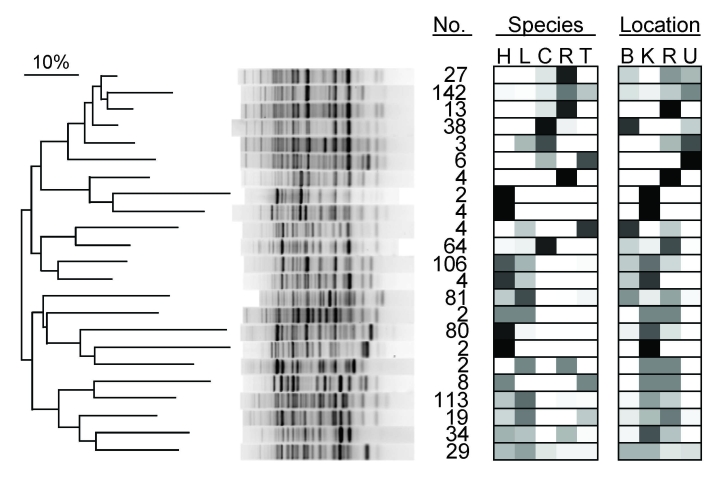
Dendrogram of genetic relatedness among 23 major clades of Escherichia coli from humans, domestic animals, and primates in 4 locations in and near Kibale National Park, western Uganda, derived from Rep-PCR genotypes. Major clades were identified from the full tree of 791 isolates by using the “cluster cutoff method” available in the computer program BioNumerics, version 4.0 (Applied Maths, Inc., Austin, TX, USA), which optimizes point-bisectional correlation across a range of cutoff similarity values to identify the most relevant clusters. A single representative bacterial genotype from each major clade is shown, and numbers of isolates falling within that clade are given (no.). Boxes indicate the host species and locations from which isolates in each clade were recovered and are shaded in proportion to the percentage of isolates in the clade from that species or location (0%, white; 100%, black). Species: H, human; L, livestock (cattle or goats); C, black-and-white colobus; R, red colobus; T, red-tailed guenon. Location: B, Bugembe fragment; K, Kiko 1 fragment; R, Rurama fragment; U, undisturbed locations within Kibale National Park. The dendrogram was drawn by using the neighbor-joining method (37) from a distance matrix generated from electrophoretic data that used optimized analytical parameters (30).
Figure 3
Figure 3
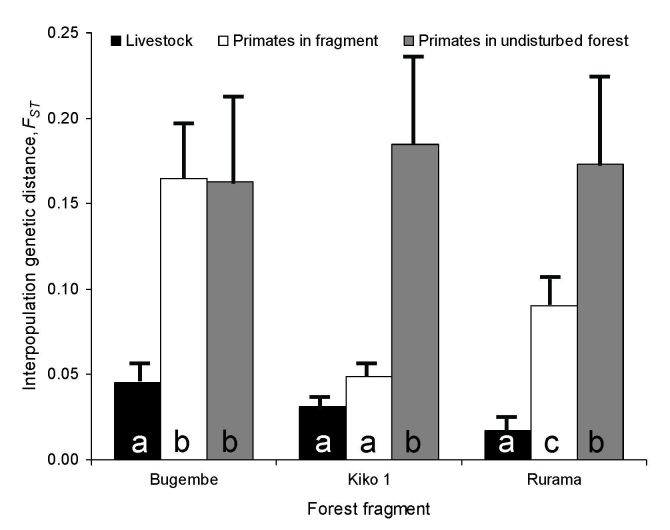
Interpopulation FST values between Escherica coli from humans in villages associated with 3 forest fragments near Kibale National Park, Uganda, and E. coli from livestock and primates in the same village or fragment, respectively. FST values between humans in each village and primates in undisturbed locations within Kibale National Park are shown for comparison. Error bars represent standard errors of the mean, estimated from bootstrap analyses with 1,000 replicates. Different letters within bars indicate statistically significantly different FST values (exact probabilities <0.05).
Figure 4
Figure 4
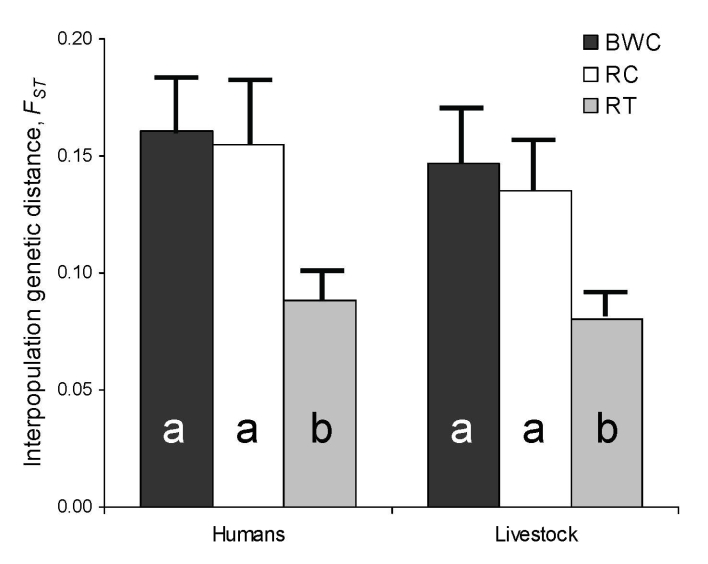
Interpopulation FST values between Escherichia coli from 3 species of primates in 3 forest fragments near Kibale National Park, Uganda, and E. coli from both humans and livestock living in villages associated with the fragments. BWC, black-and-white colobus; RC, red colobus; RT, red-tailed guenon. Error bars represent standard errors of the mean, estimated from bootstrap analyses with 1,000 replicates. Different letters within bars indicate statistically significant differences in FST values (exact probabilities <0.05).

References

    1. Chapman CA, Gillespie TR, Goldberg TL. Primates and the ecology of their infectious diseases: how will anthropogenic change affect host-parasite interactions? Evol Anthropol. 2005;14:134–44. 10.1002/evan.20068 - DOI
    1. Nunn CL, Altizer S. Infectious diseases in primates: behavior, ecology and evolution. Oxford: Oxford University Press; 2006.
    1. Leroy EM, Rouquet P, Formenty P, Souquiere S, Kilbourne A, Froment JM, et al. Multiple Ebola virus transmission events and rapid decline of central African wildlife. Science. 2004;303:387–90. 10.1126/science.1092528 - DOI - PubMed
    1. Leendertz FH, Lankester F, Neel C, Drori O, Dupain J, Speede S, et al. Anthrax joins Ebola in threatening central African great apes. Am J Primatol. 2006;68:928–33. 10.1002/ajp.20298 - DOI - PubMed
    1. Kondgen S, Kuhl H, N’Goran PK, Walsh PD, Schenk S, Ernst N, et al. Pandemic human viruses cause decline of endangered great apes. Curr Biol. 2008;18:260–4. 10.1016/j.cub.2008.01.012 - DOI - PubMed

Publication types

LinkOut - more resources