Comparative Study
. 2008 Aug 28;59(4):648-61.
doi: 10.1016/j.neuron.2008.07.004.

Basolateral amygdala neurons facilitate reward-seeking behavior by exciting nucleus accumbens neurons

Affiliations
Comparative Study

Basolateral amygdala neurons facilitate reward-seeking behavior by exciting nucleus accumbens neurons

Frederic Ambroggi et al. Neuron. .

Abstract

Both the nucleus accumbens (NAc) and basolateral amygdala (BLA) contribute to learned behavioral choice. Neurons in both structures that encode reward-predictive cues may underlie the decision to respond to such cues, but the neural circuits by which the BLA influences reward-seeking behavior have not been established. Here, we test the hypothesis that the BLA drives NAc neuronal responses to reward-predictive cues. First, using a disconnection experiment, we show that the BLA and dopamine projections to the NAc interact to promote the reward-seeking behavioral response. Next, we demonstrate that BLA neuronal responses to cues precede those of NAc neurons and that cue-evoked excitation of NAc neurons depends on BLA input. These results indicate that BLA input is required for dopamine to enhance the cue-evoked firing of NAc neurons and that this enhanced firing promotes reward-seeking behavior.


Figures

Figure 1
Figure 1
The BLA, and its relationship with dopamine transmission in the NAc, is required for the DS task. (A) Temporal organization of the DS task. Two cue tones (up to 10 sec for the DS; 10 sec for the NS) were randomly presented on a variable interval schedule with an average interval of 30 sec. A lever press was required during DS presentation to terminate the DS and cause the delivery of a 10% sucrose reward into an adjacent receptacle. (B) Effect the different injections on the DS and NS response ratios (proportion of DSs or NSs during which the animal pressed the lever). (c) Effect of injections on behavioral latencies from cue onset to lever press. BLA uni, BLA bi: unilateral and bilateral injection of B/M in the BLA, respectively. NAc uni, NAc bi: unilateral and bilateral injection of SCH23390 in the NAc, respectively. Ipsi, Contra: combined unilateral injection of B/M in the BLA and unilateral injection of SCH23390 in the ipsilateral or contralateral NAc, respectively. **P<0.005, *** P<0.001 compared to vehicle injection and # P<0.05 compared to ipsi group. Data and error bars in this and subsequent figures represent mean +/− sem.
Figure 2
Figure 2
Behavioral performance during electrophysiological recording, and example of BLA and NAc neuronal responses to cues. (A, B) Response ratio (left) and behavioral latency to respond (right) during BLA (A) and NAc (B) recording sessions. (C, D) Example of neuronal responses to cues (DS, left; NS, right) observed in the BLA (C) and the NAc (D). Rasters and PSTHs with 20 ms time bins are aligned with DS (left) and NS (right) onset and sorted in chronological order from top to bottom.
Figure 3
Figure 3
Excitations in BLA and NAc neurons encode cues differently. (A, D) Venn diagrams representing the proportion of neurons excited by the DS, the NS or both (overlapping section) in the BLA (A) and NAc (D). (B, E) Cumulative percentage of firing onset latencies of DS- and NS-evoked excitations for BLA (B) and NAc neurons (E). Arrows indicate the median onset latency for the DS. (C, F) Cumulative percentage of response durations for DS- and NS-evoked excitations in BLA (C) and NAc neurons (F). (G, H) Average PSTHs of the firing rate (expressed as z-score) aligned with DS and NS onset for BLA (G, DS n=46 and NS n=35) and NAc neurons (H, DS n=137 and NS n=26), constructed with 100 ms bins. In this and subsequent figures, thick lines represent the mean of the z-score and the lighter colored envelope represents the sem. (I, J) Average response magnitude during the early (i, from 0 to 100 ms after cue onset for BLA and from 100 to 200 ms for NAc) and late components (J, from 100 to 3000 ms after cue onset for BLA and from 200 to 3000 ms for NAc) of the excitation. *** P<0.001 for DS compared to NS and # P<0.05 for BLA compared to NAc.
Figure 4
Figure 4
Timing of incentive value-encoding in NAc and BLA neurons. (A) Top row of graphs shows PSTHs of two example neurons in the BLA (left) and two neurons in the NAc (right) that were excited by both the DS and NS. Bottom graphs represent the PSTHs in the same four neurons generated by subtracting the NS PSTH from the DS PSTH. Neurons discriminating or not discriminating the cues are shown for each structure. Arrows indicate the firing onset latency (top row of graphs) or discrimination latency (bottom row). The example neurons that discriminated the cues had discrimination latencies that were near the median for BLA and NAc neurons. (B) Proportion of BLA and NAc neurons discriminating the cues based on the subtracted PSTH. (C) Distribution of discrimination latency in BLA and NAc neurons. Arrows indicate the latencies of the BLA (grey) and NAc (black) neurons shown in A that discriminate the two cues.
Figure 5
Figure 5
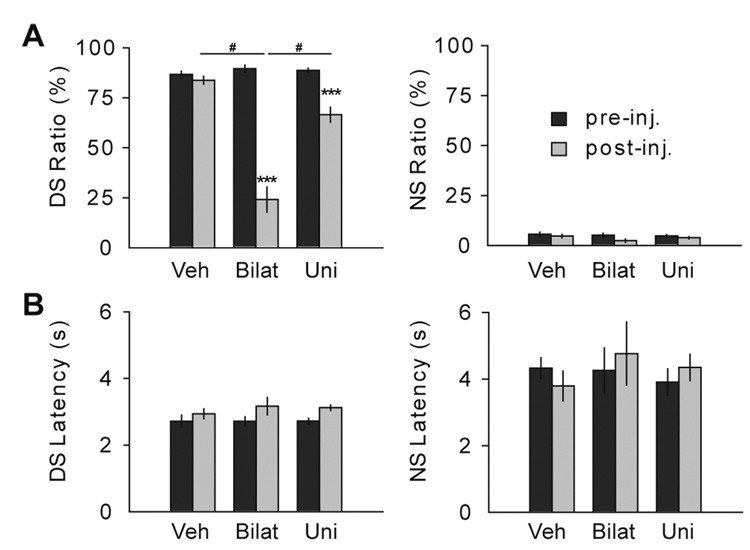
Behavioral performance during the BLA microinjection/ NAc recording study is less affected by unilateral than bilateral BLA inactivation. Response ratio (A) and behavioral latency (B) before and after bilateral vehicle (Veh), unilateral (Uni) or bilateral (Bilat) BLA inactivation. Left graphs show data for the DS; right graphs show data for the NS. *** P<0.001 compared to the pre-injection period and # P<0.05 compared to the post-injection period of the vehicle group.
Figure 6
Figure 6
Inactivation of the BLA reduces DS-evoked excitation of NAc neurons. (A) Effects of the different injections on DS excitations recorded in NAc neurons. Top graphs represent vehicle injection (top left, n=51) and bilateral BLA inactivation with B/M (top right, n=44). Bottom graph represents neurons recorded contralaterally (bottom left, n=29) or ipsilaterally (bottom right, n=26) to unilateral BLA inactivation. PSTHs of the firing rate (expressed as z-score) before and after injection are aligned with DS onset and constructed with 100 ms bins. (B) Summary of these effects during the early (100–200 ms after DS onset, left) and late (200–3000 ms after DS onset, right) component of the excitations. (C,D) Effect of bilateral injections of vehicle (left, n=9) or B/M (right, n=11) on NS excitations. Same conventions as in A and B. ** P<0.005 compared to the pre-injection period.
Figure 7
Figure 7
DS-excited NAc neurons are over-represented in the population of neurons excited by electrical stimulation of the BLA. (A,B) Example NAc neurons excited by the DS and ipsilateral (A) or contralateral (B) stimulation of the BLA. Bins are 20 and 2 ms for DS and BLA stimulation PSTHs, respectively. (C) Proportions of neurons with DS responses (excited, inhibited or none) among NAc neurons that were non-responsive (left), ipsilaterally-responsive (middle) and contralaterally-responsive (right) to BLA stimulation. (D) Distribution of onset latencies of NAc neurons in response to ipsi- or contralateral stimulation of the BLA. (E) Same representation as in D, but limited to NAc neurons that were excited by both DS presentation and ipsilateral BLA stimulation.

References

    1. Belova MA, Paton JJ, Morrison SE, Salzman CD. Expectation modulates neural responses to pleasant and aversive stimuli in primate amygdala. Neuron. 2007;55:970–984. - PMC - PubMed
    1. Brog JS, Salyapongse A, Deutch AY, Zahm DS. The patterns of afferent innervation of the core and shell in the "accumbens" part of the rat ventral striatum: immunohistochemical detection of retrogradely transported fluoro-gold. J Comp Neurol. 1993;338:255–278. - PubMed
    1. Cardinal RN, Parkinson JA, Hall J, Everitt BJ. Emotion and motivation: the role of the amygdala, ventral striatum, and prefrontal cortex. Neurosci Biobehav Rev. 2002;26:321–352. - PubMed
    1. Christie MJ, Summers RJ, Stephenson JA, Cook CJ, Beart PM. Excitatory amino acid projections to the nucleus accumbens septi in the rat: a retrograde transport study utilizing D[3H]aspartate and [3H]GABA. Neuroscience. 1987;22:425–439. - PubMed
    1. Collins DR, Pare D. Differential fear conditioning induces reciprocal changes in the sensory responses of lateral amygdala neurons to the CS(+) and CS(−) Learn Mem. 2000;7:97–103. - PMC - PubMed

Publication types