


Entertainment education for prostate cancer screening: a randomized trial among primary care patients with low health literacy
- PMID: 18760888
- PMCID: PMC2867348
- DOI: 10.1016/j.pec.2008.07.033
Entertainment education for prostate cancer screening: a randomized trial among primary care patients with low health literacy
Abstract
Objective: To evaluate an entertainment-based patient decision aid for prostate cancer screening among patients with low or high health literacy.
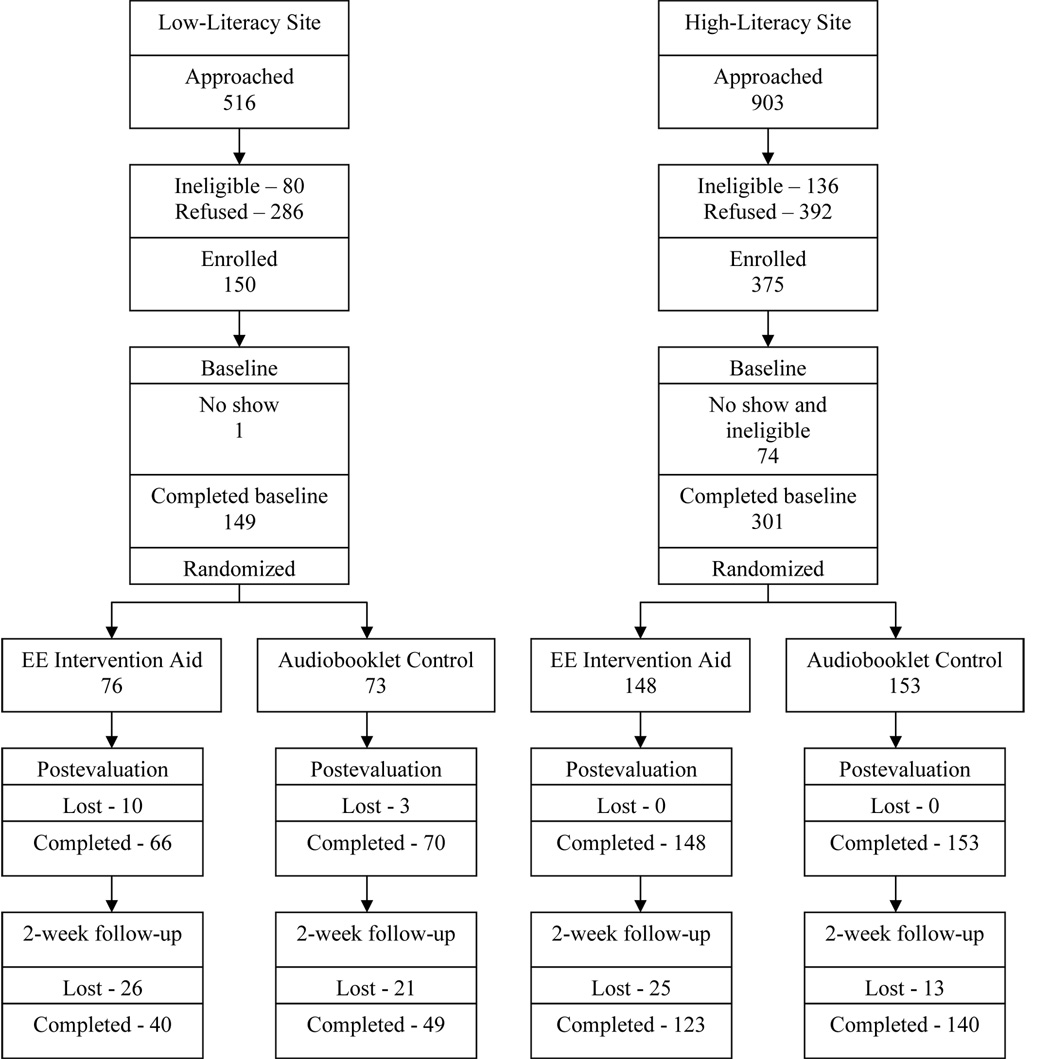
Methods: Male primary care patients from two clinical sites, one characterized as serving patients with low health literacy (n=149) and the second as serving patients with high health literacy (n=301), were randomized to receive an entertainment-based decision aid for prostate cancer screening or an audiobooklet-control aid with the same learner content but without the entertainment features. Postintervention and 2-week follow-up assessments were conducted.
Results: Patients at the low-literacy site were more engaged with the entertainment-based aid than patients at the high-literacy site. Overall, knowledge improved for all patients. Among patients at the low-literacy site, the entertainment-based aid was associated with lower decisional conflict and greater self-advocacy (i.e., mastering and obtaining information about screening) when compared to patients given the audiobooklet. No differences between the aids were observed for patients at the high-literacy site.
Conclusion: Entertainment education may be an effective strategy for promoting informed decision making about prostate cancer screening among patients with lower health literacy.
Practice implications: As barriers to implementing computer-based patient decision support programs decrease, alternative models for delivering these programs should be explored.
Conflict of interest statement
Conflict of Interest
None.
References
-
- American Urological Association (AUA) Oncology. Vol. 14. Williston Park: 2000. Prostate-specific antigen (PSA) best practice policy; pp. 267–272.pp. 77–78. 80 passim. - PubMed
-
- Harris R, Lohr KN. Screening for prostate cancer: an update of the evidence for the U.S. Preventive Services Task Force. Ann Intern Med. 2002;137:917–929. - PubMed
-
- Smith RA, Cokkinides V, Eyre HJ. American Cancer Society guidelines for the early detection of cancer, 2004. CA Cancer J Clin. 2004;54:41–52. - PubMed
-
- O'Connor AM, Stacey D, Rovner D, Holmes-Rovner M, Tetroe J, Llewellyn-Thomas H, Entwistle V, Rostom A, Fiset V, Barry M, Jones J. Decision aids for people facing health treatment or screening decisions. Oxford, UK: The Cochrane Library; 2003. - PubMed
-
- Volk RJ, Hawley ST, Kneuper S, Holden EW, Stroud LA, Cooper CP, Berkowitz JM, Scholl LE, Saraykar SS, Pavlik VN. Trials of decision AIDS for prostate cancer screening: a systematic review. Am J Prev Med. 2007;33:428–434. - PubMed
Publication types
MeSH terms
Grants and funding
LinkOut - more resources
Full Text Sources
Medical
Research Materials
