


Review
doi: 10.1016/j.yexcr.2008.08.005.
Epub 2008 Aug 19.
The role of the EGF family of ligands and receptors in renal development, physiology and pathophysiology
Affiliations
- PMID: 18761338
- PMCID: PMC2654782
- DOI: 10.1016/j.yexcr.2008.08.005
Item in Clipboard
Review
The role of the EGF family of ligands and receptors in renal development, physiology and pathophysiology
Exp Cell Res.
.
Abstract
Mammalian kidney expresses all of the members of the ErbB family of receptors and their respective ligands. Studies support a role for ErbB family receptor activation in kidney development and differentiation. Under physiologic conditions, EGFR activation appears to play an important role in the regulation of renal hemodynamics and electrolyte handling by the kidney, while in different pathophysiologic states, EGFR activation may mediate either beneficial or detrimental effects to the kidney. This article provides an overview of the expression profile of the ErbB family of ligands and receptors in the mammalian kidney and summarizes known physiological and pathophysiological roles of EGFR activation in the organ.
Figures
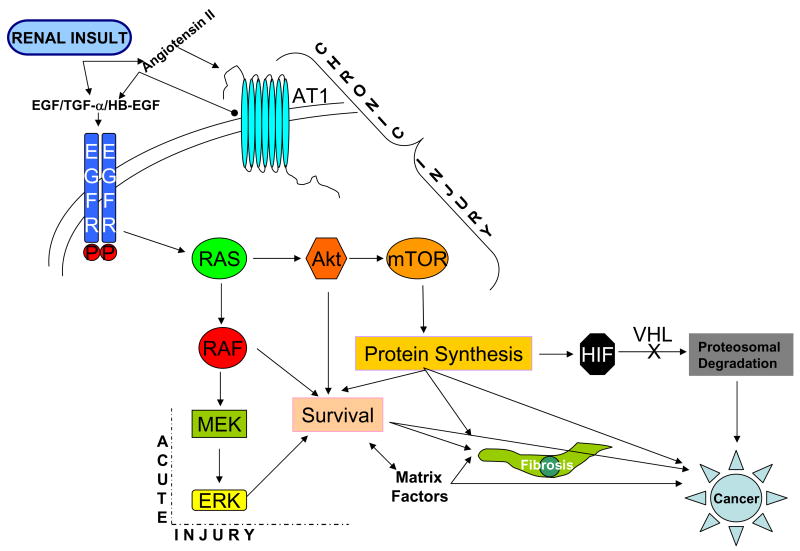
In normal intact epithelial cells, EGFR activation is tightly regulated. Epithelial injury induces cleavage of receptor ligands and results in activation of signaling pathways downstream of EGFR. While acute activation of the receptor is beneficial and may participate in repair due to proliferation and migration, chronic activation is detrimental and may participate in dedifferentiation and dysregulated proliferation (cystic diseases), dysregulated matrix deposition (fibrotic diseases) or carcinogenic transformation (renal cell carcinoma).
References
-
- Schlessinger J. Ligand-induced, receptor-mediated dimerization and activation of EGF receptor. Cell. 2002;110:669–672. - PubMed
-
- Riese DJ, 2nd, Stern DF. Specificity within the EGF family/ErbB receptor family signaling network. Bioessays. 1998;20:41–48. - PubMed
-
- Peles E, Yarden Y. Neu and its ligands: from an oncogene to neural factors. Bioessays. 1993;15:815–824. - PubMed
-
- Holbro T, Civenni G, Hynes NE. The ErbB receptors and their role in cancer progression. Exp Cell Res. 2003;284:99–110. - PubMed
-
- Hynes NE, Lane HA. ERBB receptors and cancer: the complexity of targeted inhibitors. Nat Rev Cancer. 2005;5:341–354. - PubMed
Publication types
MeSH terms
Substances
Grants and funding
LinkOut - more resources
Full Text Sources
Other Literature Sources
Research Materials
Miscellaneous
