


Abnormal joint torque patterns exhibited by chronic stroke subjects while walking with a prescribed physiological gait pattern
- PMID: 18761735
- PMCID: PMC2553074
- DOI: 10.1186/1743-0003-5-19
Abnormal joint torque patterns exhibited by chronic stroke subjects while walking with a prescribed physiological gait pattern
Abstract
Background: It is well documented that individuals with chronic stroke often exhibit considerable gait impairments that significantly impact their quality of life. While stroke subjects often walk asymmetrically, we sought to investigate whether prescribing near normal physiological gait patterns with the use of the Lokomat robotic gait-orthosis could help ameliorate asymmetries in gait, specifically, promote similar ankle, knee, and hip joint torques in both lower extremities. We hypothesized that hemiparetic stroke subjects would demonstrate significant differences in total joint torques in both the frontal and sagittal planes compared to non-disabled subjects despite walking under normal gait kinematic trajectories.
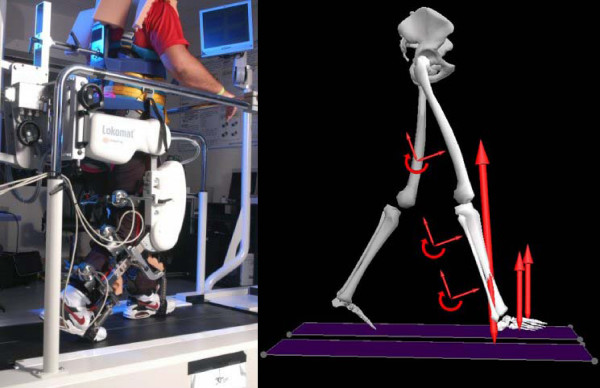
Methods: A motion analysis system was used to track the kinematic patterns of the pelvis and legs of 10 chronic hemiparetic stroke subjects and 5 age matched controls as they walked in the Lokomat. The subject's legs were attached to the Lokomat using instrumented shank and thigh cuffs while instrumented footlifters were applied to the impaired foot of stroke subjects to aid with foot clearance during swing. With minimal body-weight support, subjects walked at 2.5 km/hr on an instrumented treadmill capable of measuring ground reaction forces. Through a custom inverse dynamics model, the ankle, knee, and hip joint torques were calculated in both the frontal and sagittal planes. A single factor ANOVA was used to investigate differences in joint torques between control, unimpaired, and impaired legs at various points in the gait cycle.
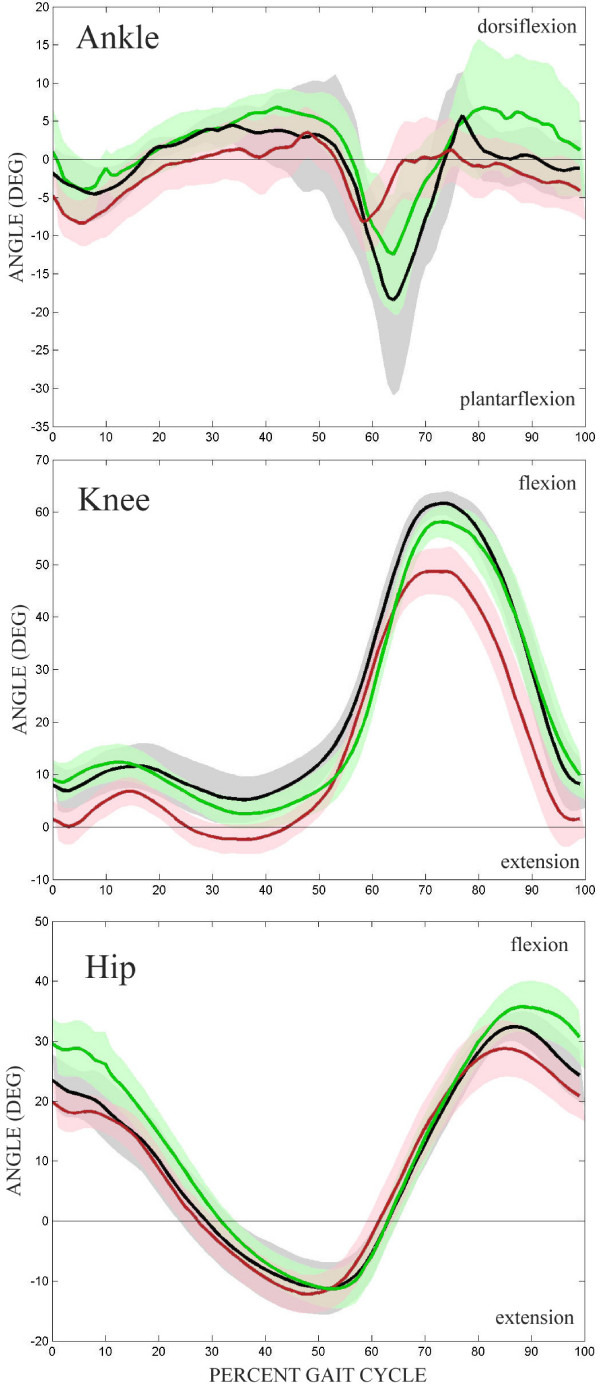
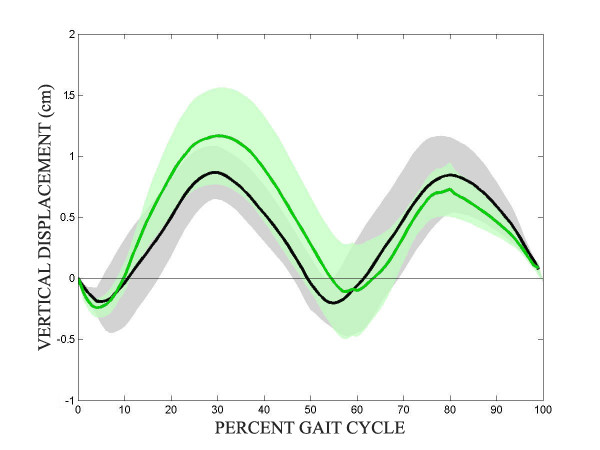
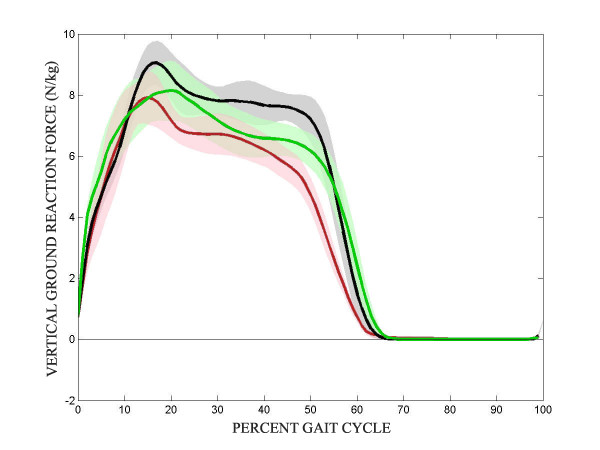
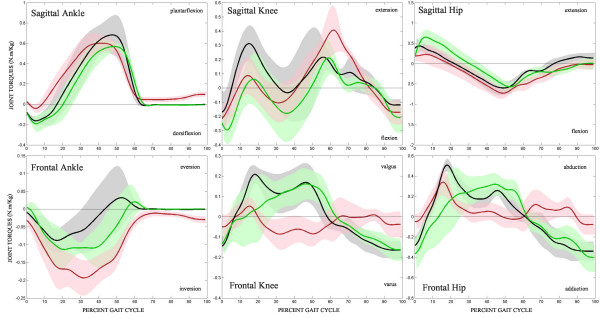
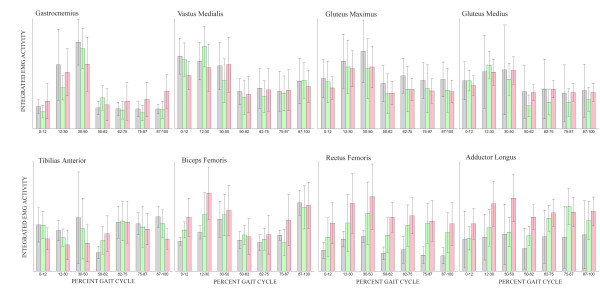
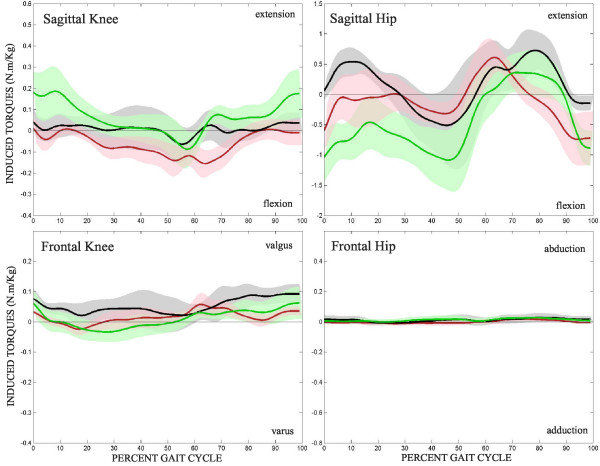
Results: While the kinematic patterns of the stroke subjects were quite similar to those of the control subjects, the kinetic patterns were very different. During stance phase, the unimpaired limb of stroke subjects produced greater hip extension and knee flexion torques than the control group. At pre-swing, stroke subjects inappropriately extended their impaired knee, while during swing they tended to abduct their impaired leg, both being typical abnormal torque synergy patterns common to stroke gait.
Conclusion: Despite the Lokomat guiding stroke subjects through physiologically symmetric kinematic gait patterns, abnormal asymmetric joint torque patterns are still generated. These differences from the control group are characteristic of the hip hike and circumduction strategy employed by stroke subjects.
Figures
References
-
- Bourbonnais D, Noven S Vanden. Weakness in patients with hemiparesis. Am J Occup Ther. 1989;43:313–9. - PubMed
-
- Duncan PW, Badke MB. Stroke Rehabilitation: The Recovery of Motor Control. Chicago: Year Book Medical Pub; 1987.
-
- Hidler JM, Carroll M, Federovich EH. Strength and coordination in the paretic leg of individuals following acute stroke. IEEE Trans Neural Syst Rehabil Eng. 2007;15:526–34. - PubMed
-
- Chung SG, Van Rey E, Bai Z, Roth EJ, Zhang LQ. Biomechanic changes in passive properties of hemiplegic ankles with spastic hypertonia. Arch Phys Med Rehabil. 2004;85:1638–46. - PubMed
Publication types
MeSH terms
LinkOut - more resources
Full Text Sources
Other Literature Sources
Medical
