


Decreased transforming growth factor beta1 in autism: a potential link between immune dysregulation and impairment in clinical behavioral outcomes
- PMID: 18762342
- PMCID: PMC2615583
- DOI: 10.1016/j.jneuroim.2008.07.006
Decreased transforming growth factor beta1 in autism: a potential link between immune dysregulation and impairment in clinical behavioral outcomes
Abstract
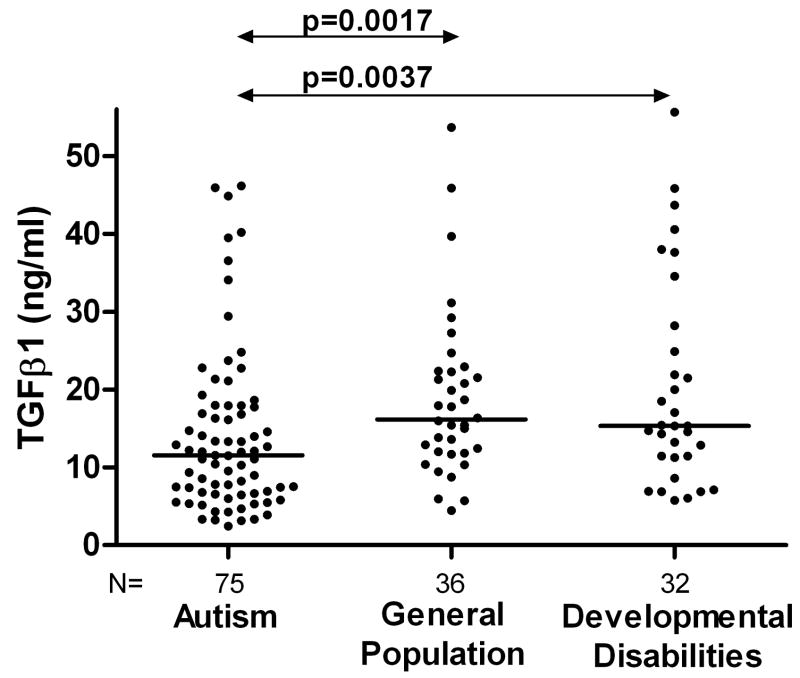
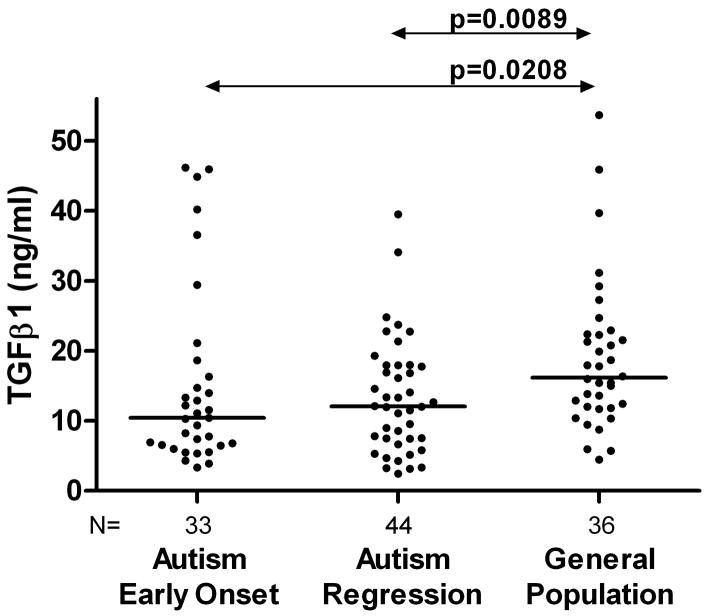
Autism spectrum disorders (ASD) are characterized by impairment in social interactions, communication deficits, and restricted repetitive interests and behaviors. There is evidence of both immune dysregulation and autoimmune phenomena in autism. We examined the regulatory cytokine transforming growth factor beta-1 (TGF beta 1) because of its role in controlling immune responses. Plasma levels of active TGF beta 1 were evaluated in 75 children with ASD compared with 68 controls. Children with ASD had significantly lower plasma TGF beta 1 levels compared with typically developing controls (p=0.0017) and compared with children with developmental disabilities other than ASD (p=0.0037), after adjusting for age and gender. In addition, there were significant correlations between psychological measures and TGF beta 1 levels, such that lower TGF beta 1 levels were associated with lower adaptive behaviors and worse behavioral symptoms. The data suggest that immune responses in autism may be inappropriately regulated due to reductions in TGF beta 1. Such immune dysregulation may predispose to the development of possible autoimmune responses and/or adverse neuroimmune interactions during critical windows in development.
Figures
References
-
- Aman MG, Singh NN, Stewart AW, Field CJ. The aberrant behavior checklist: a behavior rating scale for the assessment of treatment effects. Am J Ment Defic. 1985;89(5):485–491. - PubMed
-
- Aoki CA, Borchers AT, Li M, Flavell RA, Bowlus CL, Ansari AA, Gershwin ME. Transforming growth factor beta (TGF-beta) and autoimmunity. Autoimmun Rev. 2005;4(7):450–459. - PubMed
-
- Ashwood P, Anthony A, Torrente F, Wakefield AJ. Spontaneous mucosal lymphocyte cytokine profiles in children with autism and gastrointestinal symptoms: mucosal immune activation and reduced counter regulatory interleukin-10. J Clin Immunol. 2004;24(6):664–673. - PubMed
-
- Ashwood P, Wills S, Van de Water J. The immune response in autism: a new frontier for autism research. J Leukoc Biol. 2006a;80(1):1–15. - PubMed
-
- Ashwood P, Wakefield AJ. Immune activation of peripheral blood and mucosal CD3+ lymphocyte cytokine profiles in children with autism and gastrointestinal symptoms. J Neuroimmunol. 2006b;173(1–2):126–134. - PubMed
Publication types
MeSH terms
Substances
Grants and funding
LinkOut - more resources
Full Text Sources
Medical
