


doi: 10.1016/j.bmcl.2008.08.035.
Epub 2008 Aug 14.
A red-emitting naphthofluorescein-based fluorescent probe for selective detection of hydrogen peroxide in living cells
Affiliations
- PMID: 18762422
- PMCID: PMC2590631
- DOI: 10.1016/j.bmcl.2008.08.035
Item in Clipboard
A red-emitting naphthofluorescein-based fluorescent probe for selective detection of hydrogen peroxide in living cells
Bioorg Med Chem Lett.
.
Abstract
We report the synthesis, properties, and cellular application of Naphtho-Peroxyfluor-1 (NPF1), a new fluorescent indicator for hydrogen peroxide based on a red-emitting naphthofluorescein platform. Owing to its boronate cages, NPF1 features high selectivity for hydrogen peroxide over a panel of biologically relevant reactive oxygen species (ROS), including superoxide and nitric oxide, as well as excitation and emission profiles in the far-red region of the visible spectrum (>600nm). Flow cytometry experiments in RAW264.7 macrophages establish that NPF1 can report changes in peroxide levels in living cells.
Figures
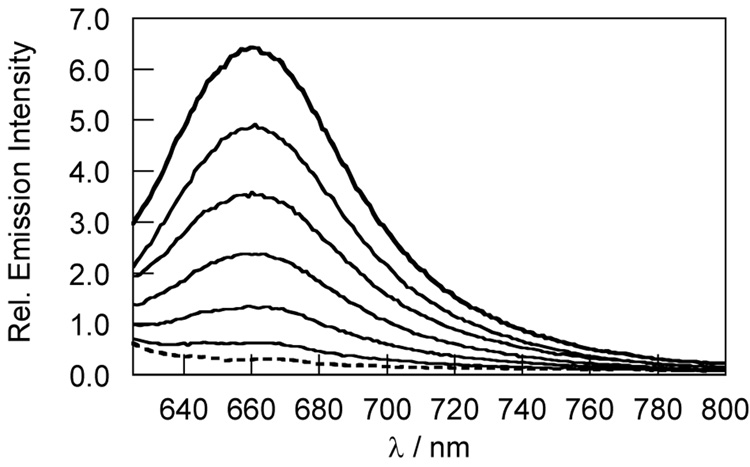
Fluorescence response of 5 µM NPF1 to 100 µM H2O2. The dashed spectrum was acquired before H2O2 addition (dotted line) and the solid line spectra shown were acquired after 10, 20, 30, 40, 50 and 60 min incubation with H2O2. Spectra were acquired in 20 mM HEPES, pH 7.5, at 37 °C (λexc = 598 nm).
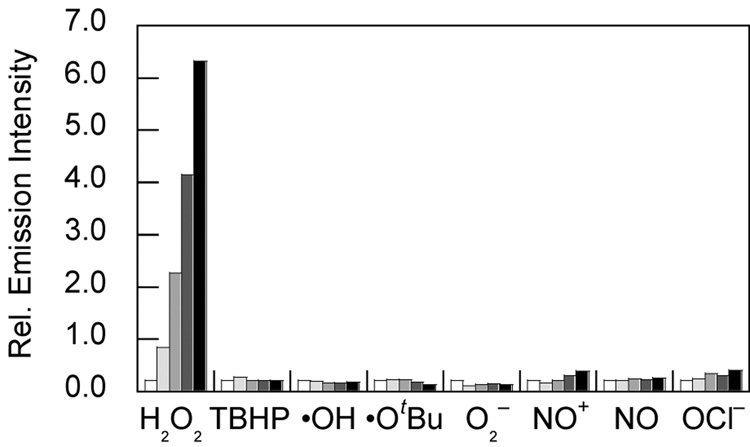
Fluorescence responses of 5 µM NPF1 to 100 µM reactive oxygen species (ROS). Hydrogen peroxide (H2O2), tert-butyl hydroperoxide (TBHP), and hypochlorite (OCl−) were delivered from 30%, 70%, and 5% aqueous solutions, respectively. Hydroxyl radical (•OH) and tert-butoxy radical (•OtBu) were generated by reactions of 1 mM Fe2+ with 100 µM H2O2 or 100 µM TBHP, respectively. Superoxide (O2−) was generated enzymatically using a xanthine/xanthine oxidase system. NO+ was delivered using S-nitrosocysteine (SNOC). NO was delivered using NOC-5. Spectra were acquired in 20 mM HEPES, pH 7.5, and all data were obtained after incubation with the appropriate ROS at 37 °C. Bars represent relative emission responses (λexc = 598 nm, λem = 660 nm at 0 (white), 15 (light gray), 30 (gray), 45 (dark gray), and 60 min (black) after addition of the appropriate ROS.
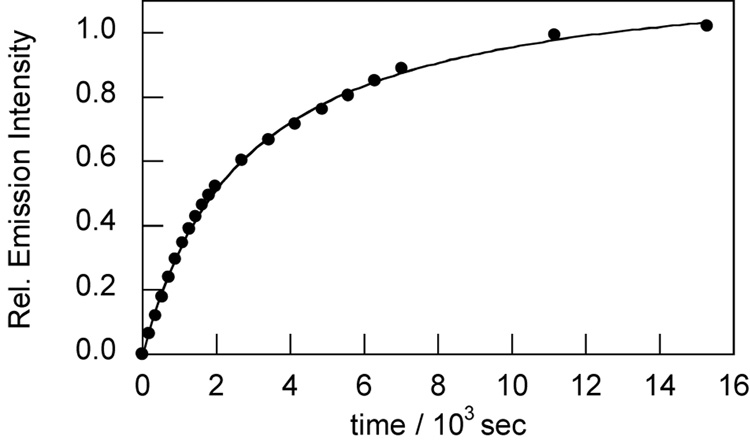
Time-course kinetics measurement of the fluorescence response of NPF1 to H2O2. Data were collected under pseudo-first-order conditions (1 µM NPF1, 1 mM H2O2). Spectra were acquired in 20 mM HEPES, pH 7.5, at 25 °C (λexc = 598 nm, λem = 660 nm), and data are plotted as relative emission intensities over initial background.
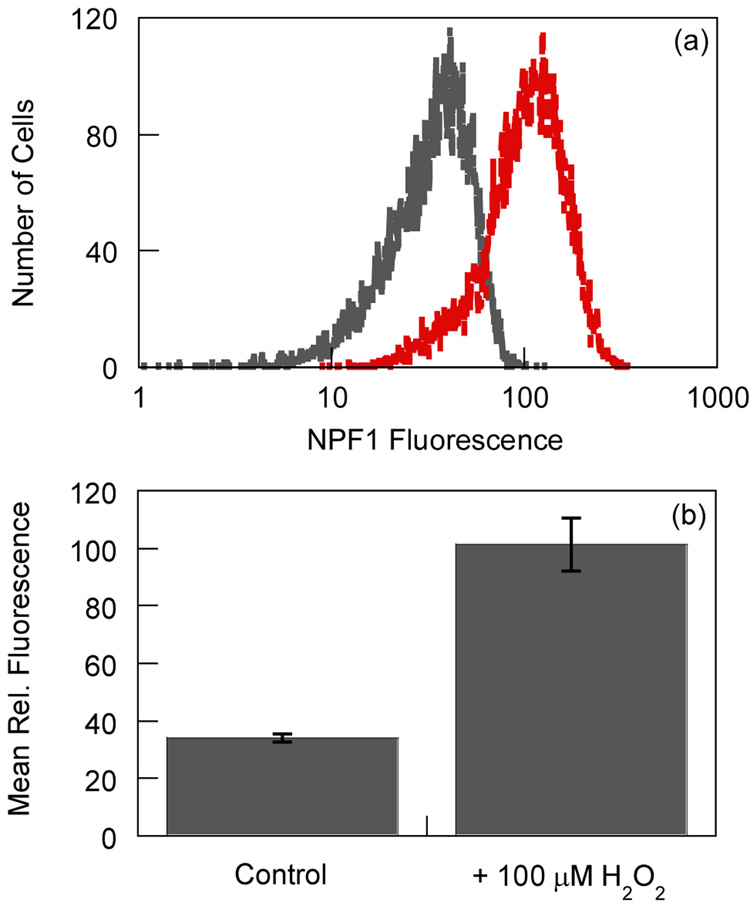
Flow cytometry analysis of NPF1-loaded live RAW 264.7 macrophages in response to increases in H2O2 levels. Two aliquots of cells were incubated with 20 µM NPF1 for 1 h. 100 µM H2O2 was subsequently added to one of the aliquots and the cells were incubated for an additional 1 h. Cells were then analyzed by flow cytometry. (a) Represetative flow cytometry trace from one experiment described above. Data are shown for NPF1-loaded control cells in the absence of H2O2 (gray) and cells treated with H2O2 (red). (b) Mean relative fluorescence for populations shown in panel (a) from three replicate experiments. Error bars represent the standard deviation from the mean for the three experiments. The data represent at least 10,000 cells for each analysis.
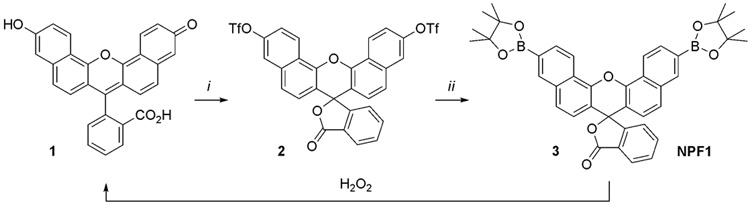
Synthesis and activation of Naphtho-Peroxyfluor-1 (NPF1). Reagents and conditions: (i) N-phenyl-bis(trifluoromethanesulfonimide), DIPEA, DMF, 25 °C, 24 h. (ii) Pd(dppf)Cl2•CH2Cl2, dppf, bis(pinacolato)diboron, KOAc, 1,4-dioxane, 100 °C, 24 h.
References
-
- Rhee SG. Science. 2006;312:1882–1883. - PubMed
-
- Stone JR, Yang S. Antioxid. Redox Signal. 2006;8:243–270. - PubMed
-
- Veal EA, Day AM, Morgan BA. Molecular Cell. 2007;26:1–14. - PubMed
-
- D’Autréaux B, Toledano MB. Nat. Rev. Mol. Cell Biol. 2007;8:813–824. - PubMed
-
- Giorgio M, Trinei M, Migliaccio E, Pelicci PG. Nat. Rev. Mol. Cell Biol. 2007;8:722–728. - PubMed
Publication types
MeSH terms
Substances
Grants and funding
LinkOut - more resources
Full Text Sources
