


"Surgery is certainly one good option": quality and time-efficiency of informed decision-making in surgery
- PMID: 18762641
- PMCID: PMC2657309
- DOI: 10.2106/JBJS.G.00840
"Surgery is certainly one good option": quality and time-efficiency of informed decision-making in surgery
Abstract
Background: Informed decision-making has been widely promoted in several medical settings, but little is known about the actual practice in orthopaedic surgery and there are no clear guidelines on how to improve the process in this setting. This study was designed to explore the quality of informed decision-making in orthopaedic practice and to identify excellent time-efficient examples with older patients.
Methods: We recruited orthopaedic surgeons, and patients sixty years of age or older, in a Midwestern metropolitan area for a descriptive study performed through the analysis of audiotaped physician-patient interviews. We used a valid and reliable measure to assess the elements of informed decision-making. These included discussions of the nature of the decision, the patient's role, alternatives, pros and cons, and uncertainties; assessment of the patient's understanding and his or her desire to receive input from others; and exploration of the patient's preferences and the impact on the patient's daily life. The audiotapes were scored with regard to whether there was a complete discussion of each informed-decision-making element (an IDM-18 score of 2) or a partial discussion of each element (an IDM-18 score of 1) as well as with a more pragmatic metric (the IDM-Min score), reflecting whether there was any discussion of the patient's role or preference and of the nature of the decision. The visit duration was studied in relation to the extent of the informed decision-making, and excellent time-efficient examples were sought.
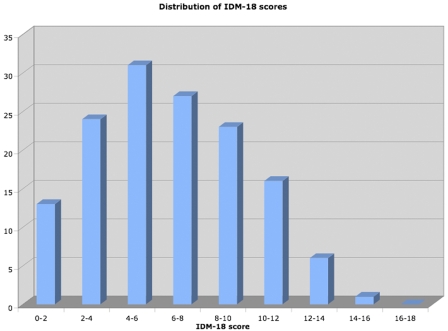
Results: There were 141 informed-decision-making discussions about surgery, including knee and hip replacement as well as wrist/hand, shoulder, and arthroscopic surgery. Surgeons frequently discussed the nature of the decision (92% of the time), alternatives (62%), and risks and benefits (59%); they rarely discussed the patient's role (14%) or assessed the patient's understanding (12%). The IDM-18 scores of the 141 discussions averaged 5.9 (range, 0 to 15; 95% confidence interval, 5.4 to 6.5). Fifty-seven percent of the discussions met the IDM-Min criteria. The median duration of the visits was sixteen minutes; the extent of informed decision-making had only a modest relationship with the visit duration. Time-efficient strategies that were identified included use of scenarios to illustrate distinct choices, encouraging patient input, and addressing primary concerns rather than lengthy recitations of pros and cons.
Conclusions: In this study, which we believe is the first to focus on informed decision-making in orthopaedic surgical practice, we found opportunities for improvement but we also found that excellent informed decision-making is feasible and can be accomplished in a time-efficient manner.
Figures
References
-
- Committee on Quality of Health Care in America; Institute of Medicine. Crossing the quality chasm: a new health system for the 21st century. Washington, DC: National Academy Press; 2001.
-
- President's Commission for the Study of Ethical Problems in Medicine and Biomedical and Behavioral Research. Making health care decisions: a report on the ethical and legal implications of informed consent in the patient-practitioner relationship. Washington, DC: US Government Printing Office; 1982.
-
- Braddock CH 3rd, Edwards KA, Hasenberg NM, Laidley TL, Levinson W. Informed decision making in outpatient practice: time to get back to basics. JAMA. 1999;282:2313-20. - PubMed
-
- Adams RJ, Appleton S, Wilson DH, Ruffin RE. Participatory decision making, asthma action plans, and use of asthma medication: a population survey. J Asthma. 2005;42:673-8. - PubMed
Publication types
MeSH terms
Grants and funding
LinkOut - more resources
Full Text Sources
Medical
Miscellaneous
