


Regionalization in local public health systems: public health preparedness in the Washington metropolitan area
- PMID: 18763408
- PMCID: PMC2430642
- DOI: 10.1177/003335490812300407
Regionalization in local public health systems: public health preparedness in the Washington metropolitan area
Abstract
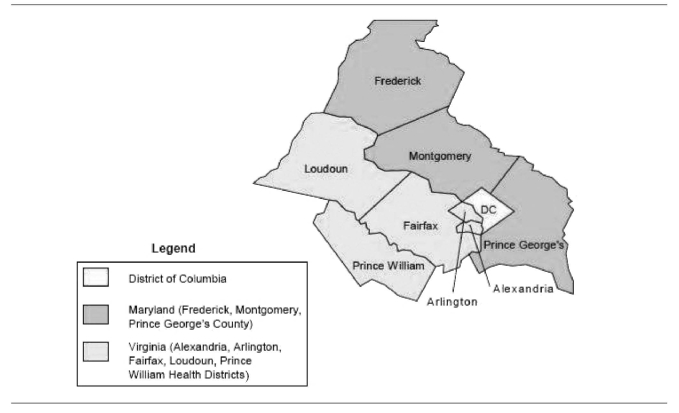
The Washington metropolitan area was closely examined to understand how these regional preparedness structures have been organized, implemented, and governed, as well as to assess the likely impact of such regional structures on public health preparedness and public health systems more generally. It was found that no single formal regional structure for the public health system exists in the Washington metropolitan area, although the region is designated by the Department of Homeland Security as the National Capital Region (NCR). In fact, the vast majority of preparedness planning and response activities in this area are the result of voluntary self-organization through both governmental and nongovernmental organizations. Some interviewed felt that this was an optimal arrangement, as personal relationships prove crucial in responding to a public health emergency and an informal response is often more timely than a formal response. The biggest challenge for public health preparedness in the NCR is incorporating all federal government agencies in the area in NCR preparedness planning.
Figures
References
-
- National Capital Planning Act of 1952, D.C. Code §§ 2-1001 to 2-1011. 2001.
-
- Chu AK, Sikes ML, Happel Lewis SL, Blythe D, Casani JA. Lessons learned from a National Capitol Region syndromic surveillance tabletop exercise, spring 2005. Adv Dis Surveill. 2006;1:82.
-
- Stoto MA, Lurie N, Myers SK, Greenberg MD, Libicki MC, Henry JV. Regional surveillance in the Washington metropolitan area: a feasibility study. Santa Monica (CA): RAND Health; 2002.
Publication types
MeSH terms
LinkOut - more resources
Full Text Sources
Medical
