


A phylogenomic profile of hemerythrins, the nonheme diiron binding respiratory proteins
- PMID: 18764950
- PMCID: PMC2556348
- DOI: 10.1186/1471-2148-8-244
A phylogenomic profile of hemerythrins, the nonheme diiron binding respiratory proteins
Abstract
Background: Hemerythrins, are the non-heme, diiron binding respiratory proteins of brachiopods, priapulids and sipunculans; they are also found in annelids and bacteria, where their functions have not been fully elucidated.
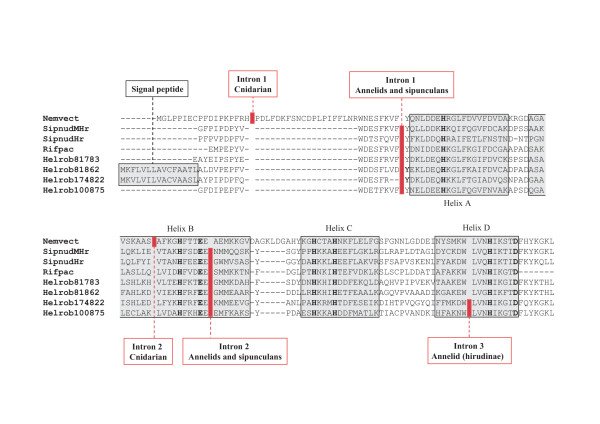
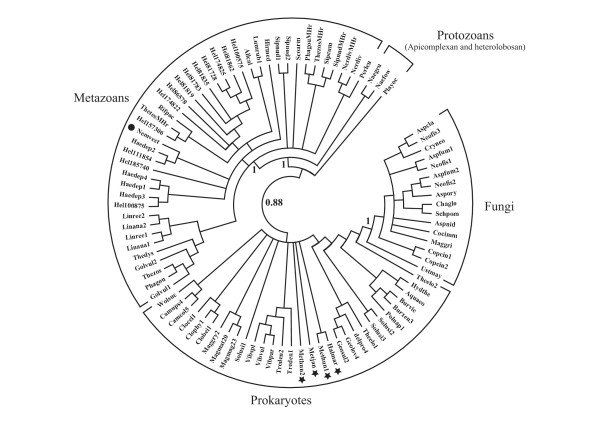
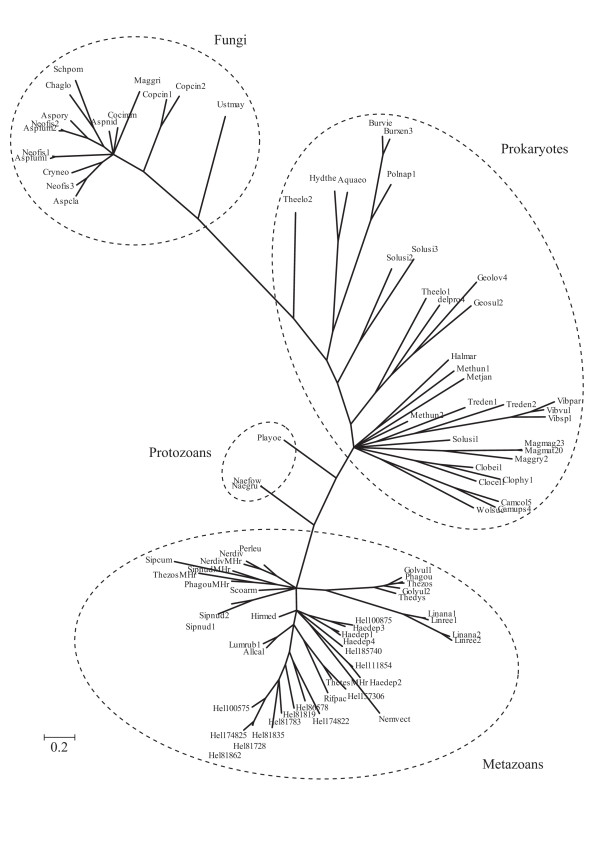
Results: A search for putative Hrs in the genomes of 43 archaea, 444 bacteria and 135 eukaryotes, revealed their presence in 3 archaea, 118 bacteria, several fungi, one apicomplexan, a heterolobosan, a cnidarian and several annelids. About a fourth of the Hr sequences were identified as N- or C-terminal domains of chimeric, chemotactic gene regulators. The function of the remaining single domain bacterial Hrs remains to be determined. In addition to oxygen transport, the possible functions in annelids have been proposed to include cadmium-binding, antibacterial action and immunoprotection. A Bayesian phylogenetic tree revealed a split into two clades, one encompassing archaea, bacteria and fungi, and the other comprising the remaining eukaryotes. The annelid and sipunculan Hrs share the same intron-exon structure, different from that of the cnidarian Hr.
Conclusion: The phylogenomic profile of Hrs demonstrated a limited occurrence in bacteria and archaea and a marked absence in the vast majority of multicellular organisms. Among the metazoa, Hrs have survived in a cnidarian and in a few protostome groups; hence, it appears that in metazoans the Hr gene was lost in deuterostome ancestor(s) after the radiata/bilateria split. Signal peptide sequences in several Hirudinea Hrs suggest for the first time, the possibility of extracellular localization. Since the alpha-helical bundle is likely to have been among the earliest protein folds, Hrs represent an ancient family of iron-binding proteins, whose primary function in bacteria may have been that of an oxygen sensor, enabling aerophilic or aerophobic responses. Although Hrs evolved to function as O2 transporters in brachiopods, priapulids and sipunculans, their function in annelids remains to be elucidated. Overall Hrs exhibit a considerable lack of evolutionary success in metazoans.
Figures
References
MeSH terms
Substances
LinkOut - more resources
Full Text Sources
