Paracetamol plus ibuprofen for the treatment of fever in children (PITCH): randomised controlled trial
- PMID: 18765450
- PMCID: PMC2528896
- DOI: 10.1136/bmj.a1302
Paracetamol plus ibuprofen for the treatment of fever in children (PITCH): randomised controlled trial
Erratum in
- BMJ. 2009;339:b3295
Abstract
Objective: To investigate whether paracetamol (acetaminophen) plus ibuprofen are superior to either drug alone for increasing time without fever and the relief of fever associated discomfort in febrile children managed at home.
Design: Individually randomised, blinded, three arm trial.
Setting: Primary care and households in England.
Participants: Children aged between 6 months and 6 years with axillary temperatures of at least 37.8 degrees C and up to 41.0 degrees C.
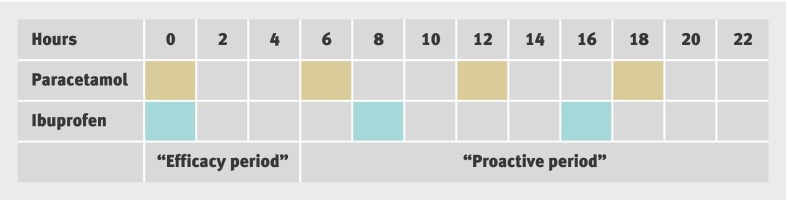
Intervention: Advice on physical measures to reduce temperature and the provision of, and advice to give, paracetamol plus ibuprofen, paracetamol alone, or ibuprofen alone.
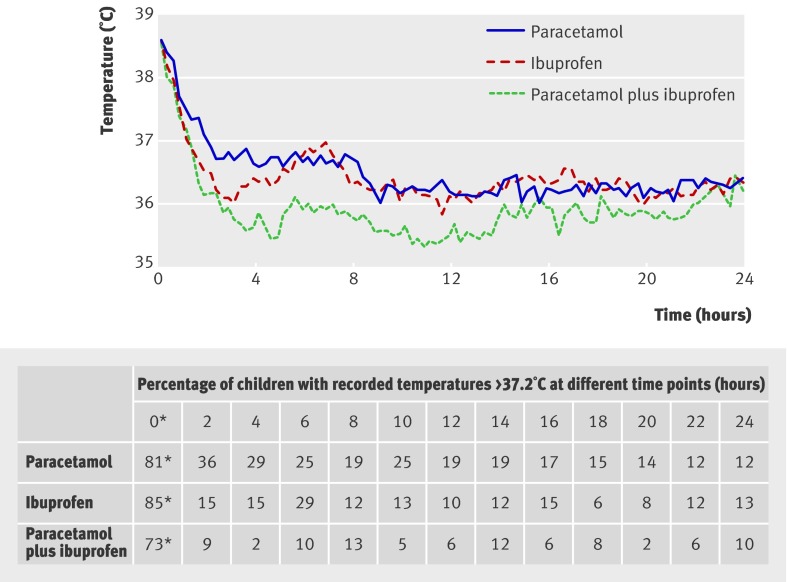
Main outcome measures: Primary outcomes were the time without fever (<37.2 degrees C) in the first four hours after the first dose was given and the proportion of children reported as being normal on the discomfort scale at 48 hours. Secondary outcomes were time to first occurrence of normal temperature (fever clearance), time without fever over 24 hours, fever associated symptoms, and adverse effects.
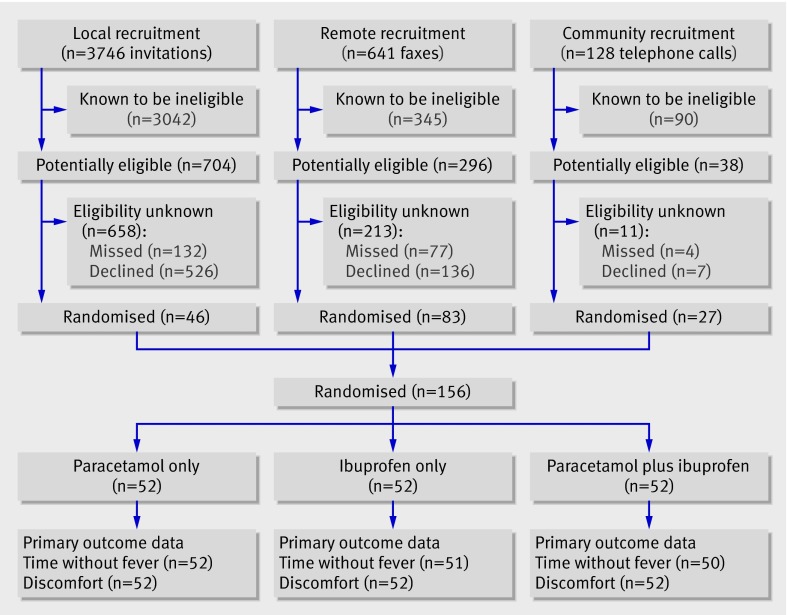
Results: On an intention to treat basis, paracetamol plus ibuprofen were superior to paracetamol for less time with fever in the first four hours (adjusted difference 55 minutes, 95% confidence interval 33 to 77; P<0.001) and may have been as good as ibuprofen (16 minutes, -7 to 39; P=0.2). For less time with fever over 24 hours, paracetamol plus ibuprofen were superior to paracetamol (4.4 hours, 2.4 to 6.3; P<0.001) and to ibuprofen (2.5 hours, 0.6 to 4.4; P=0.008). Combined therapy cleared fever 23 minutes (2 to 45; P=0.025) faster than paracetamol alone but no faster than ibuprofen alone (-3 minutes, 18 to -24; P=0.8). No benefit was found for discomfort or other symptoms, although power was low for these outcomes. Adverse effects did not differ between groups.
Conclusion: Parents, nurses, pharmacists, and doctors wanting to use medicines to supplement physical measures to maximise the time that children spend without fever should use ibuprofen first and consider the relative benefits and risks of using paracetamol plus ibuprofen over 24 hours.
Trial registration: Current Controlled Trials ISRCTN26362730.
Conflict of interest statement
Competing interests: None declared.
Figures
Comment in
-
Antipyretic treatment for feverish young children in primary care.BMJ. 2008 Sep 2;337:a1409. doi: 10.1136/bmj.a1409. BMJ. 2008. PMID: 18765451 No abstract available.
-
Combining paracetamol and ibuprofen for fever in children.BMJ. 2008 Sep 10;337:a1590. doi: 10.1136/bmj.a1590. BMJ. 2008. PMID: 18784169 No abstract available.
-
Ibuprofen increases soft tissue infections in children.BMJ. 2008 Sep 23;337:a1767. doi: 10.1136/bmj.a1767. BMJ. 2008. PMID: 18812372 No abstract available.
-
Do combination antipyretics work faster than ibuprofen alone in children?J Fam Pract. 2008 Dec;57(12):780. J Fam Pract. 2008. PMID: 19097338 No abstract available.
-
Paracetamol plus ibuprofen increased time without fever compared with paracetamol but did not differ from ibuprofen in children.Evid Based Nurs. 2009 Apr;12(2):41. doi: 10.1136/ebn.12.2.41. Evid Based Nurs. 2009. PMID: 19321818 No abstract available.
-
Evidence not persuasive for recommending a combination of ibuprofen and acetaminophen for feverish children.J Pediatr. 2009 Mar;154(3):461-2. doi: 10.1016/j.jpeds.2008.11.045. J Pediatr. 2009. PMID: 19874767 No abstract available.
References
-
- Hay AD, Heron J, Ness A, the ALSPAC study team. The prevalence of symptoms and consultations in pre-school children in the Avon Longitudinal Study of Parents and Children (ALSPAC): a prospective cohort study. Fam Pract 2005;22:367-74. - PubMed
-
- Management of childhood fever. Lancet 1991;338:1049-50. - PubMed
-
- National Institute for Health and Clinical Excellence. Feverish illness in children. Assessment and initial management in children younger than 5 years. London: NICE, 2007.
Publication types
MeSH terms
Substances
Associated data
Grants and funding
LinkOut - more resources
Full Text Sources
Other Literature Sources
Medical