Sleep disturbance and depression recurrence in community-dwelling older adults: a prospective study
- PMID: 18765482
- PMCID: PMC2707854
- DOI: 10.1176/appi.ajp.2008.07121882
Sleep disturbance and depression recurrence in community-dwelling older adults: a prospective study
Abstract
Objective: A prior depressive episode is thought to increase the risk of depression. However, among older adults with prior depression, it is unclear whether sleep disturbance predicts depression recurrence independent of other depressive symptoms.
Method: A 2-year prospective cohort study was conducted with 351 community-dwelling older adults ages 60 years and older: 145 persons with a history of major or nonmajor depression in full remission and 206 without a prior history of depression or any mental illness. The participants were assessed at baseline, 6 weeks, 1 year, and 2 years for depressive episodes, depressive symptoms, sleep quality, and chronic medical disease.
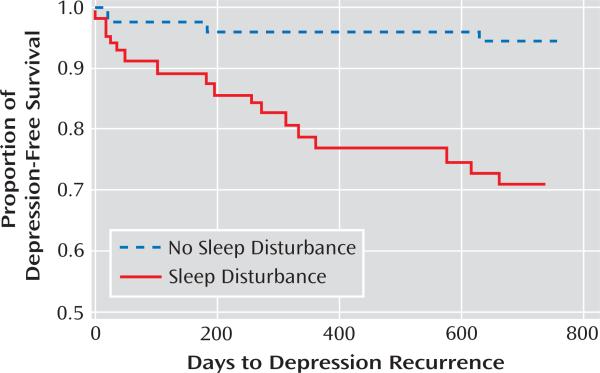
Results: Twenty-three subjects (16.9%) with prior depression developed depressive episodes during follow-up, compared to only one person in the group without prior mental illness (0.5%). Within the group with prior depression, depression recurrence was predicted by sleep disturbance, and this association was independent of other depressive symptoms, chronic medical disease, and antidepressant medication use.
Conclusions: This study is the first to demonstrate that sleep disturbance acts as an independent risk factor for depression recurrence in community-dwelling older adults. To identify older adults at risk for depression, a two-step strategy can be employed, which involves assessment of the presence of a prior depressive episode along with sleep disturbance.
Figures
Comment in
-
The rhythm of the blues.Am J Psychiatry. 2008 Dec;165(12):1501-4. doi: 10.1176/appi.ajp.2008.08081286. Am J Psychiatry. 2008. PMID: 19047326 Free PMC article. No abstract available.
References
-
- National Sleep Foundation: Sleep in America Poll 2002. www.sleepfoundation.org.
-
- Ohayon MM. Epidemiology of insomnia: what we know and what we still need to learn. Sleep Med Rev. 2002;6:97–111. - PubMed
-
- McCall WV. Diagnosis and management of insomnia in older people. J Am Geriatr Soc. 2005;53(7 suppl):S272–S277. - PubMed
-
- Haponik EF, Frye AW, Richards B, Wymer A, Hinds A, Pearce K, McCall V, Konen J. Sleep history is neglected diagnostic information: challenges for primary care physicians. J Gen Intern Med. 1996;11:759–761. - PubMed
Publication types
MeSH terms
Grants and funding
- M01 RR000865/RR/NCRR NIH HHS/United States
- T32 MH019925/MH/NIMH NIH HHS/United States
- K23 MH001948/MH/NIMH NIH HHS/United States
- R01 HL079955/HL/NHLBI NIH HHS/United States
- R01 MH055253/MH/NIMH NIH HHS/United States
- 5P30-AG02874/AG/NIA NIH HHS/United States
- R01 CA119159/CA/NCI NIH HHS/United States
- R01 AG026364/AG/NIA NIH HHS/United States
- T32 MH018399/MH/NIMH NIH HHS/United States
- T32-MH18399/MH/NIMH NIH HHS/United States
- R01 AG018367/AG/NIA NIH HHS/United States
- R01-AG18367/AG/NIA NIH HHS/United States
- P30 AG028748/AG/NIA NIH HHS/United States
- R01-MH55253/MH/NIMH NIH HHS/United States
LinkOut - more resources
Full Text Sources
Medical