


Amino acid regulation of TOR complex 1
- PMID: 18765678
- PMCID: PMC2670622
- DOI: 10.1152/ajpendo.90645.2008
Amino acid regulation of TOR complex 1
Abstract
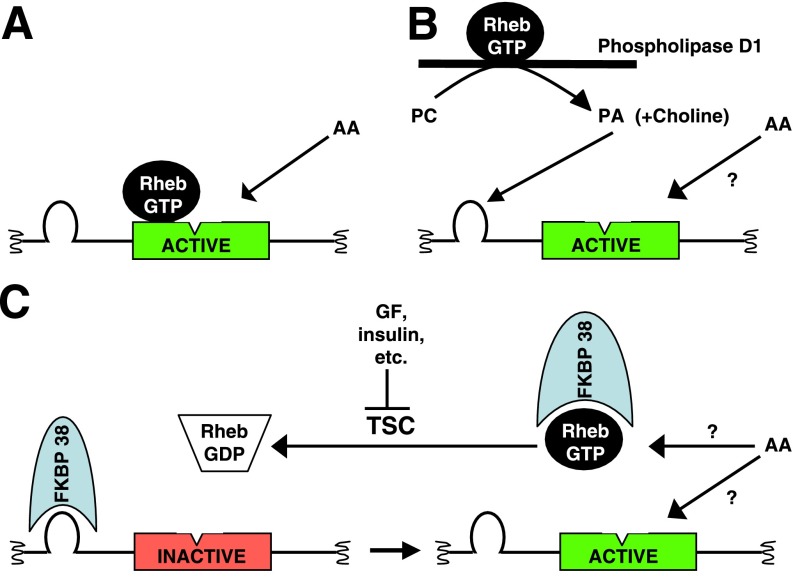
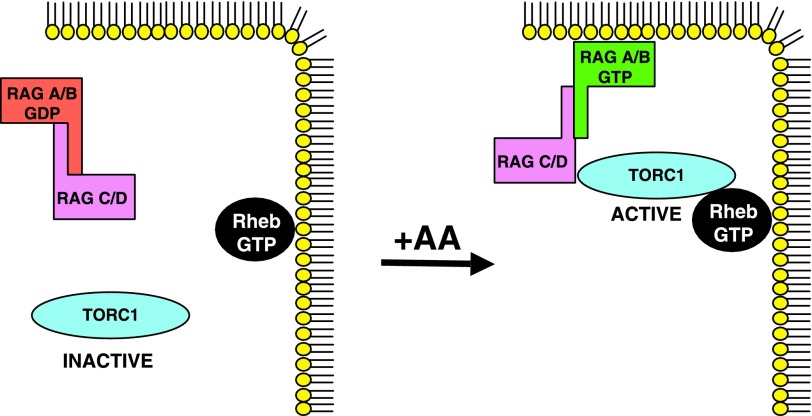
TOR complex 1 (TORC1), an oligomer of the mTOR (mammalian target of rapamycin) protein kinase, its substrate binding subunit raptor, and the polypeptide Lst8/GbetaL, controls cell growth in all eukaryotes in response to nutrient availability and in metazoans to insulin and growth factors, energy status, and stress conditions. This review focuses on the biochemical mechanisms that regulate mTORC1 kinase activity, with special emphasis on mTORC1 regulation by amino acids. The dominant positive regulator of mTORC1 is the GTP-charged form of the ras-like GTPase Rheb. Insulin, growth factors, and a variety of cellular stressors regulate mTORC1 by controlling Rheb GTP charging through modulating the activity of the tuberous sclerosis complex, the Rheb GTPase activating protein. In contrast, amino acids, especially leucine, regulate mTORC1 by controlling the ability of Rheb-GTP to activate mTORC1. Rheb binds directly to mTOR, an interaction that appears to be essential for mTORC1 activation. In addition, Rheb-GTP stimulates phospholipase D1 to generate phosphatidic acid, a positive effector of mTORC1 activation, and binds to the mTOR inhibitor FKBP38, to displace it from mTOR. The contribution of Rheb's regulation of PL-D1 and FKBP38 to mTORC1 activation, relative to Rheb's direct binding to mTOR, remains to be fully defined. The rag GTPases, functioning as obligatory heterodimers, are also required for amino acid regulation of mTORC1. As with amino acid deficiency, however, the inhibitory effect of rag depletion on mTORC1 can be overcome by Rheb overexpression, whereas Rheb depletion obviates rag's ability to activate mTORC1. The rag heterodimer interacts directly with mTORC1 and may direct mTORC1 to the Rheb-containing vesicular compartment in response to amino acid sufficiency, enabling Rheb-GTP activation of mTORC1. The type III phosphatidylinositol kinase also participates in amino acid-dependent mTORC1 activation, although the site of action of its product, 3'OH-phosphatidylinositol, in this process is unclear.
Figures
References
-
- Ali SM, Sabatini DM. Structure of S6 kinase 1 determines whether raptor-mTOR or rictor-mTOR phosphorylates its hydrophobic motif site. J Biol Chem 280: 19445–19448, 2005. - PubMed
-
- Anthony TG, McDaniel BJ, Byerley RL, McGrath BC, Cavener DR, McNurlan MA, Wek RC. Preservation of liver protein synthesis during dietary leucine deprivation occurs at the expense of skeletal muscle mass in mice deleted for eIF2 kinase GCN2. J Biol Chem 279: 36553–36561, 2004. - PubMed
-
- Aspuria PJ, Sato T, Tamanoi F. The TSC/Rheb/TOR signaling pathway in fission yeast and mammalian cells: temperature sensitive and constitutive active mutants of TOR. Cell Cycle 6: 1692–1695, 2007. - PubMed
-
- Backer JM The regulation and function of Class III PI3Ks: novel roles for Vps34. Biochem J 410: 1–17, 2008. - PubMed
-
- Bai X, Ma D, Liu A, Shen X, Wang QJ, Liu Y, Jiang Y. Rheb activates mTOR by antagonizing its endogenous inhibitor, FKBP38. Science 318: 977–980, 2007. - PubMed
Publication types
MeSH terms
Substances
Grants and funding
LinkOut - more resources
Full Text Sources
Other Literature Sources
Research Materials
Miscellaneous
