


Transplantation of a tyrosine editing domain into a tyrosyl-tRNA synthetase variant enhances its specificity for a tyrosine analog
- PMID: 18765802
- PMCID: PMC2533184
- DOI: 10.1073/pnas.0803531105
Transplantation of a tyrosine editing domain into a tyrosyl-tRNA synthetase variant enhances its specificity for a tyrosine analog
Abstract
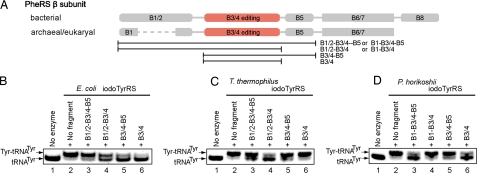
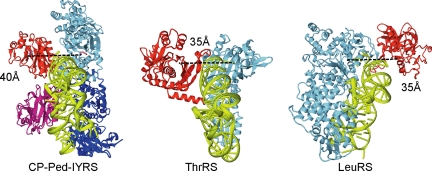
To guarantee specific tRNA and amino acid pairing, several aminoacyl-tRNA synthetases correct aminoacylation errors by deacylating or "editing" misaminoacylated tRNA. A previously developed variant of Escherichia coli tyrosyl-tRNA synthetase (iodoTyrRS) esterifies or "charges" tRNA(Tyr) with a nonnatural amino acid, 3-iodo-l-tyrosine, and with l-tyrosine less efficiently. In the present study, the editing domain of phenylalanyl-tRNA synthetase (PheRS) was transplanted into iodoTyrRS to edit tyrosyl-tRNA(Tyr) and thereby improve the overall specificity for 3-iodo-l-tyrosine. The beta-subunit fragments of the PheRSs from Pyrococcus horikoshii and two bacteria were tested for editing activity. The isolated B3/4 editing domain of the archaeal PheRS, which was exogenously added to the tyrosylation reaction with iodoTyrRS, efficiently reduced the production of tyrosyl-tRNA(Tyr). In addition, the transplantation of this domain into iodoTyrRS at the N terminus prevented tyrosyl-tRNA(Tyr) production most strongly among the tested fragments. We next transplanted this archaeal B3/4 editing domain into iodoTyrRS at several internal positions. Transplantation into the connective polypeptide in the Rossmann-fold domain generated a variant that efficiently charges tRNA(Tyr) with 3-iodo-l-tyrosine, but hardly produces tyrosyl-tRNA(Tyr). This variant, iodoTyrRS-ed, was used, together with an amber suppressor derived from tRNA(Tyr), in a wheat germ cell-free translation system and incorporated 3-iodo-l-tyrosine, but not l-tyrosine, in response to the amber codon. Thus, the editing-domain transplantation achieved unambiguous pairing between the tRNA and the nonnatural amino acid in an expanded genetic code.
Conflict of interest statement
The authors declare no conflict of interest.
Figures

Comment in
-
Proofreading optimizes iodotyrosine insertion into the genetic code.Proc Natl Acad Sci U S A. 2008 Sep 16;105(37):13699-700. doi: 10.1073/pnas.0807442105. Epub 2008 Sep 10. Proc Natl Acad Sci U S A. 2008. PMID: 18784368 Free PMC article. No abstract available.
References
-
- Fersht AR, Kaethner MM. Mechanism of aminoacylation of tRNA. Proof of the aminoacyl adenylate pathway for the isoleucyl- and tyrosyl-tRNA synthetases from Escherichia coli K12. Biochemistry. 1976;15:818–823. - PubMed
-
- Eriani G, Delarue M, Poch O, Gangloff J, Moras D. Partition of tRNA synthetases into two classes based on mutually exclusive sets of sequence motifs. Nature. 1990;347:203–206. - PubMed
-
- Fersht AR. Enzyme Structure and Mechanism. New York: Freeman; 1985.
-
- Lin L, Hale SP, Schimmel P. Aminoacylation error correction. Nature. 1996;384:33–34. - PubMed
Publication types
MeSH terms
Substances
LinkOut - more resources
Full Text Sources
Other Literature Sources
