Linking tobacco control policies and practices to early cancer endpoints: surveillance as an agent for change
- PMID: 18768485
- PMCID: PMC2768308
- DOI: 10.1158/1055-9965.EPI-08-0563
Linking tobacco control policies and practices to early cancer endpoints: surveillance as an agent for change
Abstract
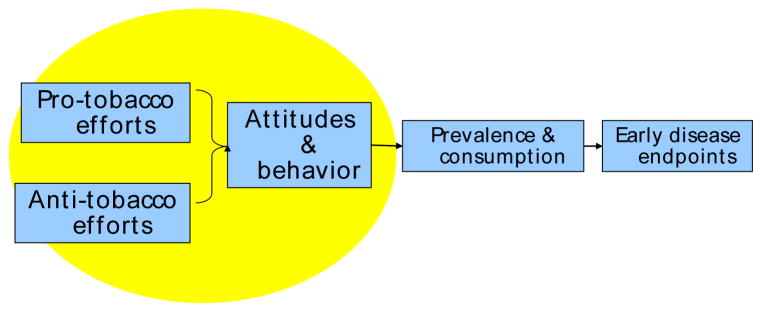
State tobacco control programs provide an important laboratory for the development, implementation, and evaluation of comprehensive tobacco control interventions. Studies have shown that states and municipalities with aggressive tobacco control programs have experienced more rapid decreases in per capita cigarette sales, smoking prevalence, lung cancer, and heart disease than entities without such programs. Despite strong evidence that population-level interventions are critical in achieving large and sustained reductions in tobacco use, states do not fund tobacco control efforts at levels recommended by the Centers for Disease Control and Prevention. Research on the effectiveness and cost effectiveness of these activities is essential to inform and strengthen tobacco control at the state level. A workshop, co-organized by the American Cancer Society, the National Cancer Institute, the American Association for Cancer Research, and the Centers for Disease Control and Prevention, was held in Philadelphia in December, 2007, to discuss the topic "Linking tobacco control policies and practices to early cancer endpoints: surveillance as an agent for change." Participants represented three different disciplines. Tobacco surveillance researchers described the data currently collected on state-level tobacco control policies, protobacco countermeasures by the industry, public attitudes toward tobacco use, and measures of smoking prevalence and consumption. Cancer registry experts described the geographic coverage of high quality, population-based cancer registries. Mathematical modeling experts discussed various modeling approaches that can be used to relate upstream tobacco promotion and control activities to downstream measures such as public attitudes, changes in tobacco use, and trends in tobacco-related diseases. The most important recommendation of the Workshop was a call for national leadership to enhance the collection and integration of data from multiple sources as a resource to further study and strengthen the scientific basis for tobacco control.
Figures
References
-
- National Cancer Institute. Tobacco Control Monograph 17. Bethesda, MD: U.S. Department of Health and Human Services, National Institutes of Health, National Cancer Institute; 2006. Evaluating ASSIST: A Blueprint for Understanding State-level Tobacco Control. NIH Pub No. 06-6058.
-
- Institute of Medicine. Ending the Tobacco Problem: A Blueprint for the Nation. Washington, D.C.: National Academy Press; 2007. p. 636.
-
- Centers for Disease Control and Prevention. Best Practices for Comprehensive Tobacco Control Programs. US Department of Health and Human Services, Centers for Disease Control and Prevention, National Center for Chronic Disease Prevention and Health Promotion, Office of Smoking and Health; Atlanta, GA: 2007.
-
- Backinger C, O’Connell M, Warner K, editors. Am J Preventive Med. 6 Suppl. Vol. 33. 2007. National Institutes of Health State-of the Science Statement on Tobacco Use, Prevention, Cessation, and Control; pp. S311–S424.
Publication types
MeSH terms
Grants and funding
LinkOut - more resources
Full Text Sources
Miscellaneous