. 2008 Sep 9;105(36):13327-32.
doi: 10.1073/pnas.0801466105. Epub 2008 Sep 3.

High-resolution x-ray structure of human aquaporin 5

Affiliations

High-resolution x-ray structure of human aquaporin 5

Rob Horsefield et al. Proc Natl Acad Sci U S A. .

Abstract

Human aquaporin 5 (HsAQP5) facilitates the transport of water across plasma membranes and has been identified within cells of the stomach, duodenum, pancreas, airways, lungs, salivary glands, sweat glands, eyes, lacrimal glands, and the inner ear. AQP5, like AQP2, is subject to posttranslational regulation by phosphorylation, at which point it is trafficked between intracellular storage compartments and the plasma membrane. Details concerning the molecular mechanism of membrane trafficking are unknown. Here we report the x-ray structure of HsAQP5 to 2.0-A resolution and highlight structural similarities and differences relative to other eukaryotic aquaporins. A lipid occludes the putative central pore, preventing the passage of gas or ions through the center of the tetramer. Multiple consensus phosphorylation sites are observed in the structure and their potential regulatory role is discussed. We postulate that a change in the conformation of the C terminus may arise from the phosphorylation of AQP5 and thereby signal trafficking.


Conflict of interest statement

The authors declare no conflict of interest.

Figures
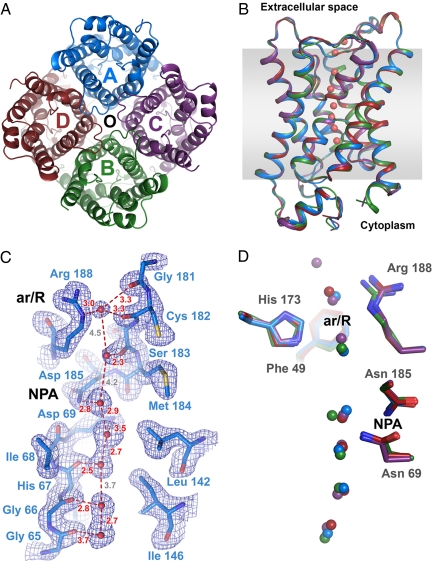
Fig. 1.
Fig. 1.
Overview of human aquaporin 5. (A) Top view of the tetramer from the cytoplasm along the membrane normal. The protomers, A-D, are shown in blue, green, purple, and red, respectively. The water channel in each protomer is labeled (A–D). The putative central pore on the pseudofourfold axis of the tetramer is marked with ○. (B) Side view of a structural overlay of all four protomers parallel to the membrane, with the same color scheme as in A. Waters for protomer A and the approximate membrane are shown (red spheres and gray shading). (C) Example of the final 2FobsFcalc electron density maps (blue mesh contoured at 1.2 σ) for the water channel of protomer A (blue sticks). Waters (red spheres) and distances (red dashes) are shown. Positions of the conserved NPA motif and constriction region (ar/R) are shown. (D) Comparison of water positions in each channel of the four protomers, showing six conserved locations. Asparagine side chains in the NPA motifs and residues of the constriction region (ar/R) are shown. Waters and side chains are colored according to their protomer, as in A.
Fig. 2.
Fig. 2.
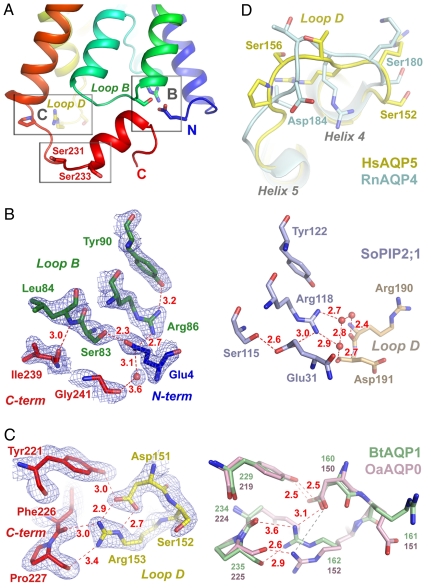
Structural comparison of the conserved sites identified in AQP5. (A) Overview of the cytoplasmic half of AQP5 in cartoon representation with residues colored according to sequence numbering where the N and C termini are blue and red, respectively. Residues distant in sequence, highlighted by color difference, form key interactions (boxes B and C), shown in detail in B and C. A putative phosphorylation site in the C terminus is also boxed and the side chains of Ser-231 and Ser-233 are shown. (B Left) Zoom window for box B in A showing backbone and side chain interactions responsible for anchoring the N (blue) and C termini (red) to helix 3 (green) with 2FobsFcalc density map (blue mesh contoured at 1.2 σ). (B Right) Same view for SoPIP2;1 highlighting how conserved residues anchor loop D. (C Left) Zoom window for box C in A showing backbone and side-chain interactions responsible for anchoring the C terminus (red) to loop D (yellow) with 2FobsFcalc density map (blue mesh contoured at 1.2 σ). (C Right) Same view for AQP1 and AQP0 highlighting conserved residues. (D) Comparison of the conformation of loop D in AQP5 (yellow) and AQP4 (blue).
Fig. 3.
Fig. 3.
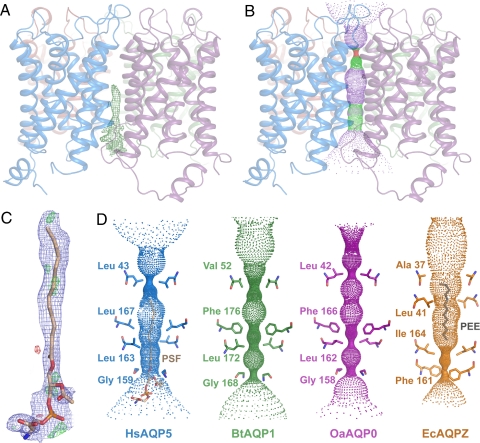
Lipid blocking the putative central pore of the AQP5 tetramer. (A) Overview of the tetramer, viewed parallel to the membrane, showing continuous excess electron density in the composite omit map (green mesh contoured at 1.2 σ), at the center of the tetramer. (B) Identical to A but showing the profile of the central pore calculated by HOLE. Red and green zones identify constricted and open regions, respectively. (C) Final refined model for the lipid with 2FobsFcalc map (blue mesh contoured at 0.9 σ). Positive (light green) and negative (red) peaks in the FobsFcalc map are also shown (contoured at 2.8 and −2.8 σ, respectively). (D) HOLE representation of the profile of the central pores of HsAQP5 (blue) compared with BtAQP1 (green), OaAQP0 (purple), and EcAQPZ (orange). Side chains constricting the pores are shown for two opposite protomers in each case. Lipid molecules found in the central pores of AQP5 (phosphatidylserine, PSF) and AQPZ (phosphatidylethanolamine, PEE) are also shown in beige and gray, respectively.

References

    1. Preston GM, Carroll TP, Guggino WB, Agre P. Appearance of water channels in Xenopus oocytes expressing red cell CHIP28 protein. Science. 1992;256:385–387. - PubMed
    1. King LS, Kozono D, Agre P. From structure to disease: The evolving tale of aquaporin biology. Nat Rev Mol Cell Biol. 2004;5:687–698. - PubMed
    1. Krane CM, Goldstein DL. Comparative functional analysis of aquaporins/glyceroporins in mammals and anurans. Mamm Genome. 2007;18:452–462. - PMC - PubMed
    1. Gonen T, Sliz P, Kistler J, Cheng Y, Walz T. Aquaporin-0 membrane junctions reveal the structure of a closed water pore. Nature. 2004;429:193–197. - PubMed
    1. Harries WE, Akhavan D, Miercke LJ, Khademi S, Stroud RM. The channel architecture of aquaporin 0 at a 2.2 Å resolution. Proc Natl Acad Sci USA. 2004;101:14045–14050. - PMC - PubMed

Publication types

Associated data