


Antiretroviral therapy prior to acute viral replication preserves CD4 T cells in the periphery but not in rectal mucosa during acute simian immunodeficiency virus infection
- PMID: 18768962
- PMCID: PMC2573260
- DOI: 10.1128/JVI.01143-08
Antiretroviral therapy prior to acute viral replication preserves CD4 T cells in the periphery but not in rectal mucosa during acute simian immunodeficiency virus infection
Abstract
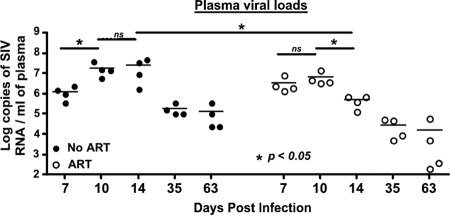
The rectal mucosa is a major site for human immunodeficiency virus entry and CD4 T-cell depletion. The early and near-total loss of these cells from the rectal mucosa severely compromises the ability of the mucosal immune system to control various opportunistic infections. Protecting these cells from infection and destruction can delay disease progression, leading to a better long-term outcome. Here we show that effective suppression of viral infection in memory CD4 T cells from the rectal mucosa and peripheral blood to a very low level with antiretroviral therapy (ART) initiated prior to the peak of infection is associated with opposite outcomes in these tissues. A near-total loss of CD4 T cells in the rectal mucosa contrasted with preservation of most memory CD4 T cells in peripheral blood during the course of treatment. Interestingly, ART significantly reduced viral infection in memory CD4 T cells from both rectal mucosa and peripheral blood. Although early ART was of limited value in protecting the CD4 T cells in the rectal mucosa, the significant preservation of peripheral CD4 T cells could contribute to maintaining immune competence, leading to a better long-term outcome.
Figures


References
-
- Anthony, K. B., C. Yoder, J. A. Metcalf, R. DerSimonian, J. M. Orenstein, R. A. Stevens, J. Falloon, M. A. Polis, H. C. Lane, and I. Sereti. 2003. Incomplete CD4 T cell recovery in HIV-1 infection after 12 months of highly active antiretroviral therapy is associated with ongoing increased CD4 T cell activation and turnover. J. Acquir. Immune Defic. Syndr. 33125-133. - PubMed
-
- Arthos, J., C. Cicala, E. Martinelli, K. Macleod, D. Van Ryk, D. Wei, Z. Xiao, T. D. Veenstra, T. P. Conrad, R. A. Lempicki, S. McLaughlin, M. Pascuccio, R. Gopaul, J. McNally, C. C. Cruz, N. Censoplano, E. Chung, K. N. Reitano, S. Kottilil, D. J. Goode, and A. S. Fauci. 2008. HIV-1 envelope protein binds to and signals through integrin alpha4beta7, the gut mucosal homing receptor for peripheral T cells. Nat. Immunol. 9301-309. - PubMed
-
- Belmonte, L., M. Olmos, A. Fanin, C. Parodi, P. Bare, H. Concetti, H. Perez, M. M. de Bracco, and P. Cahn. 2007. The intestinal mucosa as a reservoir of HIV-1 infection after successful HAART. AIDS 212106-2108. - PubMed
-
- Boirivant, M., M. Viora, L. Giordani, A. L. Luzzati, A. M. Pronio, C. Montesani, and O. Pugliese. 1998. HIV-1 gp120 accelerates Fas-mediated activation-induced human lamina propria T cell apoptosis. J. Clin. Immunol. 1839-47. - PubMed
Publication types
MeSH terms
Grants and funding
LinkOut - more resources
Full Text Sources
Other Literature Sources
Medical
Research Materials
