


Review
doi: 10.1038/jp.2008.132.
Epub 2008 Sep 4.
Potential of immunomodulatory agents for prevention and treatment of neonatal sepsis
Affiliations
- PMID: 18769381
- PMCID: PMC3971053
- DOI: 10.1038/jp.2008.132
Item in Clipboard
Review
Potential of immunomodulatory agents for prevention and treatment of neonatal sepsis
J Perinatol.
2009 Feb.
Erratum in
- J Perinatol. 2009 Jul;29(7):527
Abstract
Prevention of neonatal infection-related mortality represents a significant global challenge particularly in the vulnerable premature population. The increased risk of death from sepsis is likely due to the specific immune deficits found in the neonate as compared to the adult. Stimulation of the neonatal immune system to prevent and/or treat infection has been attempted in the past largely without success. In this review, we identify some of the known deficits in the neonatal immune system and their clinical impact, summarize previous attempts at immunomodulation and the outcomes of these interventions, and discuss the potential of novel immunomodulatory therapies to improve neonatal sepsis outcome.
Figures

The interaction between intestinal bacteria and intestinal epithelium is necessary for homeostasis and normal function of repair mechanisms. Disruption of this interaction, through the use of antibiotics or via stress to the organism (i.e. remote infection or hypoxia), results in loss of homeostasis and degradation of the intestinal boundaries with subsequent microbial translocation.

Schematic representation of toll-like receptors, both cell surface and endocytic, as well as their respective ligands. Stimulation of these receptors causes enhanced immune function through increased cellular cytokine production and improvement of antimicrobial effector mechanisms such as cellular phagocytosis and antimicrobial protein and peptide (APP) production. LTA-lipotechoic acid. PG-peptidoglycan. LPS-lipopolysaccharide.
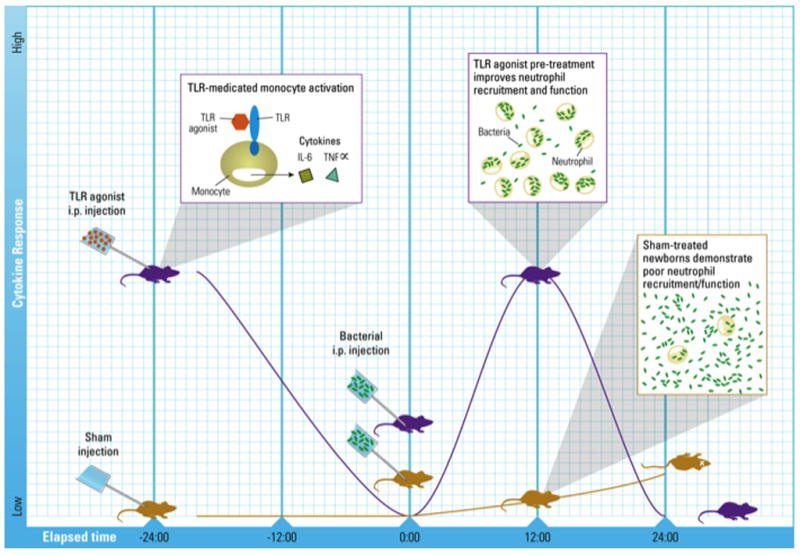
Systemic administration of select TLR agonists prior to the initiation of experimental polymicrobial sepsis significantly reduces murine neonatal mortality and is associated with a more robust but shortened inflammatory response and unique improvements in cell function (increased phagocytosis and reactive oxygen species production) with associated decreases in bacteremia as compared to saline pretreated neonatal mice.
References
-
- Lawn JE, Cousens S, Zupan J. 4 million neonatal deaths: when? Where? Why? Lancet. 2005 Mar 5–11;365(9462):891–900. - PubMed
-
- Marodi L. Innate cellular immune responses in newborns. Clin Immunol. 2006 Feb-Mar;118(2–3):137–44. - PubMed
-
- Martin GS, Mannino DM, Eaton S, Moss M. The epidemiology of sepsis in the United States from 1979 through 2000. N Engl J Med. 2003 Apr 17;348(16):1546–54. - PubMed
-
- Barton P, Kalil AC, Nadel S, Goldstein B, Okhuysen-Cawley R, Brilli RJ, et al. Safety, pharmacokinetics, and pharmacodynamics of drotrecogin alfa (activated) in children with severe sepsis. Pediatrics. 2004 Jan;113(1 Pt 1):7–17. - PubMed
-
- Martinot A, Leclerc F, Cremer R, Leteurtre S, Fourier C, Hue V. Sepsis in neonates and children: definitions, epidemiology, and outcome. Pediatr Emerg Care. 1997 Aug;13(4):277–81. - PubMed
Publication types
MeSH terms
Substances
Grants and funding
LinkOut - more resources
Full Text Sources
Medical
Miscellaneous
