Review
. 2008 Oct;9(10):759-67.
doi: 10.1038/nrn2474. Epub 2008 Sep 4.

The insulin paradox: aging, proteotoxicity and neurodegeneration

Affiliations
Review

The insulin paradox: aging, proteotoxicity and neurodegeneration

Ehud Cohen et al. Nat Rev Neurosci. 2008 Oct.

Abstract

Distinct human neurodegenerative diseases share remarkably similar temporal emergence patterns, even though different toxic proteins are involved in their onset. Typically, familial neurodegenerative diseases emerge during the fifth decade of life, whereas sporadic cases do not exhibit symptoms earlier than the seventh decade. Recently, mechanistic links between the aging process and toxic protein aggregation, a common hallmark of neurodegenerative diseases, have been revealed. The insulin/insulin-like growth factor 1 (IGF1) signalling pathway - a lifespan, metabolism and stress-resistance regulator - links neurodegeneration to the aging process. Thus, although a reduction of insulin signalling can result in diabetes, its reduction can also increase longevity and delay the onset of protein-aggregation-mediated toxicity. Here we review this apparent paradox and delineate the therapeutic potential of manipulating the insulin/IGF1 signalling pathway for the treatment of neurodegenerative diseases.


Figures
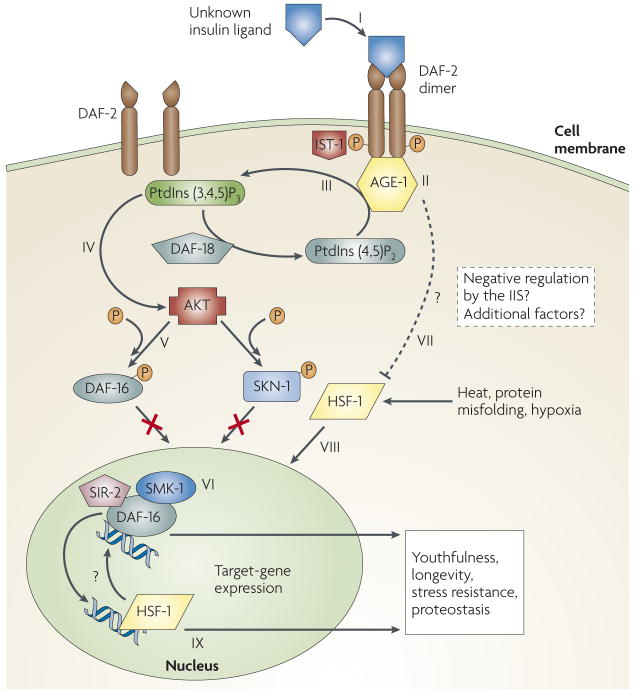
Figure 1
Figure 1. The Caenorhabditis elegans IIS pathway
The binding of an as-yet-undefined ligand to DAF-2, the sole insulin/insulin-like growth factor 1 (IGF-1) receptor of C. elegans (I), triggers the insulin/IGF-1 signalling (IIS) pathway. This binding leads to DAF-2 self-phosphorylation and dimerization and to the recruitment of the phosphatidylinositol 3-kinase AGE-1 (II) and the insulin receptor substrate 1 orthologue IST-1. AGE-1 catalyses the generation of phosphatidylinositol-3,4,5-trisphosphate (PtdIns(3,4,5)P3) (III), a molecule that activates kinases of the AKT family (IV). The phosphatase DAF-18 (a PTEN orthologue) opposes AGE-1 activity by converting PtdIns(3,4,5)P3 to phospatidylinositol-4,5-bisphosphate (PtdIns(4,5)P2); this leads to reduced AKT activation. Activated AKT phosphorylates the FOXO transcription factor DAF-16 (V), preventing it from entering the nucleus, where it would otherwise interact with its cofactors, including SMK-1 and SIR-2, and regulate its target genes (VI), which mediate longevity and stress resistance. Similarly, IIS prevents the transcription factor SKN-1 from entering the nucleus and executing its gene-expression functions. Heat-shock factor 1 (HSF-1) is also critical for the longevity functions of IIS (VII) and might be negatively regulated by the IIS pathway (dashed line). HSF-1 regulates the expression of key gene networks (IX) that are required for longevity and stress resistance, some of which are probably also regulated by DAF-16.
Figure 2
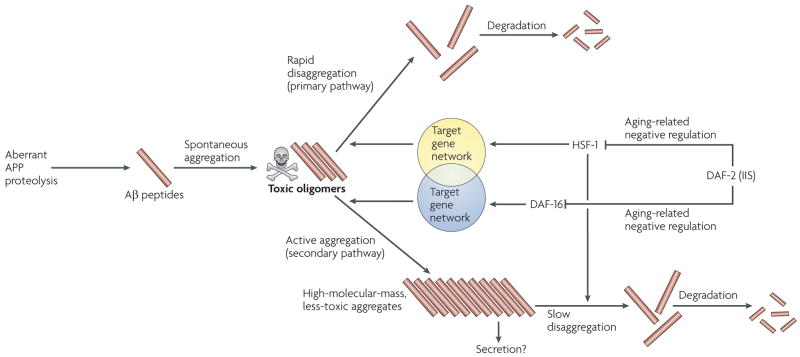
Figure 2. The IIS pathway links aging and proteotoxicity
Serial digestion of amyloid precursor protein (APP) releases aggregation-prone amyloid-β (Aβ) peptides, which spontaneously form small toxic oligomers. Heat-shock factor 1 (HSF-1)-regulated disaggregation machinery disrupts the Aβ aggregates and prepares them for degradation. When the disaggregation pathway is overtaxed, a DAF-16-regulated active aggregation activity creates high-molecular-mass aggregates of lower toxicity that might subsequently be secreted from the cell. If they are not secreted, the high-molecular-mass aggregates undergo slow disaggregation and subsequent degradation. The insulin/insulin-like growth factor 1 signalling (IIS) pathway compromises the activity of both protective mechanisms in an age-dependent manner by negatively regulating HSF-1 and DAF-16.
Figure 3
Figure 3. Optimal-IIS-rate model
a | Each organism and each tissue has an optimal insulin/insulin-like growth factor 1 (IGF1) signalling (IIS) level that ensures maximal health and longevity. IIS rates that are either lower or higher than optimal will cause disease and reduce lifespan. b | The natural IIS rate of well-fed Caenorhabditis elegans is tuned to be at the high zone. Thus, feeding them with bacteria that knock down their daf-2 RNA through RNA interference (RNAi) reduces the rate of IIS and extends their health and lifespan. Mutated daf-2 alleles further reduce IIS and provide maximal longevity, whereas daf-2 inactivation or over-reduction causes lethality. c | In mice that harbour only one copy of Igf1r, the reduction in brain IIS provides stress resistance and extends lifespan. Similarly, the optimal IIS model proposes that IGF1 infusion activates feedback loops that reduce IIS in the brain, leading to similar outcomes. Igf1r-null mice are embryonic lethal.
Figure 4
Figure 4. Age-associated decline of counter-proteotoxic activities leads to late-onset neurodegeneration
The balance between the rate of toxic protein aggregation and the cellular detoxification capacity determines the age at which the amount of toxic aggregates will cross the threshold level that is required for disease onset. A higher aggregation load and lower protective activities will lead to early disease onset, such as in familial neurodegenerative diseases, whereas lower aggregation load and higher protective capabilities will postpone the age of disease onset. This model proposes that the similar age-of-onset of different neurodegenerative diseases stems from one phenomenon, the age-related decline in natural counter-proteotoxic activities.

References

    1. Reichel W. The biology of aging. J Am Geriatr Soc. 1966;14:431–436. - PubMed
    1. Bishop NA, Guarente L. Genetic links between diet and lifespan: shared mechanisms from yeast to humans. Nature Rev Genet. 2007;8:835–844. - PubMed
    1. Mair W, Dillin A. Aging and survival: the genetics of life span extension by dietary restriction. Annu Rev Biochem. 2008;77:727–754. - PubMed
    1. Kenyon C, Chang J, Gensch E, Rudner A, Tabtiang R. A C. elegans mutant that lives twice as long as wild type. Nature. 1993;366:461–464. - PubMed
    1. Giannakou ME, Partridge L. Role of insulin-like signalling in Drosophila lifespan. Trends Biochem Sci. 2007;32:180–188. - PubMed

MeSH terms