Comparative Study
. 2008;10(5):R74.
doi: 10.1186/bcr2139. Epub 2008 Sep 4.

A divergent role for estrogen receptor-beta in node-positive and node-negative breast cancer classified according to molecular subtypes: an observational prospective study

Affiliations
Comparative Study

A divergent role for estrogen receptor-beta in node-positive and node-negative breast cancer classified according to molecular subtypes: an observational prospective study

Flavia Novelli et al. Breast Cancer Res. 2008.

Abstract

Introduction: Estrogen receptor-alpha (ER-alpha) and progesterone receptor (PgR) are consolidated predictors of response to hormonal therapy (HT). In contrast, little information regarding the role of estrogen receptor-beta (ER-beta) in various breast cancer risk groups treated with different therapeutic regimens is available. In particular, there are no data concerning ER-beta distribution within the novel molecular breast cancer subtypes luminal A (LA) and luminal B (LB), HER2 (HS), and triple-negative (TN).

Methods: We conducted an observational prospective study using immunohistochemistry to evaluate ER-beta expression in 936 breast carcinomas. Associations with conventional biopathological factors and with molecular subtypes were analyzed by multiple correspondence analysis (MCA), while univariate and multivariate Cox regression analysis and classification and regression tree analysis were applied to determine the impact of ER-beta on disease-free survival in the 728 patients with complete follow-up data.

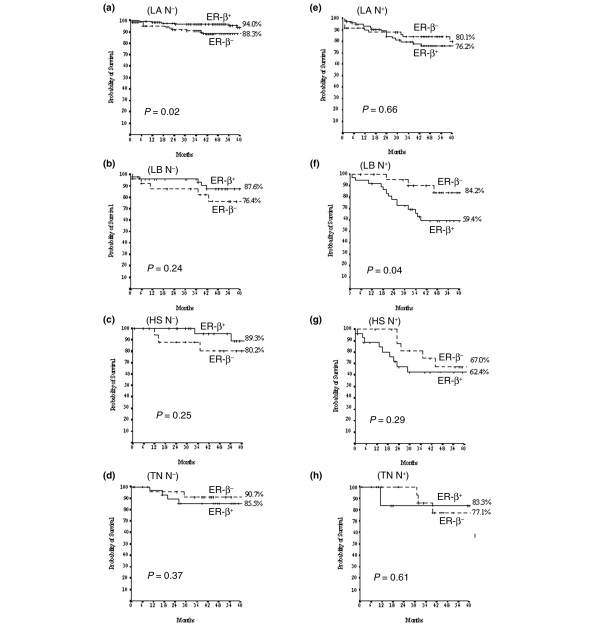
Results: ER-beta evenly distributes (55.5%) across the four molecular breast cancer subtypes, confirming the lack of correlation between ER-beta and classical prognosticators. However, the relationships among the biopathological factors, analyzed by MCA, showed that ER-beta positivity is located in the quadrant containing more aggressive phenotypes such as HER2 and TN or ER-alpha/PgR/Bcl2- tumors. Kaplan-Meier curves and Cox regression analysis identified ER-beta as a significant discriminating factor for disease-free survival both in the node-negative LA (P = 0.02) subgroup, where it is predictive of response to HT, and in the node-positive LB (P = 0.04) group, where, in association with PgR negativity, it conveys a higher risk of relapse.

Conclusion: Our data indicated that, in contrast to node-negative patients, in node-positive breast cancer patients, ER-beta positivity appears to be a biomarker related to a more aggressive clinical course. In this context, further investigations are necessary to better assess the role of the different ER-beta isoforms.


Figures
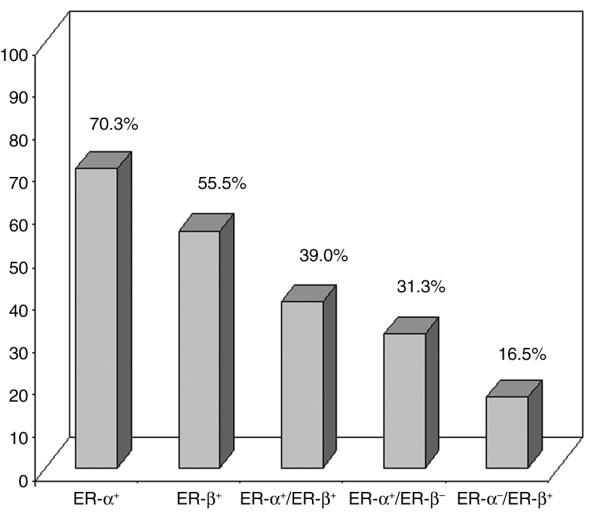
Figure 1
Figure 1
ER-alpha (ER-α) and ER-beta (ER-β) distribution in breast carcinomas. Estrogen receptor-alpha (ER-α) and estrogen receptor-beta (ER-β) frequency and coexpression in 936 invasive breast carcinomas in an observational prospective study.
Figure 2
Figure 2
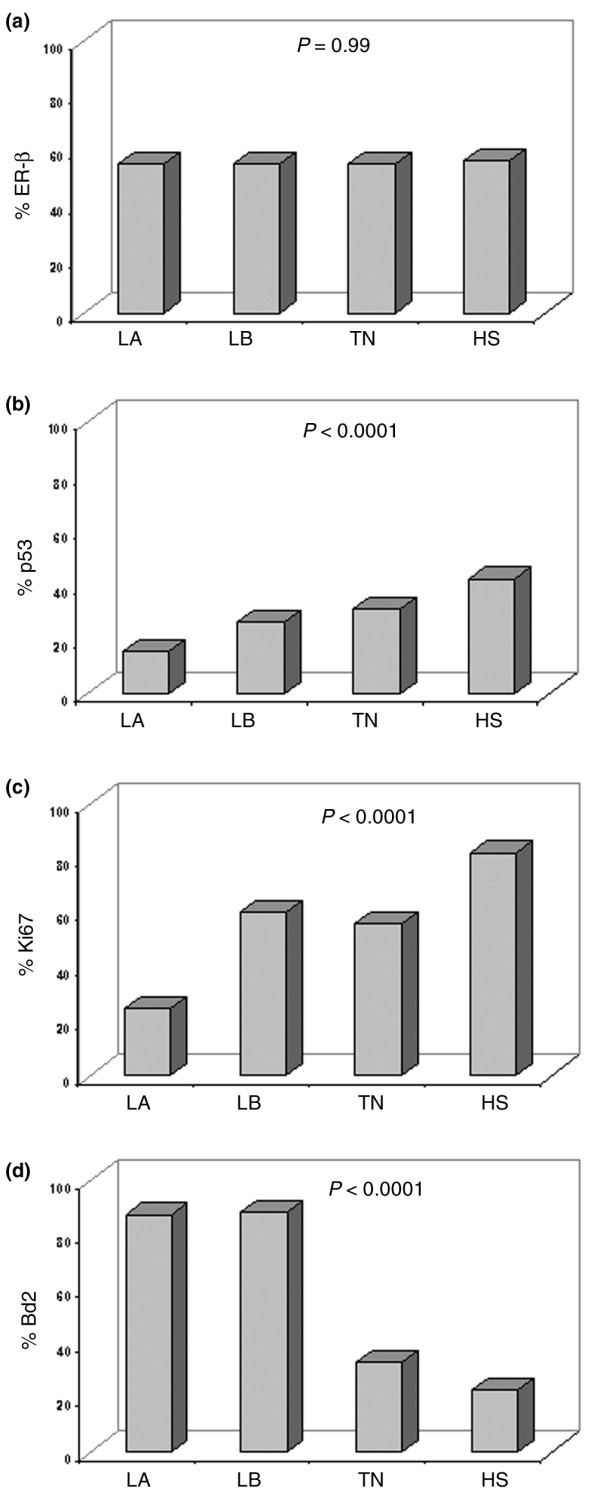
ER-beta (ER-β), p53, Ki-67 and Bcl2 distribution within BC molecular subtypes. Estrogen receptor-beta (ER-β) evenly distributes (55% to 56%, P = 0.99) across the four molecular subtypes (a), whereas the percentages of p53 (b) and Ki67+ (c) tumors significantly increased (P < 0.0001) and the percentage of Bcl2 significantly decreased (P < 0.0001) moving from the luminal A (LA) phenotype to luminal B (LB), triple-negative (TN), and HER2 (HS) (d).
Figure 3
Figure 3
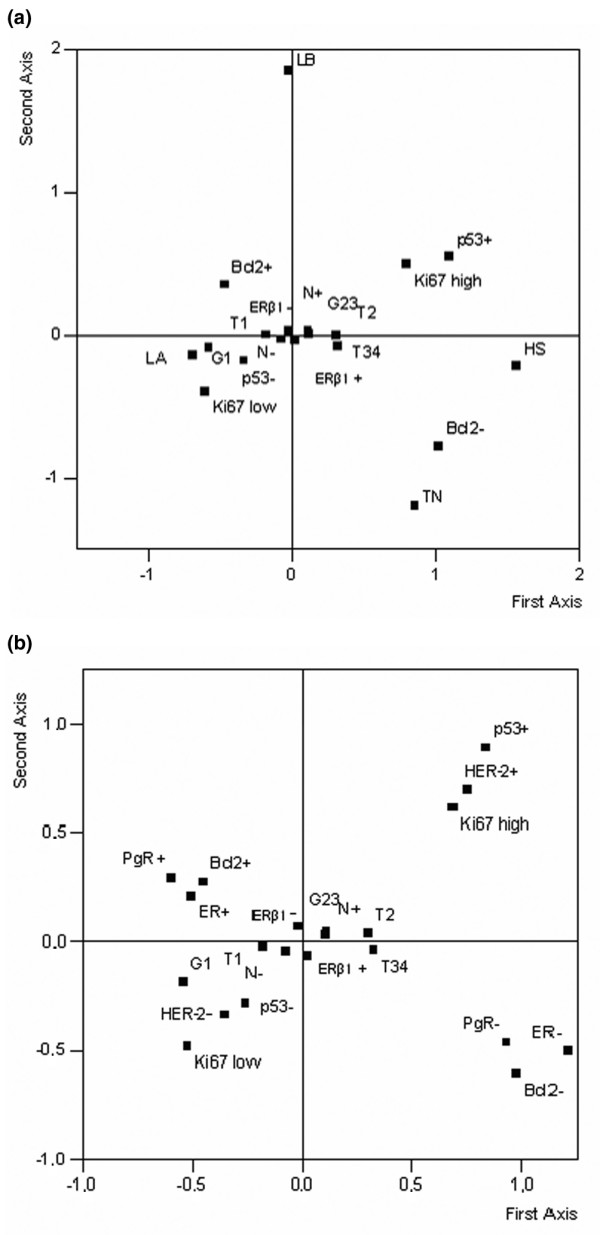
Multiple correspondence analysis of the 936 breast carcinomas. Multiple correspondence analysis of the 936 invasive breast carcinomas. Estrogen receptor-beta (ER-β) positivity is located in the quadrant containing more aggressive phenotypes such as HER2 (HS) and triple-negative (TN) (a) or estrogen receptor-alpha, progesterone receptor (PgR), and Bcl2-negative tumors (b). LA, luminal A; LB, luminal B; N-, node-negative; N+, node-positive.
Figure 4
Figure 4
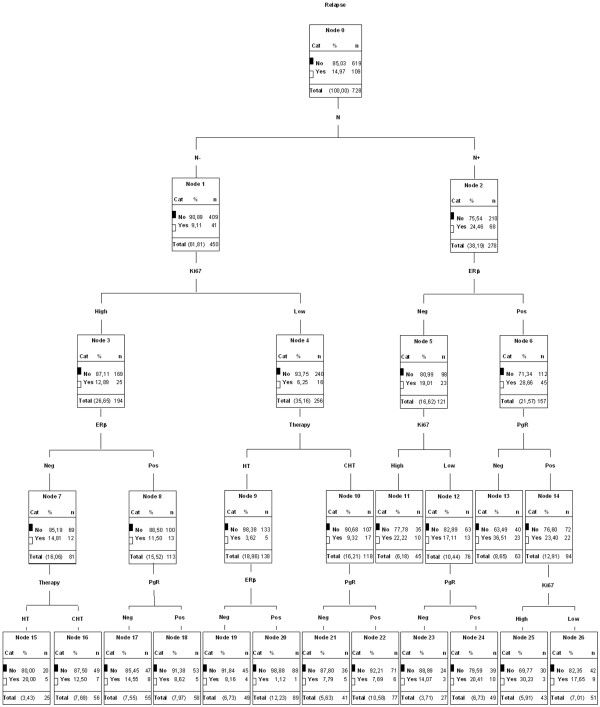
Classification and regression tree analysis (C&RT) of the 728 patients with known follow-up. Classification and regression tree analysis of 728 patients with known follow-up predicts which patient belongs to which specific class (good or poor clinical outcome) on the basis of clinical and biopathological information. Diagram shows diagnostic algorithm generated by AnswerTree 3.1 software, Statistical Package for the Social Sciences (SPSS Inc., Chicago, IL, USA). CHT, chemotherapy; ER-β, estrogen receptor-beta; HT, hormonal therapy, N-, node-negative; N+, node-positive; No, absence of recurrences; PgR, progesterone receptor; Yes, presence of recurrences.
Figure 5
Figure 5
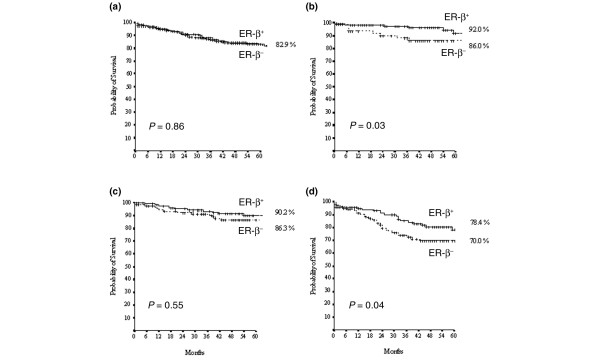
Kaplan-Meier estimates of disease-free survival for estrogen receptor-beta (ER-β) status. Kaplan-Meier estimates of disease-free survival for estrogen receptor-beta (ER-β) status in the whole patient group (a), in the 210 node-negative patients treated exclusively with hormonal therapy (b), in the 240 node-negative patients subjected to adjuvant chemotherapy followed or not followed by hormonal therapy (c), and in the 246 node-positive patients subjected to adjuvant chemotherapy followed or not followed by hormonal therapy (d). P values were calculated using the log-rank test.
Figure 6
Figure 6
Kaplan-Meier estimates of disease-free survival for estrogen receptor-beta (ER-β) status within the molecular subtypes. Kaplan-Meier estimates of disease-free survival for estrogen receptor-beta (ER-β) status within the molecular subtypes and according to negative (N-) or positive (N+) nodal status, respectively, in each subgroup: luminal A (LA) (a, e), luminal B (LB) (b, f), HER2 (HS) (c, g), and triple-negative (TN) (d, h). P values were calculated using the log-rank test.

Comment in

References

    1. Russo J, Russo IH. The role of estrogen in the initiation of breast cancer. J Steroid Biochem Mol Biol. 2006;102:89–96. doi: 10.1016/j.jsbmb.2006.09.004. - DOI - PMC - PubMed
    1. Speirs V, Malone C, Walton DS, Kerin MJ, Atkin SL. Increased expression of estrogen receptor beta mRNA in tamoxifen-resistant breast cancer patients. Cancer Res. 1999;59:5421–5424. - PubMed
    1. Gruvberger-Saal SK, Bendahl PO, Saal LH, Laakso M, Hegardt C, Edén P, Peterson C, Malmström P, Isola J, Borg A, Fernö M. Estrogen receptor beta expression is associated with tamoxifen response in ERalpha-negative breast carcinoma. Clin Cancer Res. 2007;13:1987–1994. doi: 10.1158/1078-0432.CCR-06-1823. - DOI - PubMed
    1. Wessler S, Otto C, Wilck N, Stangl V, Fritzemeier KH. Identification of estrogen receptor ligands leading to activation of non-genomic signaling pathways while exhibiting only weak transcriptional activity. J Steroid Biochem Mol Biol. 2006;98:25–35. doi: 10.1016/j.jsbmb.2005.08.003. - DOI - PubMed
    1. Paech K, Webb P, Kuiper GG, Nilsson S, Gustafsson J, Kushner PJ, Scanlan TS. Differential ligand activation of estrogen receptors ERalpha and ERbeta at AP1 sites. Science. 1997;277:1508–1510. doi: 10.1126/science.277.5331.1508. - DOI - PubMed

Publication types

MeSH terms