


Change in uptake, transport and accumulation of ions in Nerium oleander (rosebay) as affected by different nitrogen sources and salinity
- PMID: 18772147
- PMCID: PMC2712379
- DOI: 10.1093/aob/mcn156
Change in uptake, transport and accumulation of ions in Nerium oleander (rosebay) as affected by different nitrogen sources and salinity
Abstract
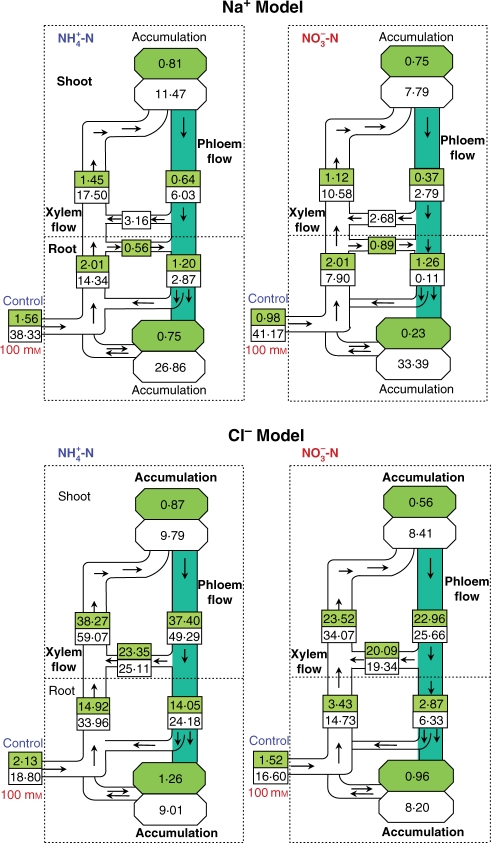
Background and aims: The source of nitrogen plays an important role in salt tolerance of plants. In this study, the effects of NaCl on net uptake, accumulation and transport of ions were investigated in Nerium oleander with ammonium or nitrate as the nitrogen source in order to analyse differences in uptake and cycling of ions within plants.
Methods: Plants were grown in a greenhouse in hydroponics under different salt treatments (control vs. 100 mm NaCl) with ammonium or nitrate as the nitrogen source, and changes in ion concentration in plants, xylem sap exuded from roots and stems, and phloem sap were determined.
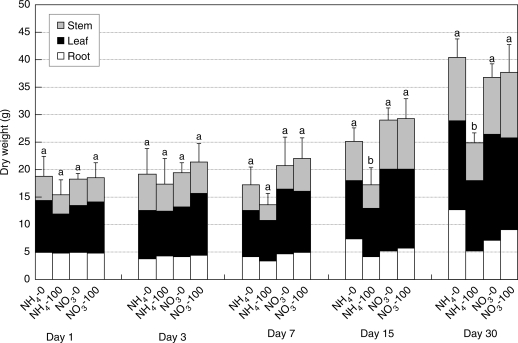
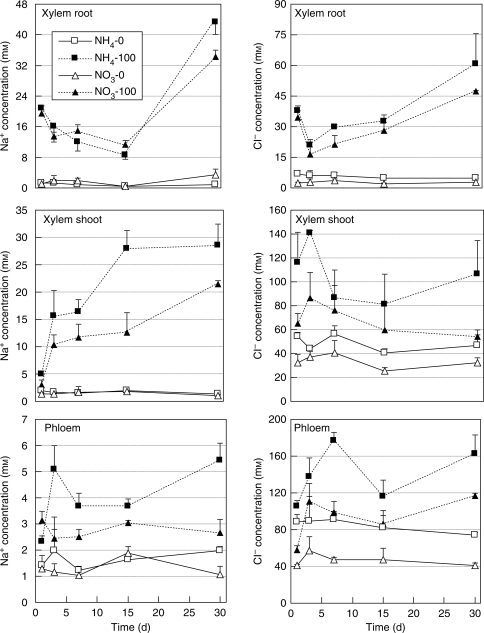
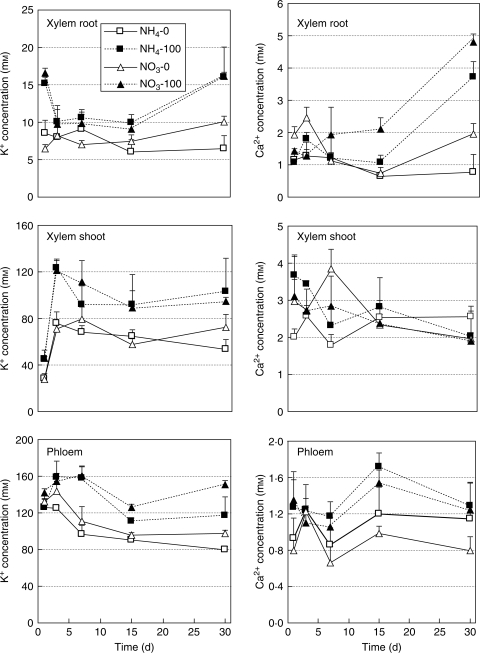
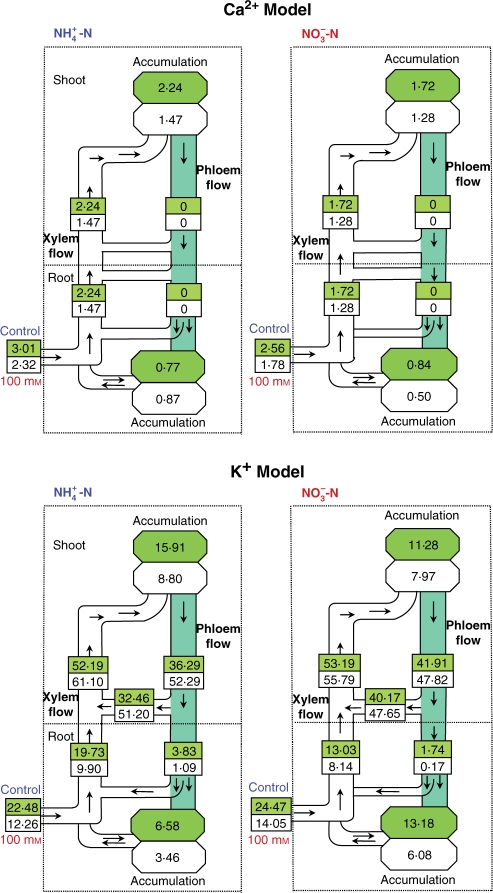
Key results: Plant weight, leaf area and photosynthetic rate showed a higher salt tolerance of nitrate-fed plants compared with that of ammonium-fed plants. The total amount of Na+ transported in the xylem in roots, accumulated in the shoot and retranslocated in the phloem of ammonium-fed plants under salt treatment was 1.8, 1.9 and 2.7 times more, respectively, than that of nitrate-treated plants. However, the amount of Na+ accumulated in roots in nitrate-fed plants was about 1.5 times higher than that in ammonium-fed plants. Similarly, Cl- transport via the xylem to the shoot and its retranslocation via the phloem (Cl- cycling) were far greater with ammonium treatment than with nitrate treatment under conditions of salinity. The uptake and accumulation of K+ in shoots decreased more due to salinity in ammonium-fed plants compared with nitrate-fed plants. In contrast, K+ cycling in shoots increased due to salinity, with higher rates in the ammonium-treated plants.
Conclusions: The faster growth of nitrate-fed plants under conditions of salinity was associated with a lower transport and accumulation of Na+ and Cl- in the shoot, whereas in ammonium-fed plants accumulation and cycling of Na+ and Cl- in shoots probably caused harmful effects and reduced growth of plants.
Figures
References
-
- Abdolzadeh A, Shima K, Chiba K. Role of ammonium and nitrate as nitrogen source on salt tolerance in Nerium oleander L. Journal of the Japanese Society of Revegetation Technology. 1998;23:237–248.
-
- Adler PR, Wilcox GE. Ammonium increases the net rate of sodium influx and partitioning to the leaf of muskmelon. Journal of Plant Nutrition. 1995;18:1951–1962.
-
- Ashraf M. Interactive effect of salt (NaCl) and nitrogen source on growth, water relations and photosynthetic capacity of sunflower (Helianthus annuus L.) Annals of Applied Biology. 1999;135:509–513.
-
- Björkman O, Powles SB. Inhibition of photosynthetic reactions under water stress: interaction with light level. Planta. 1984;161:490–504. - PubMed
Publication types
MeSH terms
Substances
LinkOut - more resources
Full Text Sources
Miscellaneous
