Preclinical characterization of a (S)-N-(4-cyano-3-trifluoromethyl-phenyl)-3-(3-fluoro, 4-chlorophenoxy)-2-hydroxy-2-methyl-propanamide: a selective androgen receptor modulator for hormonal male contraception
- PMID: 18772237
- PMCID: PMC2630904
- DOI: 10.1210/en.2008-0674
Preclinical characterization of a (S)-N-(4-cyano-3-trifluoromethyl-phenyl)-3-(3-fluoro, 4-chlorophenoxy)-2-hydroxy-2-methyl-propanamide: a selective androgen receptor modulator for hormonal male contraception
Abstract
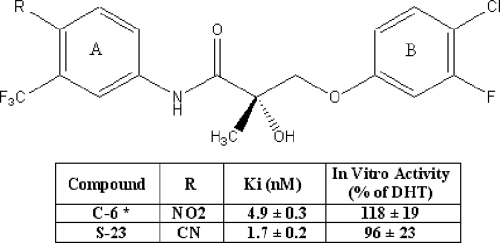
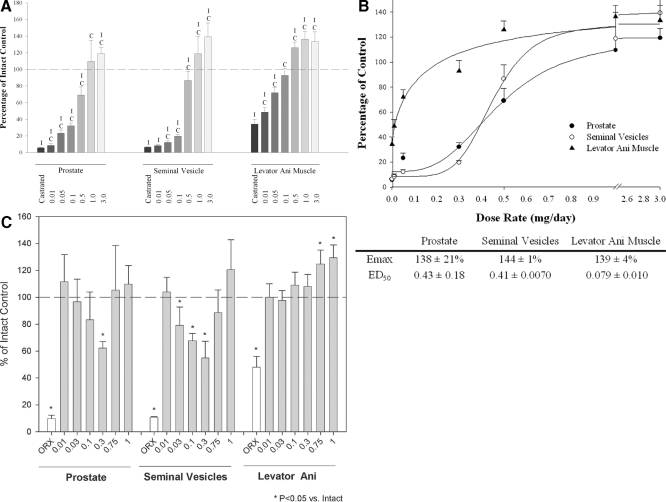
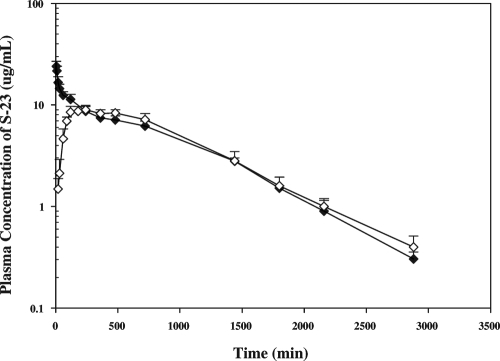
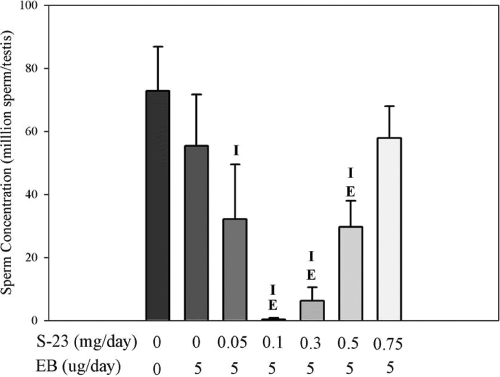
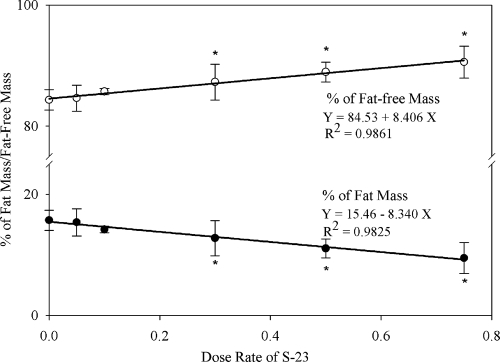
The pharmacologic effects of (S)-N-(4-cyano-3-trifluoromethyl-phenyl)-3-(3-fluoro, 4-chlorophenoxy)-2-hydroxy-2-methyl-propanamide (S-23) were characterized in male rats as an animal model of hormonal male contraception. S-23 showed high binding affinity (inhibitory constant = 1.7 +/- 0.2 nm) and was identified as a full agonist in vitro. In castrated male rats, the ED50 of S-23 in the prostate and levator ani muscle was 0.43 and 0.079 mg/d, respectively. In intact male rats treated for 14 d, S-23 alone suppressed LH levels by greater than 50% at doses greater than 0.1 mg/d, with corresponding decreases in the size of the prostate but increases in the size of levator ani muscle. In intact male rats treated for up to 10 wk with S-23 and estradiol benzoate (EB; necessary to maintain sexual behavior in rats), S-23 showed biphasic effects on androgenic tissues and spermatogenesis by suppressing serum concentrations of LH and FSH. EB alone showed no effect on spermatogenesis. In the EB + S-23 (0.1 mg/d) group, four of six animals showed no sperm in the testis and zero pregnancies (none of six) in mating trials. After termination of treatment, infertility was fully reversible, with a 100% pregnancy rate observed after 100 d of recovery. S-23 increased bone mineral density and lean mass but reduced fat mass in a dose-dependent manner. This is the first study to show that a selective androgen receptor modulator combined with EB is an effective and reversible regimen for hormonal male contraception in rats. The beneficial effects of S-23 on the muscle, tissue selectivity, and favorable pharmacokinetic properties make it a strong candidate for use in oral male contraception.
Figures
References
-
- Hohlweg WaJ K 1932 Die hormonal-nervose regulierung der funktion des hypophysenvorderlappens. Klin Wochenschr 11:321
-
- Dischreit J 1939 Wirkung des testikelhormonpraparates erugon auf den juvenilen rat-tenhoden. Klin Wochenschr 18:1493
-
- Gaarenstroom JH 1939 Inhibition of the ‘antimasculine effect’ of oestrone by testosterone propionate. Acta Brev Neerl Physiol 9:134
-
- Ludwig DJ 1950 The effect of androgen on spermatogenesis. Endocrinology 46:453 - PubMed
-
- Nieschlag E, Nieschlag S, Behre HM 1998 Testosterone: action, deficiency, substitution. 2nd ed. New York: Springer
Publication types
MeSH terms
Substances
Grants and funding
LinkOut - more resources
Full Text Sources
Other Literature Sources