


Modified total-body recumbent stepper exercise test for assessing peak oxygen consumption in people with chronic stroke
- PMID: 18772275
- PMCID: PMC2557055
- DOI: 10.2522/ptj.20080072
Modified total-body recumbent stepper exercise test for assessing peak oxygen consumption in people with chronic stroke
Abstract
Background: Assessment of peak oxygen consumption (Vo(2)peak) using traditional modes of testing such as treadmill or cycle ergometer can be difficult in individuals with stroke due to balance deficits, gait impairments, or decreased coordination.
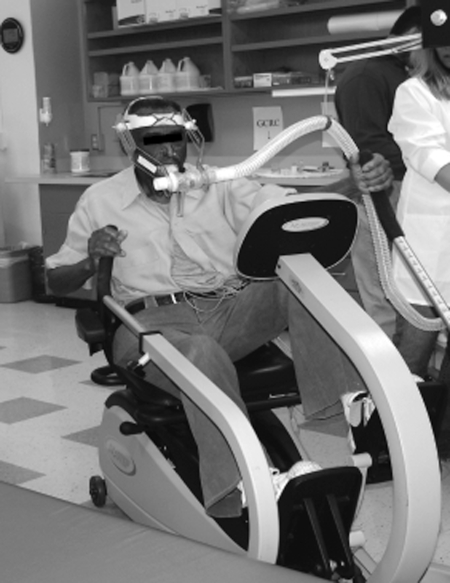
Objective: The purpose of this study was to quantitatively assess the validity and feasibility of a modified exercise test using a total-body recumbent stepper (mTBRS-XT) in individuals after stroke.
Design: A within-subject design, with a sample of convenience, was used.
Participants: Eleven participants (7 male, 4 female) with a mean of 40.1 months (SD=32.7) after stroke, a mean age of 60.9 years (SD=12.0), and mild to severe lower-extremity Fugl-Myer test scores (range=13-34) completed the study.
Methods: Participants performed 2 maximal-effort graded exercise tests on separate days using the mTBRS-XT and a cycle ergometer exercise protocol to assess cardiorespiratory fitness. Measurements of Vo(2)peak and peak heart rate (peak HR) were obtained during both tests.
Results: A strong relationship existed between the mTBRS-XT and the cycle ergometer exercise test for Vo(2)peak and peak HR (r=.91 and .89, respectively). Mean Vo(2)peak was significantly higher for the mTBRS-XT (16.6 mL x kg(-1) x min(-1)[SD=4.5]) compared with the cycle ergometer exercise protocol (15.4 mL x kg(-1) x min(-1) [SD=4.5]). All participants performed the mTBRS-XT. One individual with severe stroke was unable to pedal the cycle ergometer. No significant adverse events occurred.
Conclusion: The mTBRS-XT may be a safe, feasible, and valid exercise test to obtain measurements of Vo(2)peak in people with stroke. Health care professionals may use the mTBRS-XT to prescribe aerobic exercise based on Vo(2)peak values for individuals with mild to severe deficits after stroke.
Figures

References
-
- Gordon NF, Gulanick M, Costa F, et al. Physical activity and exercise recommendations for stroke survivors: an American Heart Association scientific statement from the Council on Clinical Cardiology, Subcommittee on Exercise, Cardiac Rehabilitation, and Prevention; the Council on Cardiovascular Nursing; the Council on Nutrition, Physical Activity, and Metabolism; and the Stroke Council. Circulation. 2004;109:2031–2041. - PubMed
-
- Durstine JL, Moore GE, eds. ACSM's Exercise Management for Persons With Chronic Diseases and Disabilities. 2nd ed. Champaign, IL: Human Kinetics Inc; 2003.
-
- Tang A, Sibley KM, Thomas SG, et al. Maximal exercise test results in subacute stroke. Arch Phys Med Rehabil. 2006;87:1100–1105. - PubMed
-
- Arsura E. Evaluating cardiorespiratory fitness after stroke: does the best provide less? Chest. 2005;127:1473–1474. - PubMed
Publication types
MeSH terms
Grants and funding
LinkOut - more resources
Full Text Sources
Medical
Miscellaneous
