. 2008 Sep 5;321(5894):1350-3.
doi: 10.1126/science.1160741.

Wnt3a-mediated formation of phosphatidylinositol 4,5-bisphosphate regulates LRP6 phosphorylation

Affiliations

Wnt3a-mediated formation of phosphatidylinositol 4,5-bisphosphate regulates LRP6 phosphorylation

Weijun Pan et al. Science. .

Abstract

The canonical Wnt-beta-catenin signaling pathway is initiated by inducing phosphorylation of one of the Wnt receptors, low-density lipoprotein receptor-related protein 6 (LRP6), at threonine residue 1479 (Thr1479) and serine residue 1490 (Ser1490). By screening a human kinase small interfering RNA library, we identified phosphatidylinositol 4-kinase type II alpha and phosphatidylinositol-4-phosphate 5-kinase type I (PIP5KI) as required for Wnt3a-induced LRP6 phosphorylation at Ser1490 in mammalian cells and confirmed that these kinases are important for Wnt signaling in Xenopus embryos. Wnt3a stimulates the formation of phosphatidylinositol 4,5-bisphosphates [PtdIns (4,5)P2] through frizzled and dishevelled, the latter of which directly interacted with and activated PIP5KI. In turn, PtdIns (4,5)P2 regulated phosphorylation of LRP6 at Thr1479 and Ser1490. Therefore, our study reveals a signaling mechanism for Wnt to regulate LRP6 phosphorylation.


Figures
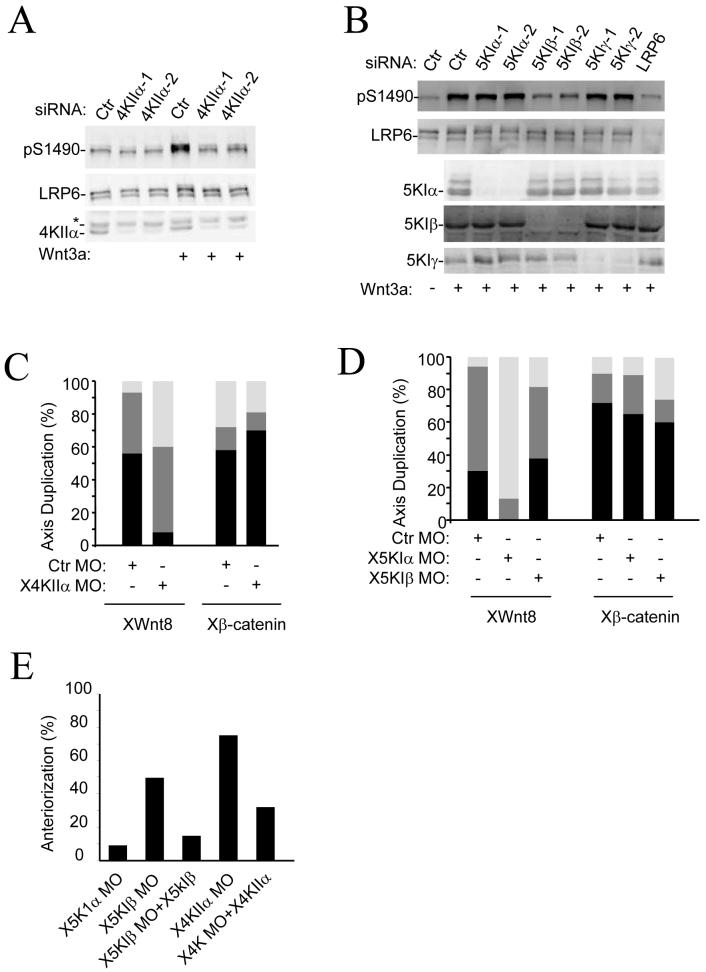
Figure 1
Figure 1. Effect of depletion of PtdIns kinases on Wnt3a signaling
A,B) Effects of PtdIns kinase siRNAs on Wnt3a-induced phosphorylation of LRP6 at Ser1490. HEK293T cells were transfected with siRNAs as indicated for 48 hours and then treated with Wnt3a (50ng/ml) for 30mins. Phosphorylated proteins were assayed by Western blotting. The experiments were repeated at least three times. Representative images are shown. C,D) A control morpholino oligos (Ctr MO, 10 nM) or MO (10 nM) targeting Xenopus PI4KIIα (C), PIP5KIα, or PIP5KIβ (D) was injected with XWnt8 (2 pg) or Xβ-catenin (10 pg) mRNA into four-cell stage embryos. n>40 for all of the Xenopus embryo studies. Open bar, no double axis; shaded, incomplete double axis; closed, complete double axis. E) Four-cell stage embryos were injected with XPIP5KIβ MO (40ng) or XPI4KIIα MO (40ng), or XPIP5KIα MO (40ng) with or without XPIP5KIβ (10pg) or XPI4KIIα (5pg) RNA in the dorsal region and cultured to tailbud stages. XPIP5KIα MO (n=30), XPIP5KIβ MO (n=45), XPIP5KIβ MO+XPIP5KIβ (n=29), XPI4KIIα MO (n=55), and XPI4KIIα MO+XPI4KIIα (n=30).
Figure 2
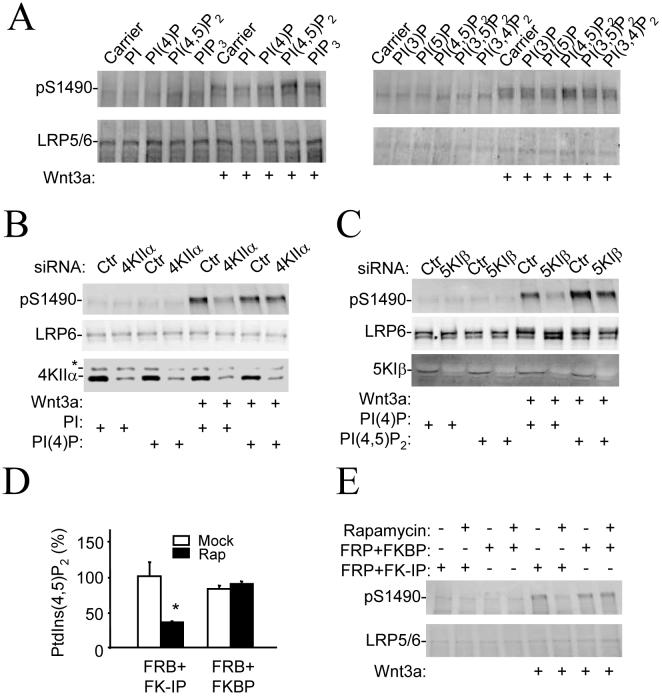
Figure 2. Effect of PtdIns (4,5)P2 on Wnt3a signaling
A) Effect of exogenous PtdIns (4,5)P2 on Wnt3a-induced phosphorylation of LRP6 at Ser1490. HEK293T cells were treated with various PtdIns lipids in a lipid carrier for 10mins and incubated with Wnt3a (20ng/ml) for additional 20 mins before assayed by immunoblotting. B, C) Rescuing the effects of PI kinase siRNAs by direct delivery of PtdIns lipids. D,E) Reduction in PtdIns (4,5)P2 levels decreases LRP6 Ser1490 phosphorylation. HEK293T cells transfected with FRB (PM-FRB-CFP), FKBP (mRFP-FKBP12) or FK-IP (mRFP-FKBP12-5-ptase-dom) were treated with Wnt3a (20ng/ml) in the presence or absence of rapamycin (100nM) for 30 mins before they were collected for the lipid assay (D) and Immunoblotting analysis (E). * stands for P<0.01 compared to the absence of rapamycin (Student’s t-Test).
Figure 3
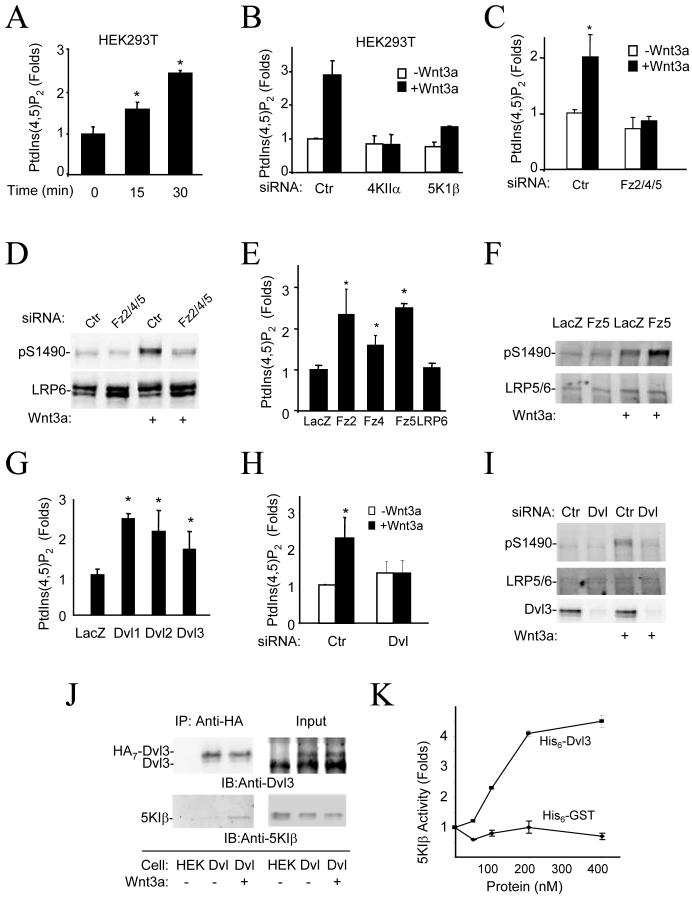
Figure 3. Stimulation of PtdIns (4,5)P2 formation by Wnt3a through Fz and Dvl
A) Effect of Wnt3a treatment on PtdIns (4,5)P2 content. HEK293T Cells were stimulated with Wnt3a protein (50ng/ml) before lipid extraction. PtdIns (4,5)P2 content was determined by HPLC. * P<0.01 compared to Time 0 (Student’s t-Test). B) Requirement of PI4KIIα and PIP5KIβ for Wnt3a-induced formation of PtdIns (4,5)P2. Cells were transfected with siRNAs as indicated for 48 hours and then treated with Wnt3a (50ng/ml) for 30mins. PtdIns (4,5)P2 were detected by ELISA. C) Effect of Fz siRNAs on Wnt3a-induced formation of PtdIns (4,5)P2. Cells were transfected with control siRNA or a combination of Fz2, Fz4, and Fz5 siRNAs for 48 hours and then treated with Wnt3a (50ng/ml) for 30mins before assays. * P<0.01 compared to control siRNA transfection in the absence of Wnt3a (Student’s t-Test). D) Effect of Fz siRNAs on Wnt3a-induced phosphorylation of LRP6 at Ser1490. Cells were transfected as in C for 48 hours and then treated with Wnt3a (50ng/ml) for 30mins. E) Effect of Fz overexpression on accumulation of PtdIns (4,5)P2. HEK293T cells were transfected with the Lac Z, Fz5, or LRP6 expression plasmids for 18 hours, and PtdIns (4,5)P2 levels were determined by ELISA. F) Effect of Fz5 expression on phosphorylation of LRP6 at Ser1490. Cells were transfected with Fz5 expression plasmid for 18 hrs and then treated with Wnt3a (20ng/ml) for 20mins. G) Effect of Dvl expression on the PtdIns (4,5)P2 levels. HEK293T cells were transfected with the mouse Dvl1, 2, or 3 expression plasmid for 18 hours before the PtdIns (4,5)P2 ELISA assay. * P<0.01 compared to the sample expressing LacZ (Student’s t-Test). H,I) Effect of Dvl siRNAs on formation of PtdIns (4,5)P2 and phosphorylation of LRP6 at Ser1490. HEK293T cells were transfected with control siRNA or Dvl siRNA mixture targeting Dvl1, 2 and 3 for 48 hours and then treated with Wnt3a (50ng/ml) for 30mins. * P<0.01 compared to control siRNA transfection in the absence of Wnt3a (Student’s t-Test). J) Interaction of Dvl3 with endogenous PIP5KIβ. HEK293T cells (Dvl) stably expressing Dvl3-HA7 whose expression level is similar to that of the endogenous Dvl3 were used in immunoprecipitation by an anti-HA antibody. The parent HEK293T cells (HEK) were used as a control. Immunocomplexes were detected by the anti-Dvl3 and anti-PIP5KIβ antibodies. K) Effect of purified recombinant Dvl3 protein on kinase activity of purified recombinant PIP5KIβ protein. PIP5KIβ (50 nM) was incubated with GST or Dvl3 proteins at concentrations indicated in the figure for 2 hours at room temperature. One-tenth of the samples was taken for Western blotting and the rest was subjected to in vitro kinase assay with PtdIns (4)P as a substrate. The product PtdIns (4,5)P2 is separated by TLC, detected, and quantified by a phosphoimager.
Figure 4
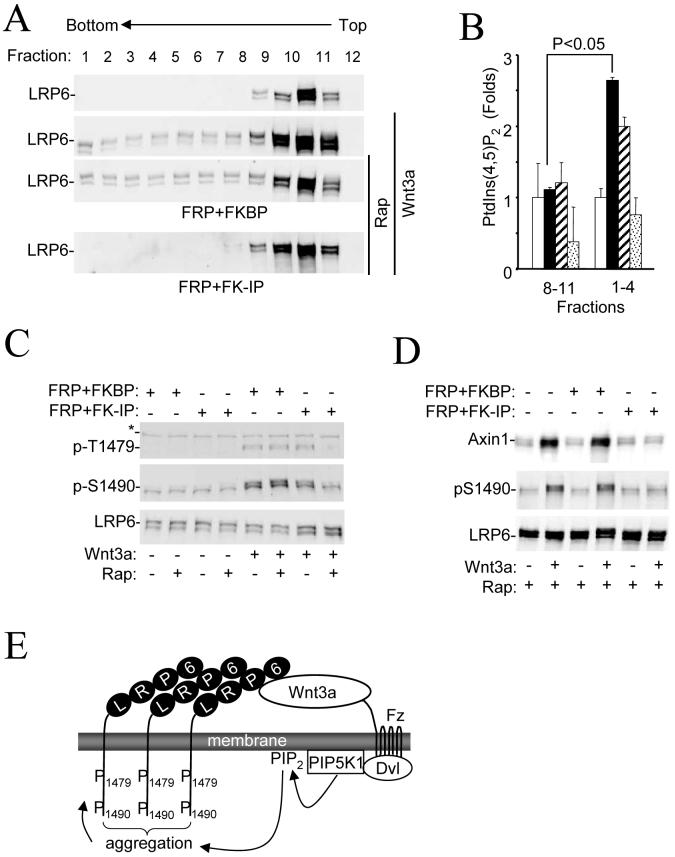
Figure 4. Requirement of PtdIns (4,5)P2 for formation of LRP6 aggregate and membrane translocation of Axin and GSK3
A) Requirement of PtdIns (4,5)P2 for Wnt3a-induced LRP6 aggregation. HEK293T cells were transfected and treated with Wnt3a and rapamycin as indicated. Cell lysates were subjected to sucrose density gradient ultracentrifugation, and fractions were analyzed by Western analysis. B) PtdIns (4,5)P2 amounts in two sucrose density gradient ultracentrifugation fraction pools. Fractions 8-11 and 1-4 from A were pooled, and PtdIns (4,5)P2 amounts were measured by ELISA. Open bars correspond to the samples from the top panel of A; black bars to the second panel; shaded bars to the third panel; and dotted bars to the last panel. The PtdIns (4,5)P2 amounts are presented relative to those in untreated cells. C) Requirement of PtdIns (4,5)P2 for phosphorylation of LRP6 at Thr1479. HEK293T cells were transfected with plasmids as indicated for 20 hrs and then treated with Wnt3a (20ng/ml) for 30mins in the presence or absence of rapamycin (100nM) before they were collected for immunoblotting analysis. D) Requirement of PtdIns (4,5)P2 for Wnt3a-induced membrane recruitment of Axin1. HEK293T cells were transfected and treated as indicated. The membrane fractions were prepared and analyzed by Western analysis. E) A model for Wnt3a cross-membrane signaling.

References

    1. Logan CY, Nusse R. Annu Rev Cell Dev Biol. 2004;20:781. - PubMed
    1. Reya T, Clevers H. Nature. 2005 Apr 14;434:843. - PubMed
    1. Clevers H. Cell. 2006 Nov 3;127:469. - PubMed
    1. Moon RT, Kohn AD, De Ferrari GV, Kaykas A. Nat Rev Genet. 2004 Sep;5:691. - PubMed
    1. Mani A, et al. Science. 2007 Mar 2;315:1278. - PMC - PubMed

Publication types

MeSH terms

Substances